By Charles Hubbard, Film & TV Deputy Editor
To say that The Mousetrap (1952) is a staple of the West End is a gross understatement. In fact, Christie’s historic whodunnit, which reached its 30,000th performance earlier this year, is so entirely synonymous with London’s theatre scene, it’s almost impossible to imagine one without the other.
While most of the world’s longest-running shows are musicals, The Mousetrap is virtually the lone example of a piece of theatre running for decades without the aid of catchy songs, dazzling dance numbers or expensive Coup de Theatres. In a notoriously unstable industry where even the safest bets are starting to flop, it remains the one sure thing. It is an entirely anomalous mega-success that confounded me when I watched it on its touring production earlier this month.
As the play’s languorous and deeply cliched setup unfolded, I felt myself lulled into a sense of vaguely pleasant boredom only to be jolted awake by a realisation. This play - the one whose profound mediocrity was leaving me struggling to stay awake - is the biggest theatrical juggernaut of all time and one whose success and endurance will likely never be replicated! I spent the rest of the play’s runtime trying to unwind not the mystery of its plot, but rather that of how it’s been able to run for so long.
All other long-running shows usually exist for one of two reasons: either they are hardwired for returning audiences, or the show has a contagious element where its rabid fans badger those around them to see it to no end. They have either a guaranteed well of repeat business or an irrepressible “you just have to see it live” aura floating around them. Firmly in the first camp are high-wire theatrical trickery of The Phantom of the Opera (1986) and The Play that Goes Wrong (2012), which are somehow just as impressive the fifth time you see them as the first. In the other camp is a show like The Woman in Black (1987) – the second longest-running play in West End history and one who’s reputation as the scariest thing ever to be put onstage forms a magnetic pull for those who haven’t seen it, such as myself.
The Mousetrap doesn’t fit into either category. I couldn’t imagine going back to see it a second time, especially once I knew the twist, nor would I ever encourage people I know to see it, much less urge them. The final twist is thoroughly underwhelming so there’s not even an element of “you have to go and see it so we can discuss the ending” that made films like The Sixth Sense (1999) and Inception (2010) box office powerhouses. Yes, there’s a certain amount of charm to the fact that, after every performance, the cast stays onstage after the curtain call and asks the audience to “preserve the tradition of The Mousetrap” and not spoil the twist for anyone - as if we too are now the killer’s accomplices (you’ll notice I’ve kept their wishes and not given the twist away). But enough charm to power 75 years of packed houses? I think not.
Another wrinkle here is that the play doesn’t really seem to have seeped into popular culture in any way. It features neither of Christie’s iconic protagonists - Hercule Poirot or Miss Marple - and none of the character names would elicit any more than a confused “who?” from anyone but the most devoted theatre nerd. Shows like Les Miserables (1985) and Mamma Mia (1999) have run so long as their songs are in constant circulation with many people being able to sing them line-for-line without having ever sat through either of the shows.
Julie Taymor’s production The Lion King (1997) - the most financially successful show of all time in terms of worldwide box office receipts - and the Disney film it’s based on form a constant loop where one increases the cultural prominence of the other. The Mousetrap has none of this life support, nor a film adaptation, and yet endures nevertheless. In fact, the only truly famous element of the show is its place in the Guinness Book of Records for its longevity.
And yet the play’s appeal (wherever it may lie) is seemingly not restricted to the UK. The play ran in Toronto’s Truck Theatre for 26 years with over 9,000 performances from 1977 to 2004, showing that mild-mannered maple syrup lovers go just as crazy for a muted murder mystery as us repressed tea-drinkers. And yet the play’s current touring production to celebrate its 75th anniversary is selling dismally. As I am writing this, the performances in less than a month's time at the Opera House in Manchester are less than 20% sold with tickets starting at just £15.00 and the next stops down the road at Aylesbury and Woking not looking much better. Not exactly what you want from a year-long tour - I wouldn’t be surprised if a Trainspotting-esque cancellation is on the cards. This could speak to a chink in the play’s armour. It’s endured for so long in part due to its reputation as a major tourist attraction - what’s the point of a tourist attraction if it’s going to meet you on your own doorstep? Indeed, I only booked my tickets out of morbid curiosity rather than any real excitement.
The Mousetrap is perhaps the single most glaring casualty of what legendary theatre director Peter Brooks describes as the “deadly evolution” - the process by which, if a show runs long enough, it will be sapped of all its original artistic intent and spontaneity. While I generally find the way many theatre critics connote a show’s commercial and financial longevity with a lack of artistic sophistication ugly and classist, I cannot deny that it holds some water in this instance. Whilst not containing any material that reads as explicitly outdated or politically incorrect (rare and almost commendable for a play from the 50s), the play is still a relic and one that has been barred from a healthy degree of change by its own success.
I would give anything for the Christie estate to throw that all away for once and let a director like Evita’s Jamie Lloyd take a huge swing with a massive, star-studded revival of the play. What would Ivo Van Hove bring to the show? What about Rebecca Frecknall? Or Simon Stone? Alas, if a new company was to nudge Christie’s words or stage directions one iota, her estate would be on them like a rather unpleasant rash. I can only hope that a whole horde of hungry young directors will be ready at the starting line to finally revitalise Christie’s crusty old antique the moment it enters public domain in 2052. I guess we’ll just have to wait until then.
So why is The Mousetrap still running? I’m afraid, after over 1,300 words and a lot of hair-pulling, the answer is disappointingly simple: it’s very economical. Eight actors, virtually no backstage personnel and no scenery. And St Martin’s is also an incredibly cheap and easy venue to keep running – it’s only got 550 seats, practically a broom cupboard by West End standards. I know the answer “it’s cheap and easy” is a little underwhelming but a disappointing solution to a long pre-amble seems fitting when talking about this play.
 Hannah Courtney
At the end of the day, The Mousetrap is the ultimate self-fulfilling prophecy - it runs so long because it has already run so long. As frustrating as it is to watch what is essentially a cheat code run the table on the West End for the eight consecutive decades when subsidised theatre as an industry is facing gigantic layoffs, The Mousetrap isn’t exactly hurting anyone (unlike that money-grubbing ghoul Mackintosh). So, if it exists solely to send a crowd of pensioners to sleep eight times a week in return for haunting a small West End theatre until hell freezes over, so be it.
Currently running at the Princess Theatre in Torquay, The Mousetrap will continue its national tour before finishing on Saturday 26th June 2027 at the Grand Opera House in York.
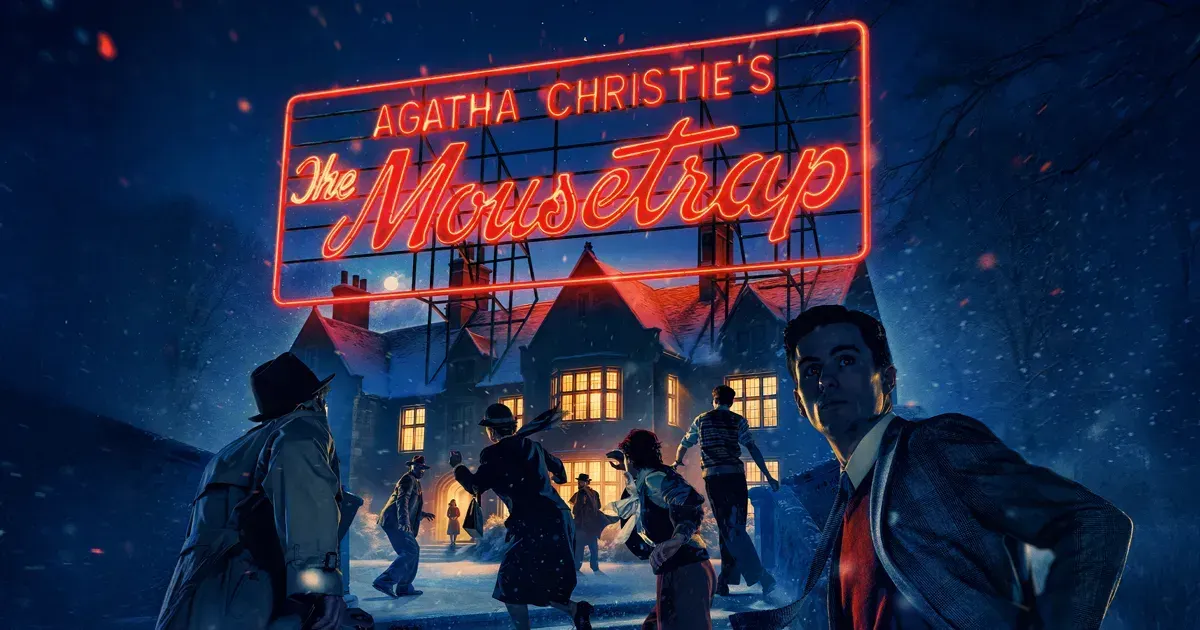
Featured image: TheMousetrapLondon / The Mousetrap Official Website
Are you ever going to see The Mousetrap before it closes?