By Lara Kurtulus, Second Year, History of Art and Italian, and Nour Aloukdah, Second Year, Mathematics
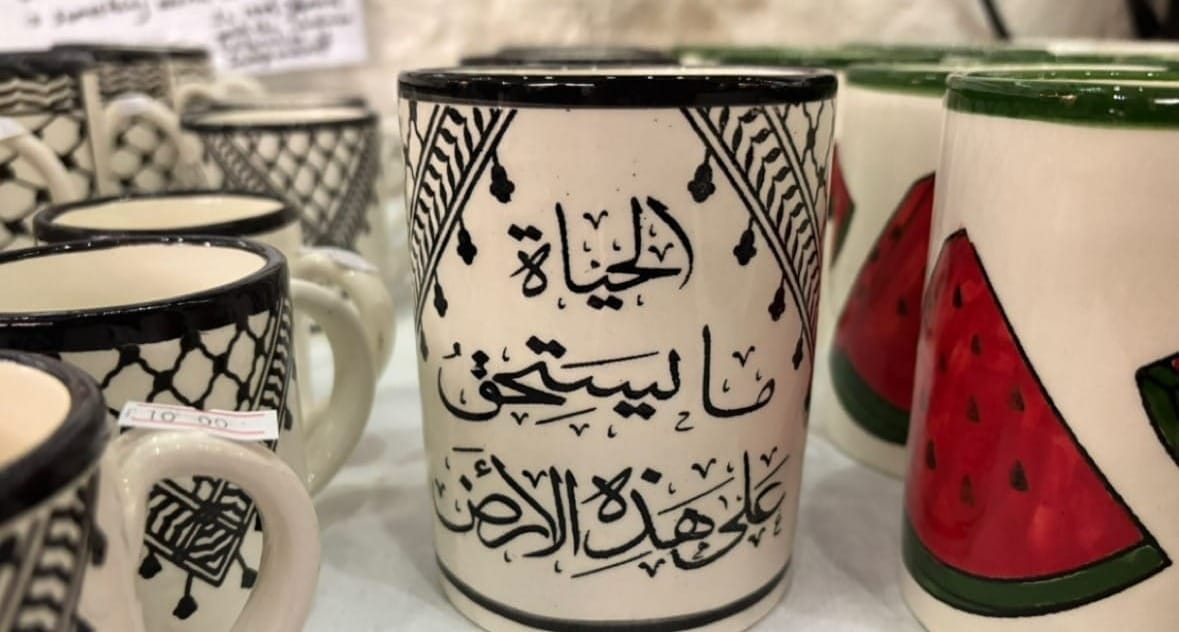
‘On this land is what makes life worth living’, the poet Mahmoud Darwish wrote. In these brief but profound words, he reclaimed the soul of Palestine, a homeland written into the hearts of its people, where every olive tree is a memory, every stone holds a story, and every inch of land aches with longing. Some 2,341 miles away, in the heart of Bristol, this connection is being kept alive. Under the roof of the Palestine Museum, heritage, history, and legacy are preserved, reclaimed, and shared. Here, one can feel the warmth of community, the strength of collective effort, resistance, and a shared commitment to a cause greater than any one individual.
My friend Nour and I were interested in telling the story of this space, exploring its narratives and bringing them to the readers of Epigram. With this in mind, we approached Bristol Friends of Palestine to see if they would like to collaborate with us. On October 11, we had the opportunity to visit the museum with the society, where we were warmly welcomed by Rameez, one of the museum‘s committee members. He generously showed us around, telling us about the exhibits and the stories behind them, opening our eyes to a history beyond the headlines.
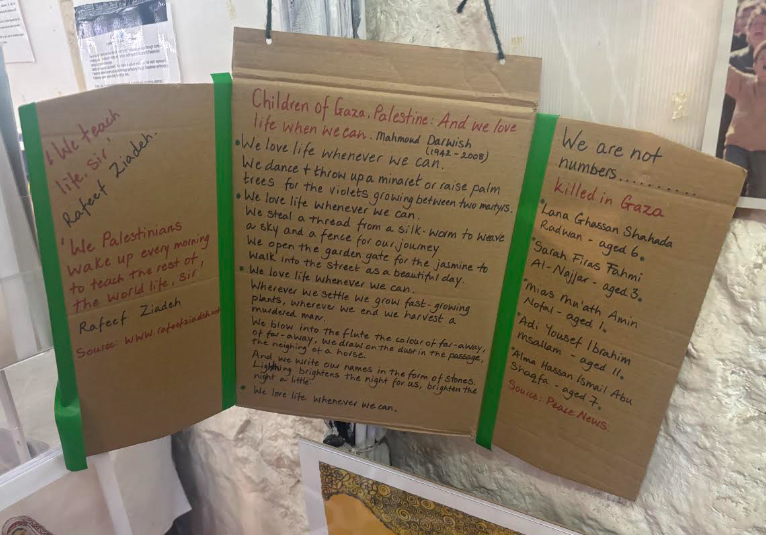
Before beginning our tour, Rameez shared a little of the building’s own history. What now stands as a space dedicated to Palestinian heritage and resistance was once a night club, before its owner donated it to be transformed into a contemporary space for the cause. I believe there is something deeply symbolic about this transformation: how spaces, much like histories, can be reclaimed, reimagined, and given new meanings.
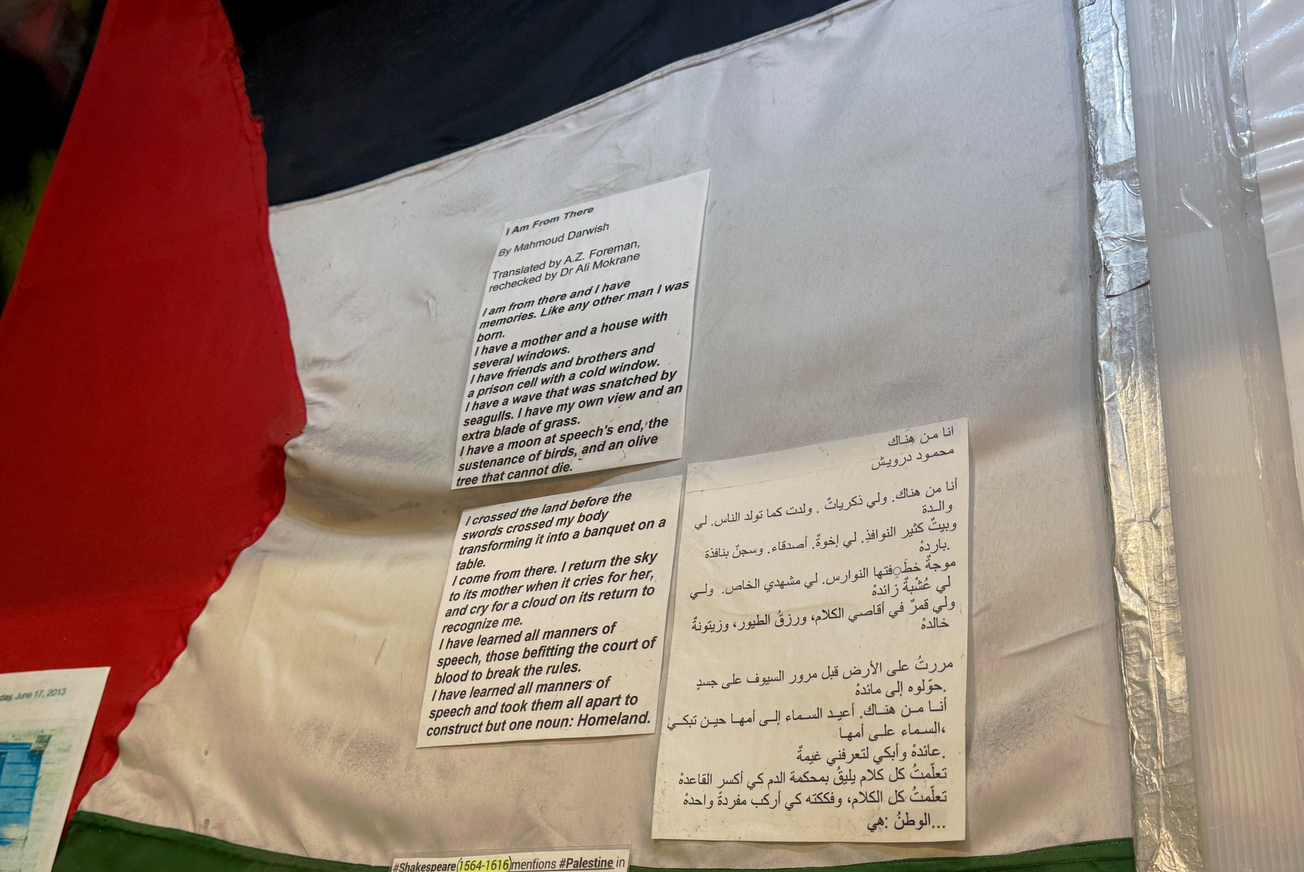
Another famous poem from Mahmoud Darwish’s poetry welcomed us at the entrance:
‘I come from there. I render the sky unto her mother When the sky weeps for her mother. And I weep to make myself known To a returning cloud. I learnt all the words worthy of the court of blood So that I could break the rule. I learnt all the words and broke them up To make a single word: Homeland’
— Mahmoud Darwish
In these few lines, Darwish creates a home for the diaspora, for those forced to exist between two homes and two languages, for those who carry the memories of a homeland wherever they go. Encountering these words as we enter the museum gives the space another layer of meaning. The museum becomes more than a museum. It becomes a home, a community centre, a little piece of the home Rameez left behind, and a little piece of the home Nour never had the chance to see.
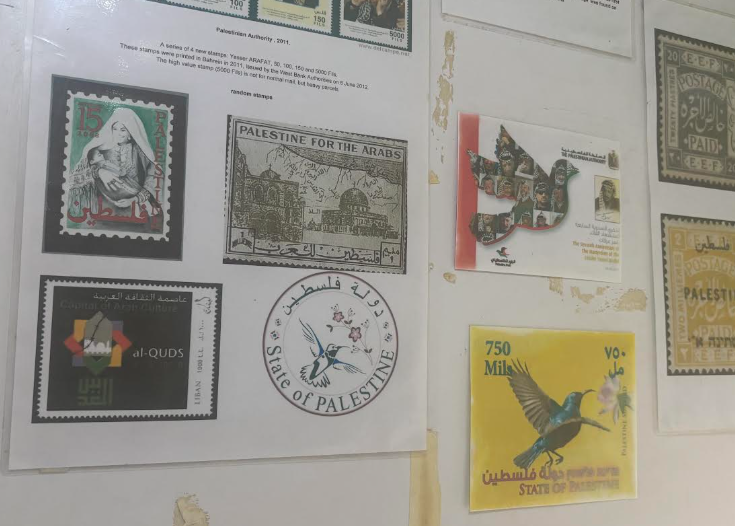
From the moment we stepped inside until we reached the top floor, every corner seemed to have a story to tell. Every bit of space, every wall, floor, and doorway had been carefully transformed into a canvas of memory and history, of past, present, and future. Not an inch of space felt wasted. You could sense the effort, compassion, and resilience in every detail, as though the museum itself were refusing to let any part of identity to be taken away, or anything to be forgotten.
And I believe that is what makes this space so powerful.
Here, Palestine exists beyond the headlines. Beyond the images of bombings, explosions, displacement, and suffering that have come to dominate the representation in the media. Here, we are reminded of a Palestine that is different from the one we have come to recognise so often in the news and newspapers, this is a Palestine that lives, laughs, loves and creates. A Palestine whose mornings are filled with the smell of za’atar, whose homes are filled with family gatherings, whose streets echo with children playing.
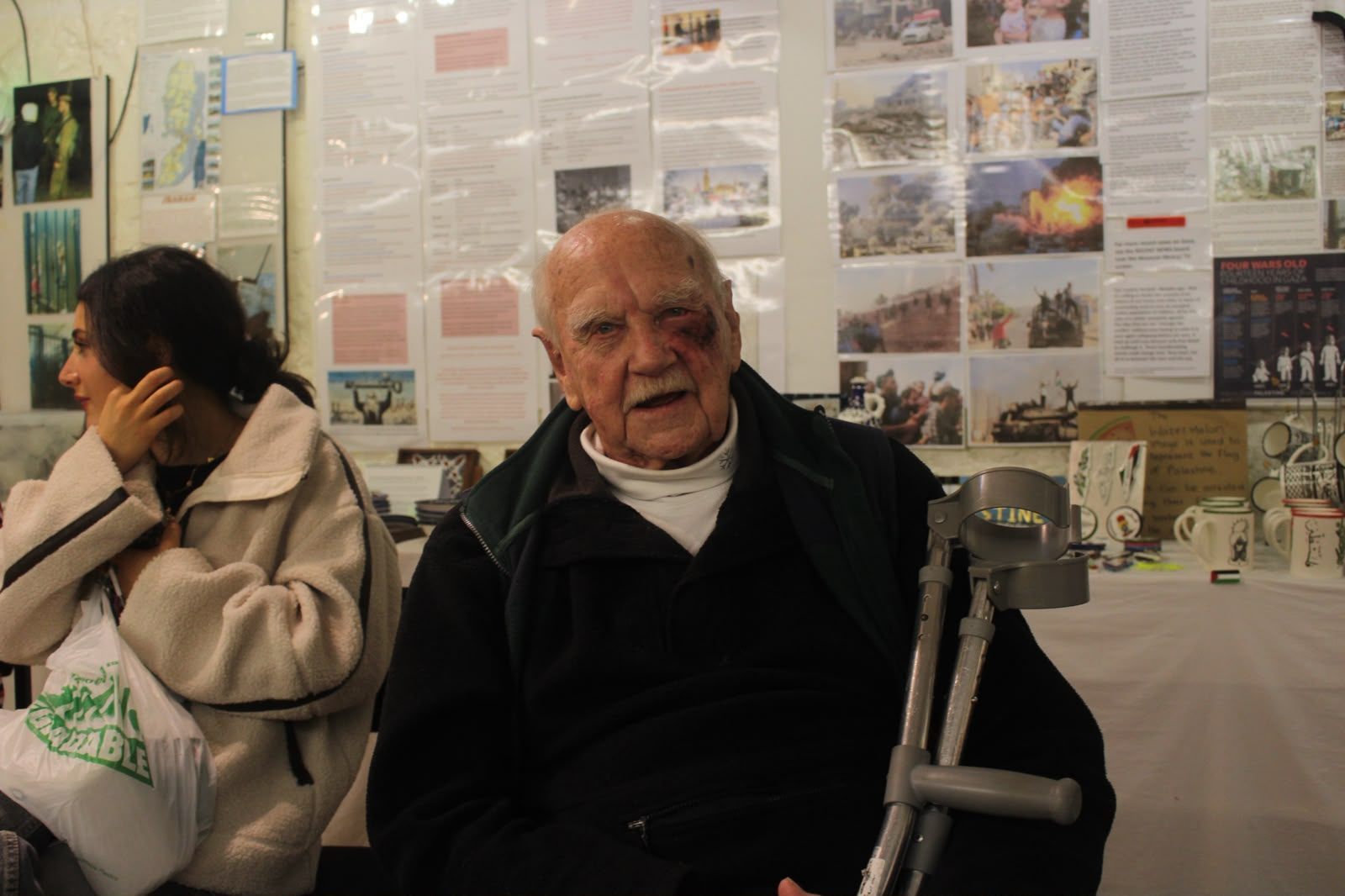
One of the most unexpected moments of our visit was meeting Bill, a former British policeman who had served in Haifa during the Nakba of 1948. Actually encountering someone who had walked the streets of the places we had just been talking about brought another dimension to our experience. He told us that he was only 18 at the time, that he did not fully grasp the extent of what was happening, and that he had never imagined things would reach the stage they have today.
‘There is nobody in between anymore, there is only two sides. We were in the middle, there is no middle anymore.’
Hearing this from someone whose memories stretched back to one of the defining moments that shaped the lives of generations of Palestinians was particularly striking. Palestinian history, which we had been encountering through displays, photographs, and stories throughout the museum, was suddenly standing right in front of us. His words reminded me of how easily we look at an old photograph or read a passage in a history book and assume that all of this belongs entirely to the past, without realising the butterfly effect, that its consequences continue to unfold and are carried by generations of those who lived through it.
‘Lovely place, lovely people... I was meant to stay there forever, if the mandate had not ended I was going to make it my place t0 live, it was a beautiful country.’
Despite not fully understanding the extent of what was unfolding at the time, he spoke of Haifa and its people with such awe and longing. He told us that he wished he could have stayed there forever. There was something particularly moving about this: a man remembering a place he had known almost 80 years ago, not through the language of conflict or destruction, but through the warmth of its people and the life that once filled its streets. His memories contrasted significantly with the narratives that portray Palestine as an empty land, a place without people or life before the conflict. Yet here was someone who remembered that life, who had witnessed it first-hand, and who after all these years, still spoke of it with admiration and longing.
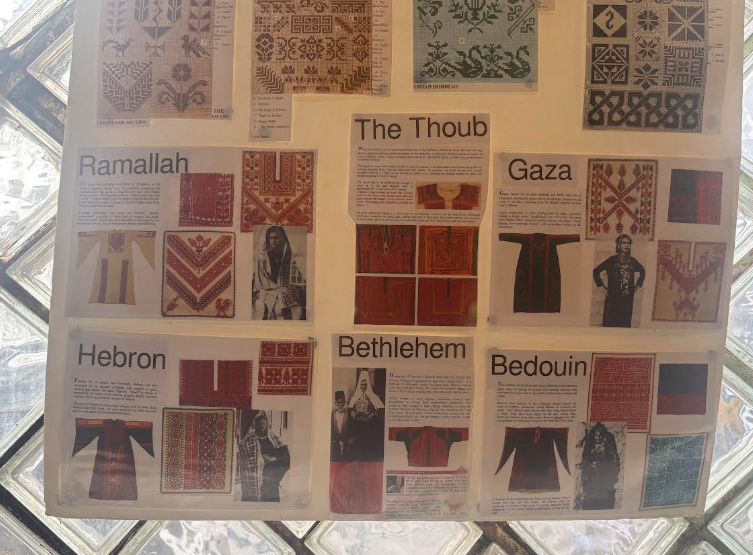
This is precisely what the museum reminds us of that before people became statistics, refugees, asylum seekers, or victims of war, they were simply people. As alive and as real as us. People whose lives were once as ordinary, complicated, and full of possibility as our own. There were countless Nours and Rameezs, people with names, stories and futures they imagined for themselves. Before war and displacement came to define how the world saw them, they were living their own lives, studying, working, having fun, making memories. When we recognise this ordinariness, we realise that these were not just lives interrupted but entire worlds disrupted and the violence of dehumanisation becomes impossible to ignore.
We are constantly exposed to images of suffering, and the risk is that we begin to turn away from them. The extraordinary becomes ordinary. Suffering becomes normalised, and destruction becomes another headline, another photograph, another tragedy to scroll past. The more we are exposed to violence, the easier it becomes to grow numb to it. Eventually, we risk reaching a point where we turn our heads, not because we do not care, but because suffering has become so familiar that we no longer know how to respond. The Palestine Museum challenges this normalisation and numbness.
It asks us to look again, to look closer, and, more importantly, to remember what we are looking at. It refuses to allow Palestine to be reduced to a war zone, or its people to be reduced to numbers and remembered only through their suffering. Every display in the museum reminds us that Palestine is not merely a place where people die, but a land where people have lived, and where they continue to live, love, and resist. In a world where the tendency to turn away from suffering is all too common, the Palestine Museum offers a place where turning our head away means encountering another memory, another reminder of humanity. And that can be one of the greatest acts of resistance: insisting that, even in the face of erasure, Palestinian life is not only remembered through what has been lost, but celebrated and cherished through everything that continues to exist.
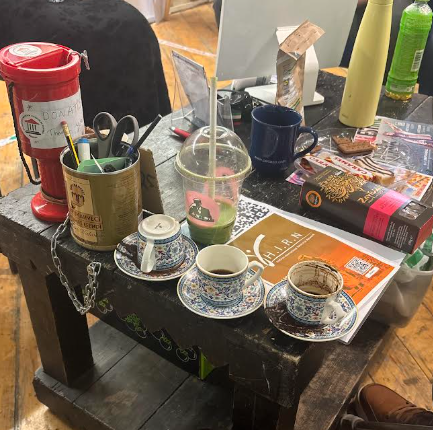
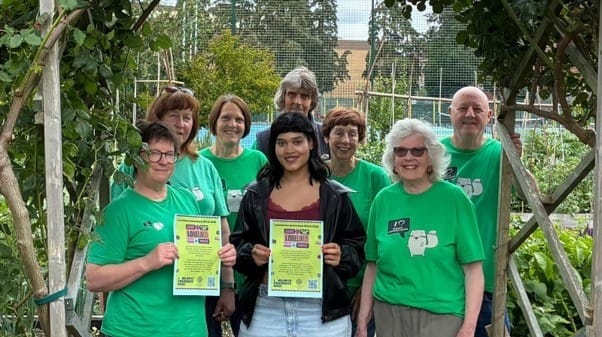
We ended our day over cups of Turkish coffee, sitting with some of the museum's volunteers, sharing stories and getting to know one another. We met a Spanish woman who had been volunteering at the museum for 15 years, a man who had recently moved to Bristol from America after working with Indigenous communities and had found a new sense of belonging through volunteering at the museum, and some volunteers who had been born and raised in Bristol. We met a young woman whose grandmother was Palestinian, who had started volunteering as a way of reconnecting with a part of her history.
Here we were, people from different corners of the world, with different life paths, ethnicities and ambitions, finding ourselves under the same roof, brought together by a shared cause. Some had inherited this history, others had encountered it along the way, but everyone had found something worth holding on to. That Sunday afternoon, and the cup of coffee we shared with those people, became one of the most profound experiences we have had in Bristol so far. Only three of us in that room were Palestinian, yet everyone was there to listen, to understand, to remember, and to help keep alive the history and culture of a nation facing erasure. And maybe that was what moved us the most, that you do not have to come from the same land, speak the same language, or carry the same memories to care about one another's stories. Nour reconnected with her roots and history, 2,341 miles away, from home and I got to read coffee cups, the way my Turkish grandma taught me, years later for people that I just met.
And that is where hope begins. Not always in grand gestures but in a room full of strangers who become familiar over cups of coffee, in stories and in the simple act of showing up for a history that may not be your own. That Sunday, we walked into the Palestine Museum expecting to learn about a place and its history. We left having experienced something much greater: a reminder that while a homeland can be separated from its people by thousands of miles, the sense of belonging it creates can travel far beyond its borders.
 Beth Robinson
And we did see for ourselves what Darwish meant, there really is something on this land that makes life worth living.
‘On this land, is what makes life worth living:
on this land is the lady of the land, the mother
of beginnings and endings. She was named Palestine. Still
named Palestine. My lady, I am worthy, because you are my lady,
I am worthy of life.’
— Mahmoud Darwish
Featured Image: ‘I Come From There’ (أنا من هناك) by Mahmoud Darwish | Epigram / Lara Kurtulus
Will you visit the Palestine Museum?