By Charles Hubbard, Film & TV Deputy Editor
The announcement that a major movie studio is releasing a dark and gritty reboot of Robin Hood is now greeted with virtually as much frustration and face-palming in film circles as a US president announcing their entry into a new war in the Middle East that will totally be quick and easy and won’t turn into a decades-long quagmire littered with horrific human rights violations and terrible long-term impacts on the global economy.
An insensitive analogy, perhaps, but I can’t overstate my angry bafflement at Hollywood’s continuing dogmatism that the only way to remake Michael Curtiz’s original film, starring Errol Flynn in the titular role, is to strip everything fun and joyful away from the intellectual property - it’s happened three times in the last 16 years! Like Victor Fleming’s The Wizard of Oz - another 1939 Technicolour masterpiece directed by an underappreciated Old Hollywood master starring a screen icon with a complicated legacy - why does every further iteration have to look so grey? The strength of Michael Sarnoski’s The Death of Robin Hood (2026) isn’t that it bucks that trend - on the contrary, it often reaches parody-levels of bleak portent - rather that its commitment to grimness and violence feels both personal to the filmmaker and intrinsically tied to his sledgehammer take on the material.
Sarnoski, best known for his 2021 Nicholas Cage vehicle Pig, is no stranger to making angry, bitter films about violent, self-loathing men. This makes his approach to the material feel a lot more necessary than the similar ones taken by Kevin Reynolds in 1991, Ridley Scott in 2010 and Otto Bathurst in 2018. It’s the difference between a production of Hamlet or Macbeth that casts a woman in the titular role because it’s the only way the director can possibly make sense of the narrative and one that makes the same decision but only because the RSC needed a bold new take. Furthermore, if The Death of Robin Hood is about anything, and with a script this light on concrete plot it really has to be, it’s about how stories are slowly sanded down and whitewashed over time. It’s as if Sarnoski is painting Curtiz’s bouncy, triumphant version of the story as a tale spun to cover up the true monstrosity of how the bandit of Sherwood Forest really behaved.
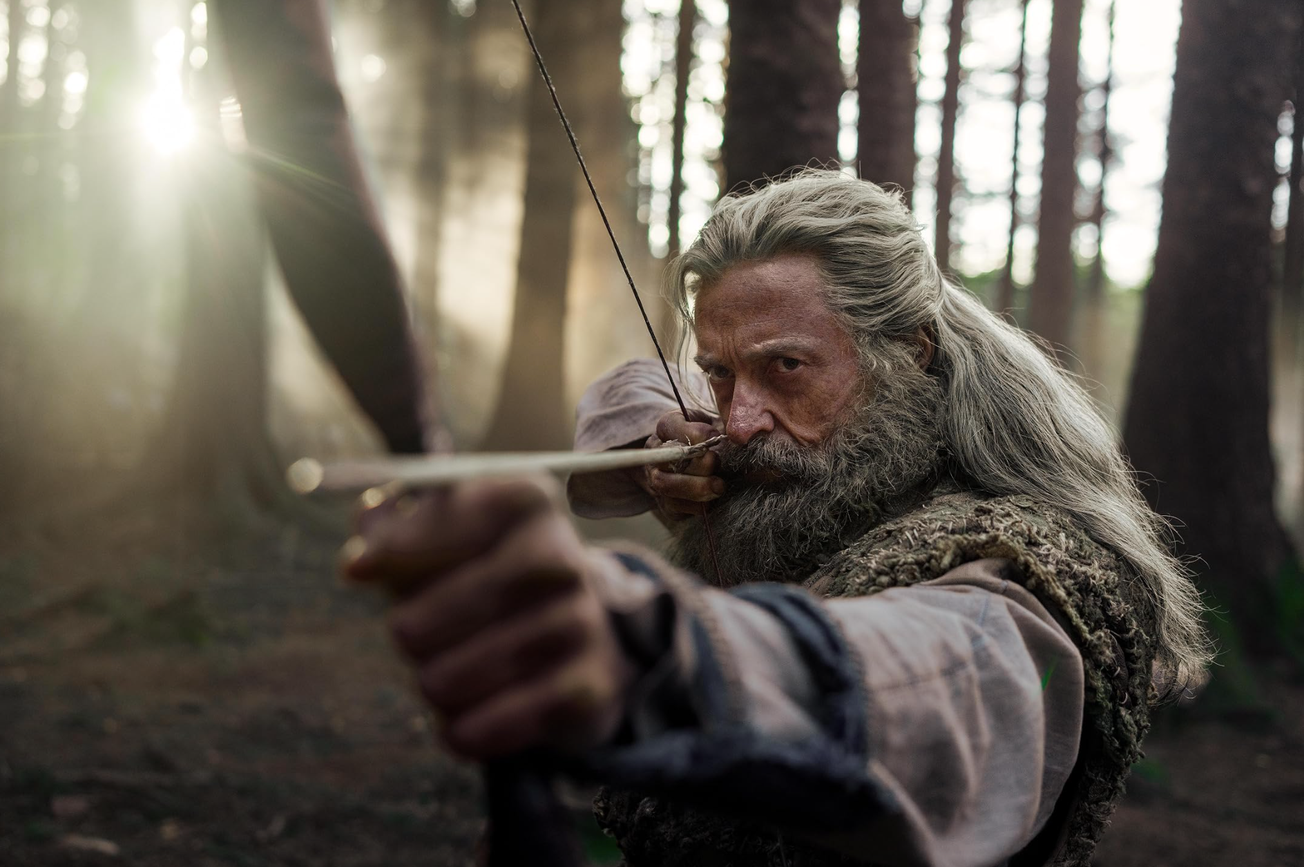
Adapted from the anonymously written 17th century ballad Robin Hood’s Death, the film starts when Robin (Hugh Jackman, hidden under a silver mane that makes Matt Damon’s Odysseus look clean-shaven by comparison), more often referred to by his code name, Randolph, has reached the bottom of the pit in terms of bloodlust and dehumanisation. Murdering children with an ease and sociopathy that makes Hamnet (2020) author Maggie O’Farrell look sappy by comparison, Robin seems to hate only one thing more than every remaining human on the planet - the tales they keep spinning of him to make him seem like a hero. Little John (Bill Skarsgard, somewhat unrecognisable even by his usual chameleonic standards), Robin’s last remaining ‘friend’, enlists his help to win back his farm but, when their attempt leaves Robin maimed and delirious, he falls into the care of blood-letting nurse Sister Brigid (a characteristically teary-eyed Jodie Comer), who helps to slowly build back up Robin’s body as Robin confronts the possibility of ever building back up his humanity as well.
The choice to drop the audience right at the end of Robin’s life sans-context is the film’s strongest asset and its biggest Achilles heel. On the one hand, it makes the film’s rare and well-placed references to parts of the Robin Hood legend the audience may recognise read as haunted glimpses into a horrifying past, especially when Robin is so reticent to talk about it. This couldn’t be more different from most IP-driven legacy sequels, which practically leave in audible breaks for gasps and applause every time one of the characters utters a name from the previous entry in the franchise. However, it also means that the audience is never really given a sense of how the whitewashed legend of Robin Hood was propagated and spread. We never see his violence be generously misinterpreted nor hear any of the specifics of the stories told about him. For a film whose entire marketing campaign rested upon the idea that all the stories about him are wrong, this feels like an odd blind spot.
The film is otherwise perhaps most interesting when considered as a sum of its various influences. Its aesthetics and content obviously bear a striking resemblance to the recent work of Robert Eggers. However, the more patient and contemplative sections of the film call to mind the work of Soviet filmmaker Andrei Tarkovsky, whose existential meditations on nature and connection in Solaris (1972) and Stalker (1979) changed film language forever. The script, also written by Sarnoski, borrows a lot from the infamous spec script written by Ethan Reiff and Cyrus Voris, which painted the Sheriff of Nottingham as the protagonist and Robin as the antagonist and was eventually mangled and crushed into Ridley Scott’s 2010 version. And a disturbingly tense scene set on a beach where Robin considers killing an innocent young man (Noah Jupe) felt inspired by a similar moment in There Will Be Blood (2007), only Sarnoski unsurprisingly swaps out Paul Thomas Anderson’s glittering azure wash for an intimidating grey expanse.
Jackman has always strayed a little too far into the realm of unintentional comedy when asked to play the role of the tormented man in The Fountain (2006), Prisoners (2013) and The Son (2021) and I was worried that his performance here would produce a similar effect. Fortunately, Jackman plays the role with an impressive degree of restraint, allowing the suffering and self-loathing inside him to come out subtly without ever veering into his usual histrionics. Sarowski and D.P. Pat Scola regularly train their camera on Jackman’s eyes alone, which communicate everything the audience needs to know about the character without any added fireworks.
 Ella Saxton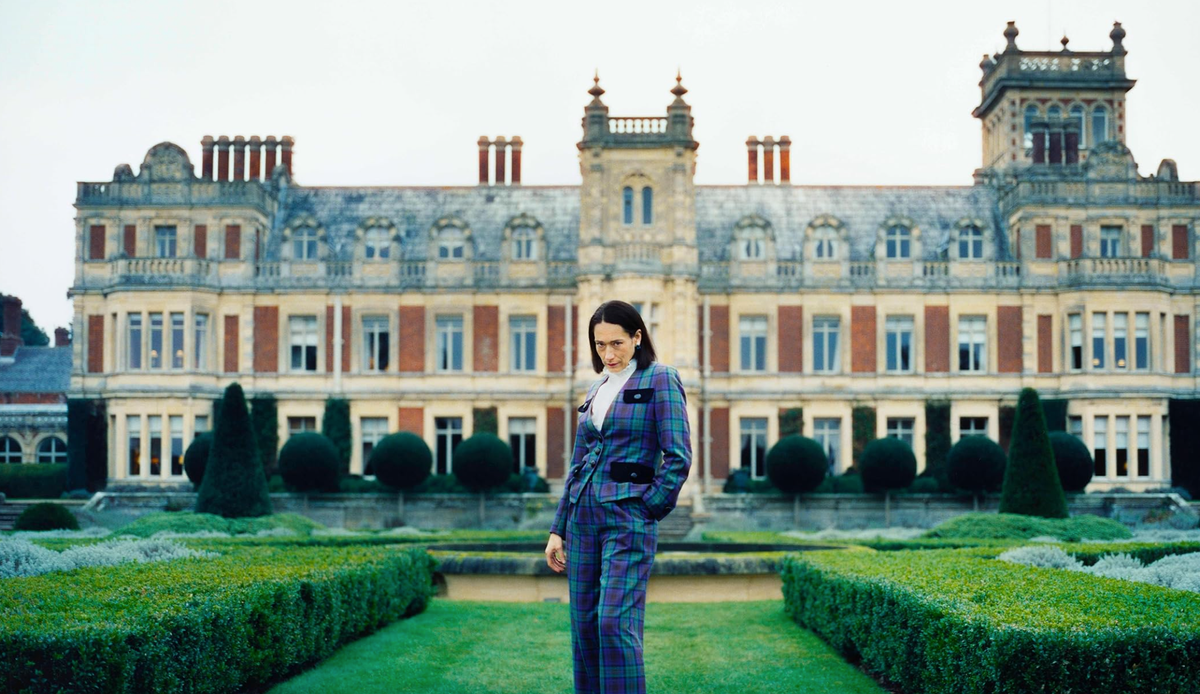
I’m still not sure the film is successful enough to achieve anything more impactful or cohesive than a stylistic exercise (though certainly a gorgeous one at that), especially since it’s an elevator pitch we’ve heard so many times before. However, if this is going to be the last time Hollywood tries to push this particular button (and I pray to all the angels in heaven it is), then at least the character, or at least this version of him, went out on a high note - and not just because he’d been stabbed in the arm.
Featured image: IMDb / The Death of Robin Hood
What's your favourite onscreen take on the character of Robin Hood?