By Dmitri Cole, Third Year, Law
Covid-19 caused a revolution in assessment formats across the higher education sector. I will chronicle the degree’s shift towards take-home exams, coursework, and online multiple-choice quizzes.
I, a final-year law student at Bristol, argue for a return to in-person exams for all core units, with a balance of coursework where applicable, and the substantial elimination of multiple-choice questions.
Timed Assessments and Coursework
The shift from in-person exams during the pandemic’s restrictions remains mostly unchanged. Instead, we undertake a series of take-home assessments, with five-day time frames (now shortened to two-and-a-half days). Meanwhile, coursework has replaced exams for fundamental law modules, such as Trusts.
There are several issues with this approach. An exam that takes several days limits our incentives to memorise knowledge, as one can learn the topic once the exam question is released, rather than revise a broad range of topics. It encourages widespread and unregulated collusion among students.
The situation within an AI-incentivised society is now much worse.
Students can successfully tweak an AI-generated answer to coursework or timed assessments to improve their grades. This risks creating a perception that the degree can be cheated, which may devalue student degree classifications and module grades as a result. Therefore, an honest Bristol student’s reputation may be tarnished through no fault of their own.
This is not an issue isolated to Bristol. Professor Andy Hamilton of Durham University recently resigned as the Chair of the Board of Examiners for Philosophy. And, on June 7th published an article in The Spectator titled, ‘Why isn’t Durham University taking AI cheating seriously?’ where he makes several sound points.
Firstly, AI use cannot be reliably detected. Few students simply copy-and-paste an AI response. An AI model identifying the issues in a problem question, which the student then rewrites to avoid detection cannot be picked up by programmes like Turnitin. This devalues the purpose of a law assessment, as it allows those proficient in AI prompting to attain good grades on the same standing as those who rely solely on their own minds.
Secondly, permitting AI exacerbates the division between rich and poor, as the wealthier pay for expensive subscriptions to higher-grade AI models. Allowing for take-home exams and coursework, in effect, allows the wealthy to ‘buy’ their degree classifications, which is eminently unjust.
Anti-exam ideologues respond by saying that a time-constrained in-person exam is harmful to our mental health and non-inclusive. On the contrary, a multi-day assessment can be significantly more stressful, as students redraft answers line-by-line and fret over its quality day and night.
The bar is set so high, students are disincentivised to limit themselves to the recommended six hours on their exam. This is a significantly worse way of mitigating against stress. A two-or-three-hour exam is in many ways nicer to students who just want to get it over with.
 Meg Pantry
 Lily Clark
It is asserted that AI is not good at writing law essays or problem questions. This is only partially correct. An AI model can be fed PDF downloads of textbook chapters along with comprehensive typed notes, which trains the AI model to solve law problem questions with a significantly higher degree of accuracy.
Moreover, a blind study conducted by Stanford Law School found that law professors overwhelmingly preferred AI-generated answers to student legal questions over answers written by fellow law professors. Indeed, AI-generated answers were chosen over answers by law professors 75% of the time.
Thus, AI can be used to quickly distil information and apply it to an exam question – effectively solving any complexity without requiring much work from the student, who must only rewrite the AI’s response to avoid AI detection.
Furthermore, Bristol’s law degree has an entry requirement of A*AA. A-Levels are assessed through in-person, written exams. Therefore, Bristol’s high entry requirement selects students who already excel in exams – why not maintain this format at university, since it is what students are already accustomed to?
Multiple-Choice Questions
The situation that I have described has been made worse after the shift to multiple-choice questions with Tort I (Liability for Negligence) and Company Law now being assessed through multiple-choice quizzes.
Regarding Company Law, the shift can be mapped. Pre-2020, there was a three-hour exam, post-2020 a 3000-word take-home timed assessment, then a 1200-word piece of coursework, now Multiple-Choice Questions. This downward trend in word-count culminating in Multiple-Choice Questions (which require no marking whatsoever) is, in my opinion, reflects a desire to reduce the marking load rather than a genuine search for a superior test of knowledge.
The average grade in Company Law in 2023/24 was 61-62%, which was low. The Unit Report 2023/24 called this an “unfortunately underperforming set of results”. However, the report explicitly stated that the teaching team anticipated improvement “in light of new teaching model and assessment model for 24/25 academic year.” The assessment then switched from a 3000-word take-home exam to a 1200-word coursework.
It is, in my opinion, not improbable that the assessment methods selected for Company Law are partly motivated by a desire to increase grades. This is evidenced by the “marked increase in higher final classifications (1st and 2:1) on the unit” in 2024/25. Indeed, 21% of students achieved a 1st and 81% achieved a 2:1 or better.
Though it is too soon to see how the shift to multiple-choice questions will impact grade averages for this module, it is highly likely they will continue to increase. The Unit Report 2024/25 predicts that these new assessment methods have “laid the foundations for the 25 academic year cohort to be the most successful at Bristol in the last 5-10 years.” Nonetheless, making an assessment easier and, therefore, increasing the grades attained is not a measure of academic ‘success’ – rather than trying to improve the teaching on a unit, it simply changes the assessment format.
To have as an end goal high attainment of good grades puts the cart before the horse – a good assessment should measure student ability, and good teachers and hardworking students work towards their higher grades within those parameters.
The outcome of the alternative approach is demonstrated in the Tort I (Liability for Negligence) Unit Report 2024/25. It is stated that “[t]he overall standard of performance was excellent, significantly exceeding the unit teaching team's expectations.” Yet, in the unit report itself, 27/50 questions were classified as ‘easy’ whilst only 3/50 were ‘difficult’, suggesting the exam itself was far from difficult.
The multiple-choice exam was online, with 3 hours allocated for 50 questions. This gave us an average of 3 minutes and 36 seconds per question. That is ample time to use another device, such as a mobile phone, to search up each answer. In the case of a multiple-choice exam, this can be done with AI. An AI model could be loaded on the phone, and then the student can use the in-built voice-to-text tool to read out the question and the options. Such hypothetical cheating cannot be ruled out and shows the vulnerabilities present in an online assessment.
Return to in-person exams
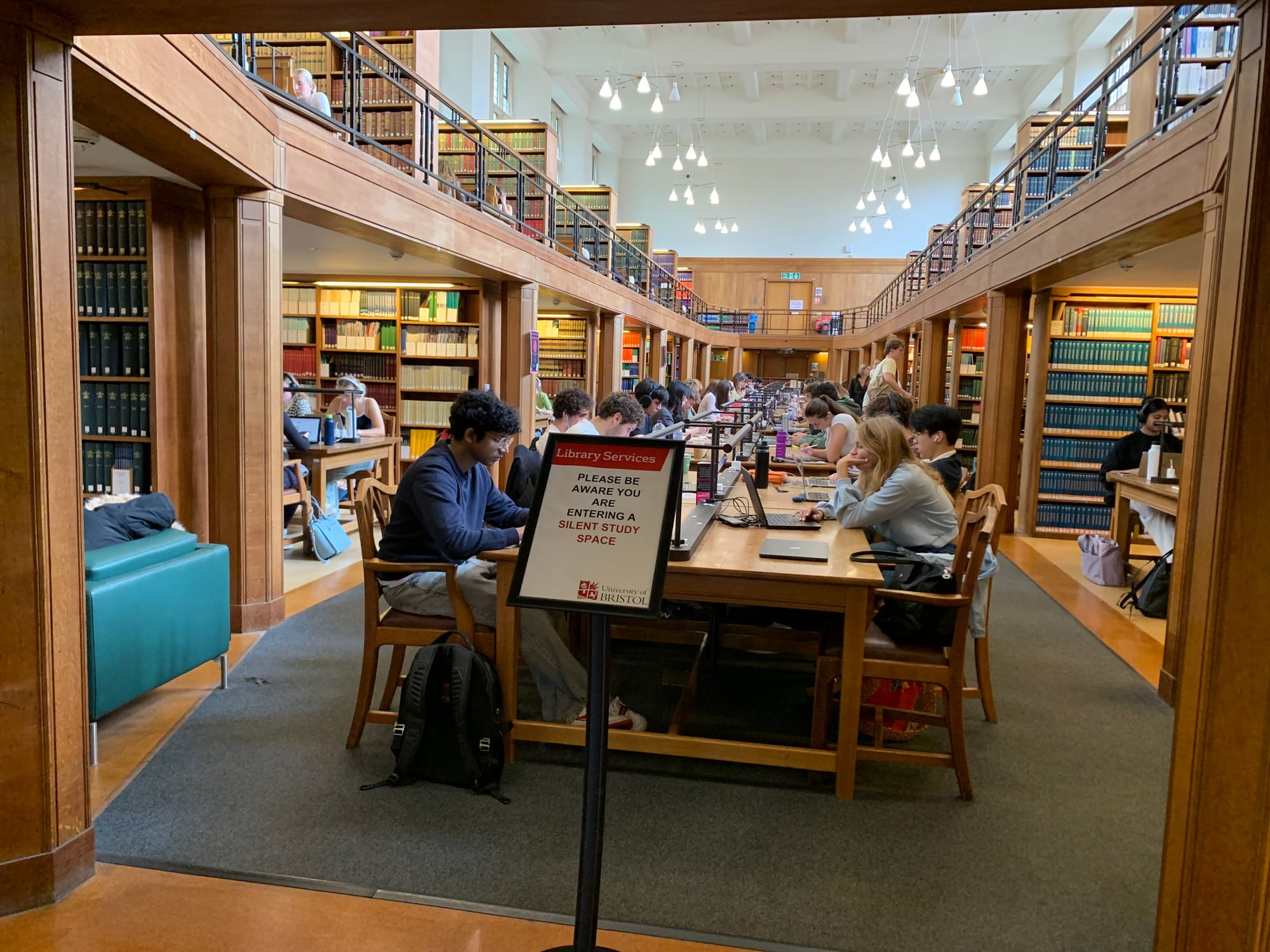
There is a beacon of hope. In 2026/27, Criminal Law and Land Law will be assessed through a two-hour, in-person exam. The Law School has committed for the multiple-choice exams for Tort I and Company Law to be held in-person. After six years, the Law School has accepted the necessity of in-person exams. Hopefully this is but the first step towards secure, in-person exams across modules. It is too early to say, and it has taken far too long to achieve even this modest advance.
The message to higher education is quite simple: there is no other choice. Perhaps in-person timed exams are not an ideal way to test knowledge, prioritising memorisation over deep thinking. Yet, in the age of AI there is simply no alternative.
The present situation is manifestly unsustainable. In a foreword to Policy Exchange’s ‘Evidence of Learning Through Assessment: Protecting the Value of a Degree in the Age of AI’ from August 17th 2026, the Rt Hon Sir Vince Cable, former Secretary of State for Business, Innovation and Skills, said:
To maintain public confidence in the value of a degree, and the societal benefits of higher education, the higher education sector must urgently and significantly overhaul its assessment system. In-person examination should replace remote assessment unless the latter is fully secure.
The Report, as covered by Iain Mansfield in The Spectator on 18 August 2026, called for the end of online, unsupervised exams. If universities fail to comply, it further called for intervention by the Office for Students to enforce this. Therefore, Bristol University (as well as most other universities) should act now before the full extent of this issue comes to light, mitigating against the risk of reputational damage.
The question facing Bristol, as well as many other British universities, is whether they can face reality. Hopefully, the flagbearers of unsupervised online exams and multiple-choice quizzes lose their influence, and action is taken to restore academic integrity before it is too late.
Professor Andy Hamilton had the courage to make his voice heard, and many more privately share his concerns, including at Bristol University.
A Bristol University spokesperson said:
The Law School takes a proactive approach to the challenge of AI in higher education, with the introduction of a range of accountability moments, implementation of a new AI strategy and the return of in-person exams for the 26/27 academic year.
Multiple choice exams will also be conducted in-person, under exam conditions, and are internationally recognised as robust and effective methods of assessing aspects of legal knowledge. A range of assessment mechanisms are used in our units, ensuring that assessment across the programme is integrated, authentic and designed for all.
There will be differing views on assessment profiles, but we keep our assessment practices under review and are confident that our assessment strategy is rigorous and consistent with assessment profiles in other institutions.
Featured Image: Epigram / Lianne Ponferrada
Do you think Bristol's law school, as well as other disciplines, should return to in-person exams?