

By Lottie Merchant, Film & TV Deputy Editor
In 2026, many fanbases of singer-songwriters demand radically honest and personal documentations of their relationships and experiences through their music. And this, paired with the information era, where surveillance and disclosure dominate, is resulting in private lives being almost an impossibility for many artists who wish to offer a confessional song-writing style. Is there an imperative for ‘confessional’ songwriters to sacrifice their own personal relationships and privacy in exchange for a successful music career?
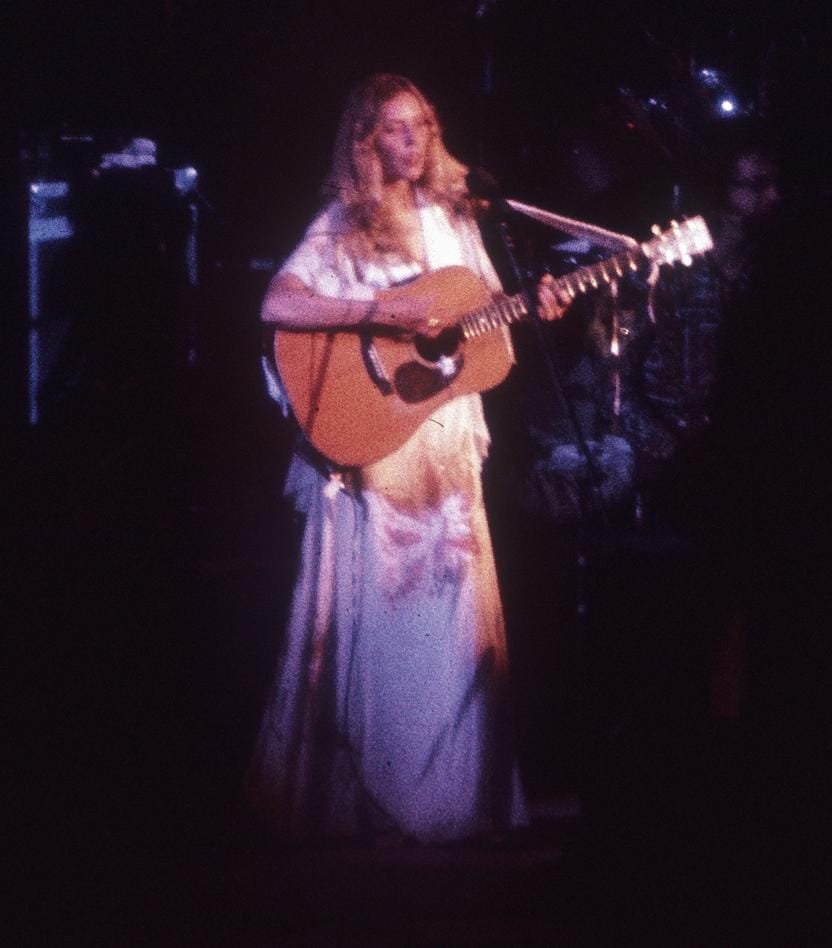
Confessional songwriting emerged in the mid-20th century and was characterised by a blend of folk and popular music by artists such as Joni Mitchell, James Taylor, Carole King and Bob Dylan. ‘Confessional’ songwriting was a movement away from traditional personas and general storytelling and a shift towards sincerity, radical honesty and ‘autobiography’. I use the term autobiography somewhat tentatively here, as although there was a rise in popularity for personal stories, there was less inclination, in this era, towards legitimising the validity of the stories presented through the songs.

Confessionalism was a depiction of private experiences through raw, diaristic, and authentic storytelling. It was perhaps more comparable to the poetry and literature of Robert Lowell and Sylvia Plath than the popular music of the time. But, as David Shumway posits in his article on Mitchell, ‘Confessionalism in songwriting is not the same as confessionalism in poetry.’ I would argue that alongside the evolution of songwriting and music, the evolution of the role of ‘celebrity’ has fostered a demand for exposé and disclosure. As a result, ‘confessionalism’ in songwriting has become a sensationalised and parasocial invasion of the personal experience, with fans demanding the ‘tell all’ when it comes to their favourite artists' private relationships and experiences.
Joni Mitchell’s 1971 album Blue documents emotive personal life experiences. Shifting focus between the painful end of her relationship with Graham Nash, the end of her romance with James Taylor, and the grief of giving her daughter up for adoption. And although both she and her biographers have confirmed that the album is about these topics, the diaristic approach to the writing allows the songs to tell these stories themselves.
Listeners infer that the title track, ‘Blue’ is about James Taylor because of the references to ‘acid’, ‘booze’, and ‘needles’, allusions tied directly to Taylor's well-documented struggles with heroin addiction. Taylor also played acoustic guitar on several tracks of the Blue album (‘All I Want’, ‘Carey’, ‘California’, and ‘A Case of You’), confirming their romantic and creative overlap during the exact recording window.
Confessional songwriting, as a genre, developed throughout the 80s, 90s and 2000s, with artists (to name just a few) such as Tracey Chapman, PJ Harvey, Tori Amos and Fiona Apple contributing to this style of writing. It became even more popular by the 2010s with artists such as Adele, Lana Del Rey and perhaps most prolifically, Taylor Swift dominating the scene.
Taylor Swift has become notorious for her big break-up albums and public relationships over the last decade. Fans and followers of Swift observe her public relationships and breakups through the media and then await her latest album, where they can effectively hear her side of the story. Swift has built her incomparable career off of documenting romantic relationships through confessional songwriting, with her two most renowned albums for this topic being Red (2012) (following the same chromatic theme as Mitchell here), and The Tortured Poets Department (TTPD) (2023). Red, a chart-topping country/pop album documents her relationship with actor Jake Gyllenhaal and TTPD follows her split with actor Joe Alwyn and subsequent tumultuous relationship with Matty Healy (the frontman of The 1975). In an interview published in The New York Times Magazine in April 2026, Swift discusses how fans often treat her songs like a ‘paternity test’, a means through which they can figure out who this album is about.
In ‘Chloe or Sam or Sophia or Marcus’, a song with an awfully indulgent name but a very tight concept, Swift details her decade-long love affair with Healy. Similar to Joni Mitchell and James Taylor, Swift reveals who this song is about through allusions to substance abuse: ‘but you needed drugs more’. Encouraging listeners to surmise that this song is about Healy (due to his very public issues with drug abuse). The song uses typical confessional songwriting conventions such as specificity and diaristic writing. Opening in media res: ‘Your hologram stumbled into my apartment / Hands in the hair of somebody in darkness (…) / And I just watched it happen.’ But the song isn’t just confessional through specific and earnest lyricism, it’s confessional through its autobiographical nature -backed up by public relationships and breakups that are observed by parasocial fans.

Swift’s career marks this new progression within the genre of confessional songwriting that demands exposé and biography – public experiences about public people that are documented through songwriting. So, is the success of a breakup album somewhat determined by the popularity of the muse?
We can see the effect of this new criteria for confessional songwriting through artists such as Olivia Rodrigo, Gracie Abrams and the wonderful Phoebe Bridgers. For example, Rodrigo’s new album You Seem Pretty Sad for a Girl so in Love (what’s with all these long titles?) almost operates as a concept album, documenting chronologically, from beginning to end, her public relationship with actor Louis Partridge. Like Swift, this album has the benefit of a very public relationship to do a lot of the marketing for her.
Gracie Abrams also dropped an album this year: Daughter from Hell. This indie-pop album wasn’t anything to write home about in my opinion. As well as lacking a compelling perspective, Abrams suffers from a lack of a lot of conventions that substantiate confessional songwriting. In her conversation with Olivia Rodrigo for Spotify, Abrams discussed being "careless" about the impact of her past songwriting, and her attempt to write with more restraint upon this new record. To me, this is exactly the problem with this album.
The absence of detail and vulnerability when it comes to Abrams’ depiction of her characters allows them to keep that anonymity publicly but also within the song itself. The album suffers from vague intimations of characters rather than specific imagery. ‘I'm living with a knife in my side // I'm gonna take it for a joy ride // You left when you gave it’. Here, the knife stuck in her side is meant to represent the permanent pain she has to carry around after someone hurt her. But throughout the song, all we are told is that someone hurt her, we don’t know anything about this person or why she let them into her life. There’s no storytelling, only emotions and ambiguous metaphor. Can an artist even be labelled as a confessional songwriter when they aren’t vulnerable or earnest. I’m not sure she is confessing anything.
On the other end of the spectrum Phoebe Bridgers' new album Lost Weekend explores breakups, new love and the grief of losing her father. Bridgers is one of the most talented confessional songwriters of this generation. Her depictions are raw, authentic and extremely vulnerable. Most potently, in her song ‘Still Standing’, Bridgers explores her relationship with her recently deceased father. When describing him she states: ‘You left your suitcase by the bed / Like you needed to know you could go whenever you wanted.’ These lines reveal that this father was someone who was often absent through a specific image of the suitcase. She doesn’t tell us that he was a flight-risk, she shows us.
Where Gracie Abrams uses vagueness in a confusing and almost cliché way, Bridgers’ vagueness is intentional and specific in a way that creates enigmatic and vivid characters. Bridgers’ writing is confessional because she isn’t afraid to look ‘bad’. Later in the same song, she confesses to us, ‘Sometimes I want you back / but not today,’ (in regard to her late father). These lines diverge from typical depictions of grief and are confessional in a way that is vulnerable and true to her at the expense of being ‘careful’ about upsetting people around her.
In a way, Phoebe Bridgers’ reverts back to traditional conventions of confessionalism, where the good stories are found in the songs themselves rather than on the front page. But I couldn’t help but notice that as a society we are still obsessed with working out who songs are about - especially if they are famous. Interestingly, the two songs that have charted best on Lost Weekend are ‘The Governer’s Waltz’ and ‘Bobby’, the same two songs that most overtly centre upon her public relationships with Paul Mescal and Bo Burnham. This could always be coincidental, but I believe it has something to do with our inclination towards disclosure and sensationalism.
 Lucy Bevan
Confessionalism, as it appears in 2026, seems to demand both the poetic merit established in the 1970s and the public exposé that emerged in the 2010s. Perhaps exposé and disclosure are something inherent to the genre itself, or maybe it is the result of the current intersection between personal storytelling and celebrity culture.
Featured image: Lucy Bevan
Do you think confessional songwriting demands disclosure?








.jpg?ref=epigram.org.uk)