The term ‘establishment’ has never been so incendiary or so commonly misused. When privately educated former commodity traders who seek only to give tax cuts to their millionaire mates, enrich themselves while in office and sell off our precious public services to the highest bidder are sanctimoniously shaking their fists about ‘the establishment’, we know we are truly through the looking glass.
Those in positions of power and privilege have always disingenuously thrown around the language of class divides to reinforce their own influence but never so brazenly as when Nigel Farage attempted to label a man dressed as a bin as ‘the establishment’ in order to distract from his own dodgy financial donations from foreign-based crypto billionaires.
And it is this particularly heinous and disturbing trend that Ink (2026), Danny Boyle’s newest film (and best in over a decade), sets its cross-hairs on the most - beside all the flippant (and often misguided) sideswipes at ‘lowbrow’ journalism. Above all else, Ink, adapted from James Graham’s 2017 play of the same name, is a story of two outsiders who seek to dismantle the establishment that would never give them the time of day before, only to find themselves weapons of its most pernicious tendencies.
I suspect critical responses to this film will vary widely based on how much you think Boyle and Graham are actually meaningfully interrogating their characters and their attitudes towards news and journalism. Some will see a smart and incisive skewering of a capitalist system that will always seek to crush the underclass, no matter how high a member of said underclass may rise within it. Others will see a smug, didactic, superficial morality tale about why it’s bad to put a pair of breasts in a newspaper. I see both sides, but also find the combination of the two within the film to be its most interesting element.
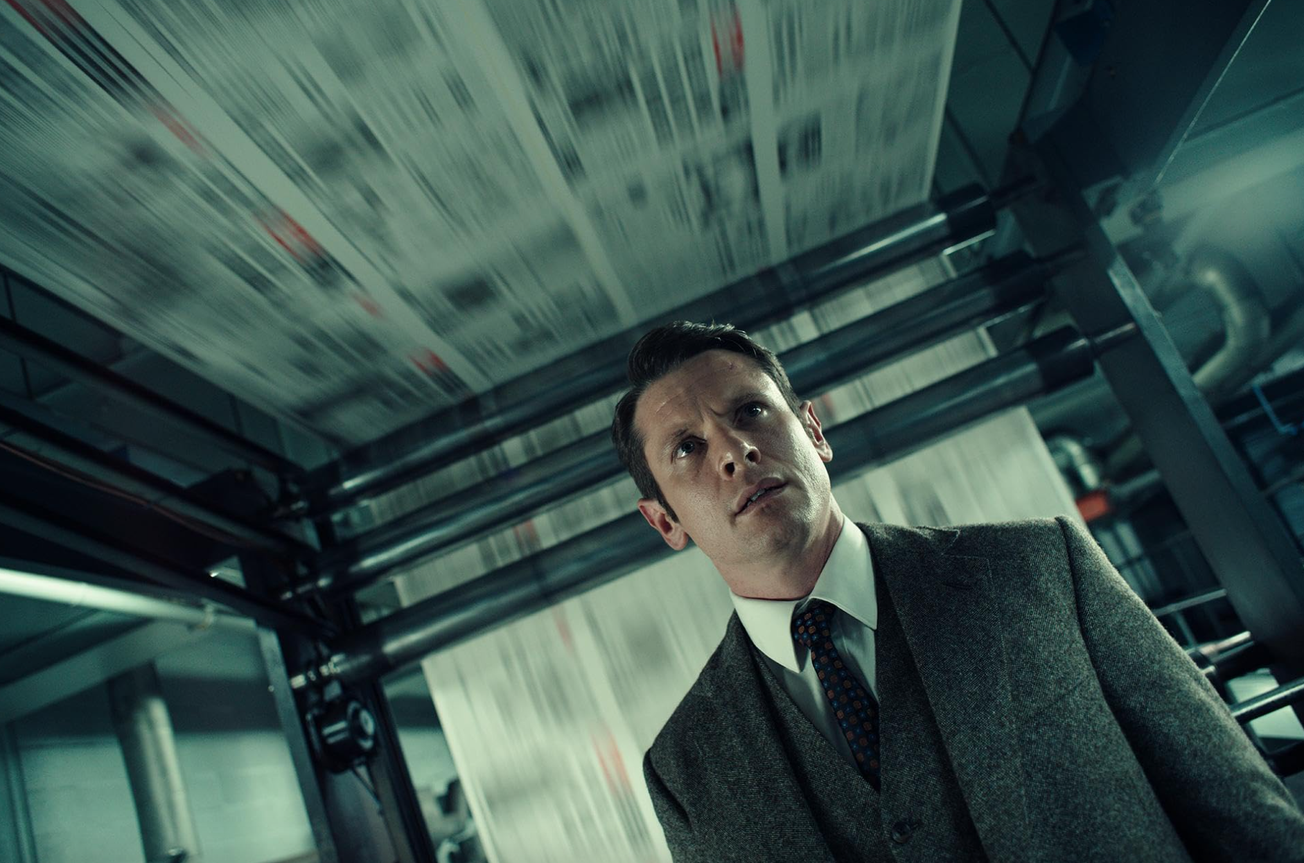
Larry Lamb (Jack O’Connell - every bit as possessed as he was in his role as a literal vampire in Sinners (2025)) has never been given his dues as a subeditor, especially from Hugh Cudlipp (Bertie Carvel, who won a Tony for his performance as Rupert Murdoch in the play), his boss at the Daily Mirror. Maybe that’s why, when sly and ethically dubious media mogul Rupert Murdoch (a disappointingly chained Guy Pearce) offers him the chance to be chief editor on the ailing Sun, he takes it with both hands. And, armed with only the marching orders of ‘make it loud!’ and a gang of Fleet Street rejects, he turns it into the best-selling newspaper in the world in less than a year. At what cost? Well, Boyle and Graham seem to disagree on this.
It’s this rift between the self-serious, preaching playwright and flashy, punk rock director that I find most interesting in the film as it’s very comparable to the similar dynamic between Aaron Sorkin and David Fincher that powered The Social Network (2010) into masterpiece territory. If only Graham and Boyle were able to gel as successfully as Sorkin and Fincher. To give Graham his flowers, he does focus on the way Murdoch slowly infected the paper with Tory-friendly politics soon after it reached near the top of the sales chart in a way that very few other writers would do. And there is a kind of magic to seeing The Sun at the very last point where it could legitimately claim to be a paper ‘of the working class, by the working class’. Or even when someone like Rupert Murdoch would actually ride public transport.
Unfortunately, Graham muddles his targets just as he reaches the finishing line. Fair warning: I will briefly get into spoilers here (and when I say ‘spoilers’, I mean very well-known and well-documented historical events that anyone can Google in five seconds). Graham’s ultimate sin is depicting the creation of Page 3 and Stephanie Kahn’s nude photoshoot as a greater stain on Lamb’s ledger than irresponsibly publishing hostage information that led to an innocent woman being murdered. It’s also telling that Graham clearly has more chagrin for Lamb consensually photographing Kahn nude than the way The Sun forcibly stripped her of her ethnic identity.
Boyle, on the other hand, seems to see this as something of an autobiography - or maybe an autocritique if we’re being generous. Boyle’s always been an irrepressible maximalist whose love of frenzied camera movements and experimental editing techniques to spruce up dialogue scenes is at least a little comparable to Lamb dangling breasts and free giveaways in front of the British public to get them to buy his paper. Now, I don’t think Boyle is quite self-aware enough to be knowingly dismantling the very imagery and attitudes he’s trafficking in but it makes for a neat, if unintentional, parallel anyway. Though I did quickly tire of his pathological need to cut away to an object, person or location whenever it is referenced in dialogue.
O’Connell is clearly the most exemplary element of the film - his almost sadistic single-mindedness and authentic Northern accent forge a genuine bond between him and the audience, even when you’re not supposed to be identifying with him. If the rumours about him being at the top of the list to be the next James Bond are true, I will take to celebrating in the street. Pearce has always been one of my favourite actors and it’s sad to see him given such a one-note role (Graham unfortunately splits the opportunities for empathy 5% and 95% between him and Lamb).
Furthermore, Lamb and Murdoch are supposed to be direct contemporaries, yet Pearce is 23 years older than O’Connell, making it feel much more like a father-son dynamic. Claire Foy is reliably steady in an underwritten role as Lamb’s subeditor and mistress but has one monologue so dreadful I’m shocked Graham didn’t cringe when it came out of Foy’s mouth at the film’s premiere, let alone eight times a week on the West End.
 James Hattan
Ink is a film I suspect I will be wrestling with for quite some time. The dartboard it’s aiming at (journalistic integrity, the role of the free press, classism in publishing etc.) is very standard but it comes at it in such a fascinating way I cannot help but give Graham and Boyle credit. And considering the play was written 10 years ago, I have to imagine the most politically relevant parts of this script have been added in exclusively for the film adaptation. Or who knows? Maybe Graham’s just a seer - he’s certainly a great playwright. Needless to say, I’d thoroughly recommend watching Ink and form your own opinion on it - certainly don’t take my word for it. If this film teaches us anything, it’s that you shouldn’t believe everything you read.
Featured image: IMDb / Ink
Will you see Ink when it's released on Netflix?