
By Maia Morris, First year, Cellular and Molecular Medicine
Please note this article is not medical advice, so if you have any questions or concerns, please speak to a GP or someone from the University's Wellbeing Team.
Tiredness is a universal experience, yet it is deeply personal, affecting individuals differently depending on their physiological, physical and cognitive processes. Whether with friends, family or online, we often connect over lack of sleep. So why are Bristol students so prone to exhaustion even when we try to prioritise sleep?
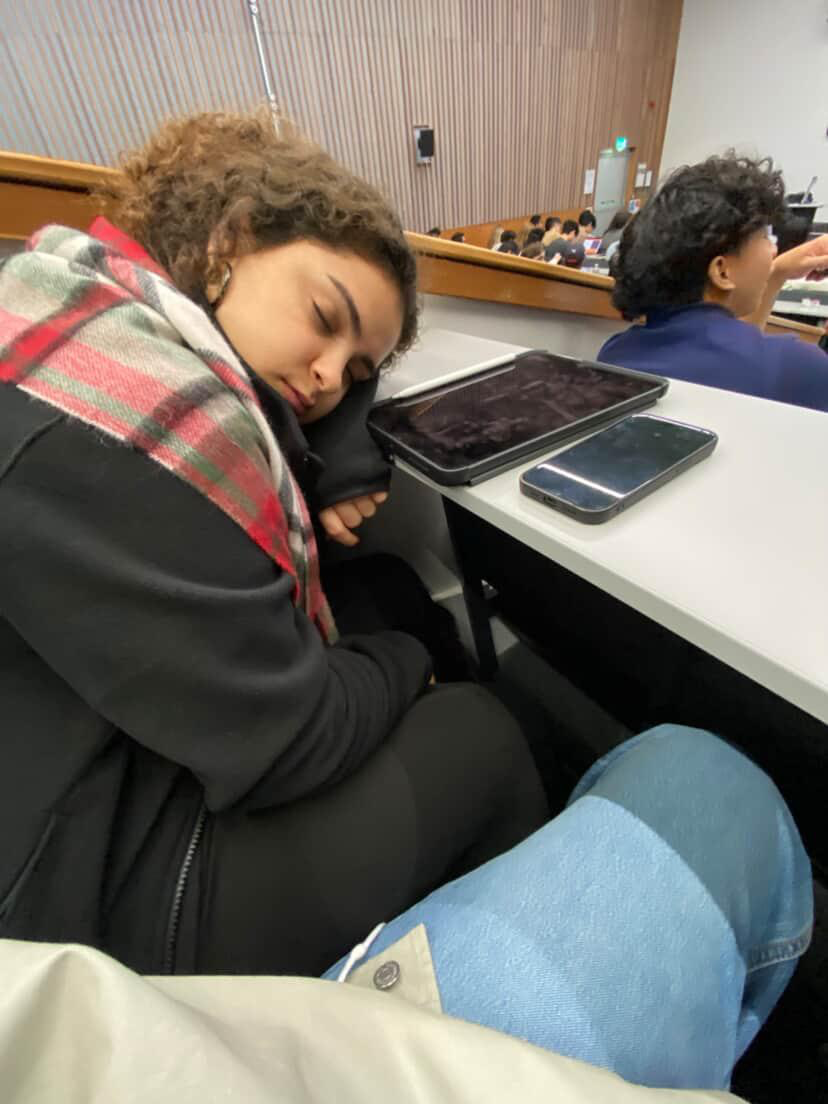
Time anxiety is common for students due to our busy schedules. Often, waking up in the night can cause people to worry about the decreasing number of hours until their 9am lecture. When this happens, it is important to remember that it is normal to wake up during the night following the natural sleep cycle. In his book The Sleepless Ape, Professor David. R. Sampson observes the natural sleep habits of the Hadza tribe. Sampson’s team found that for over 99% of the night, at least one person in the tribe was awake or in light sleep. Time anxiety, however, can break the natural cycle, and it can be hard to return to sleep. It is good advice to try to actively shift your focus. Perhaps thinking about recent accomplishments or coming up with imaginative scenarios should help you get your much-wanted shut-eye.
Additionally, experiencing high cognitive demand can cause exhaustion despite having plenty of sleep. The typical Bristol student needs to organise lectures, money, housing, food and their Wednesday night out. A 2022 article in Current Biology demonstrates that under high cognitive demand, people develop cognitive fatigue, resulting in them making decisions that require lower mental costs.
Moreover, people with cognitive fatigue demonstrated less pupil dilation, suggesting less engagement and mental effort. Finally, glutamate levels in the lateral prefrontal cortex were higher in high cognitive demand groups. The study suggests that mental effort becomes more costly after difficult tasks as the brain needs to regulate its chemical activity. Cognitive exhaustion is the reason why we struggle to focus during a one-hour lecture despite previously being able to study after a six-hour school day. The Sustained Attention Paradox explains how our brain functions in waves of activity; it is natural to feel tired when pushing these mental limits.
Following these examples of a typical Bristol student, it is convincing to argue that our society is not optimised to support natural sleep schedules. We organise our days so that we have a regimented slot for rest, and we constantly try to complete mental tasks that go beyond nature’s expectation for humans, such as that guilty late-night study session. A recent study by Jerome. M. Siegel demonstrated that industrial societies have a 10-30% rate of insomnia (depending on the criteria). In comparison, isolated hunter-gatherer tribes in Namibia and Bolivia have a rate of insomnia of less than 2%. This demonstrates that widespread insomnia is not a characteristic of all humans. Instead, it is far more likely that our schedules and cognitive load are not designed to improve the quality of our sleep.

Unfortunately, there are serious causes for chronic fatigue that are not simply due to the lifestyle of a student. Anxiety and sleep apnoea (obstructed airways during sleep) can cause people to have constantly disturbed sleep. This can cause tiredness, mood swings and difficulty concentrating. Additionally, low iron and low vitamin B12 can affect your red blood cells causing brain fog and persistent tiredness. Blood tests can determine if tiredness is due to nutrient deficiencies. If you believe you're experiencing unexplainable or constant fatigue, a GP will be able to provide support or treatment.
 Sophie Lee
 april whitworth
Tiredness is a common side effect of students pushing their mental capacity to its limits. So, next time you find yourself stuck in the typical ‘how are you?’, ‘I’m tired’ dialogue, it will be valuable to remember that your brain is testing the restraints of nature.
Featured image by Unsplash / Quin Stevenson
Do you find tiredness prevents you from engaging with the university experience?