By Luca Woodruff, Third Year, Law
Some of the best moments of modern cinema are the so-called needle-drops: when an existing song plays to accompany on-screen action. Its utility is vast, serving anything from a rom-com montage to a closing message; a journey sequence or a brutal fight scene. And within horror, the needle-drop can play a significant role in enhancing tension, dissolving it, and connecting the viewer to the characters.
Take the biggest horror-hit of the year so far: Curry Barker’s Obsession (2026), which was a hard-hitting cautionary tale surrounding deep-seated romantic insecurity. Obsession’s soundtrack features some well-known songs which play at various points within the story, notably several songs by Current Joys – ‘Kids’ can be heard over the car radio in the background of a scene between protagonist Bear (Michael Johnston) and his friend Sarah (Megan Lawless).
As its name suggests, it is a youthful track of reminiscence and regret, with a melancholic hope for the future. Its placement in the scene allows the audience to feel that same hope in a way that mere dialogue is unable to capture, as Sarah excitedly holds her college acceptance letter. Those who have seen the film will know this is quite literally short-lived, but the use of a mellow, nostalgic track concisely elevates the connection between viewer and character.
Obsession is a great example of using the needle-drop to achieve tonal dissonance. A comforting song in an uncomfortable narrative provides sensory security, perceived by our ears as brief shelter. Even if we refuse to sympathise with Bear, a tender, personal song can plead us to – it is an efficient tool of evoking empathy.
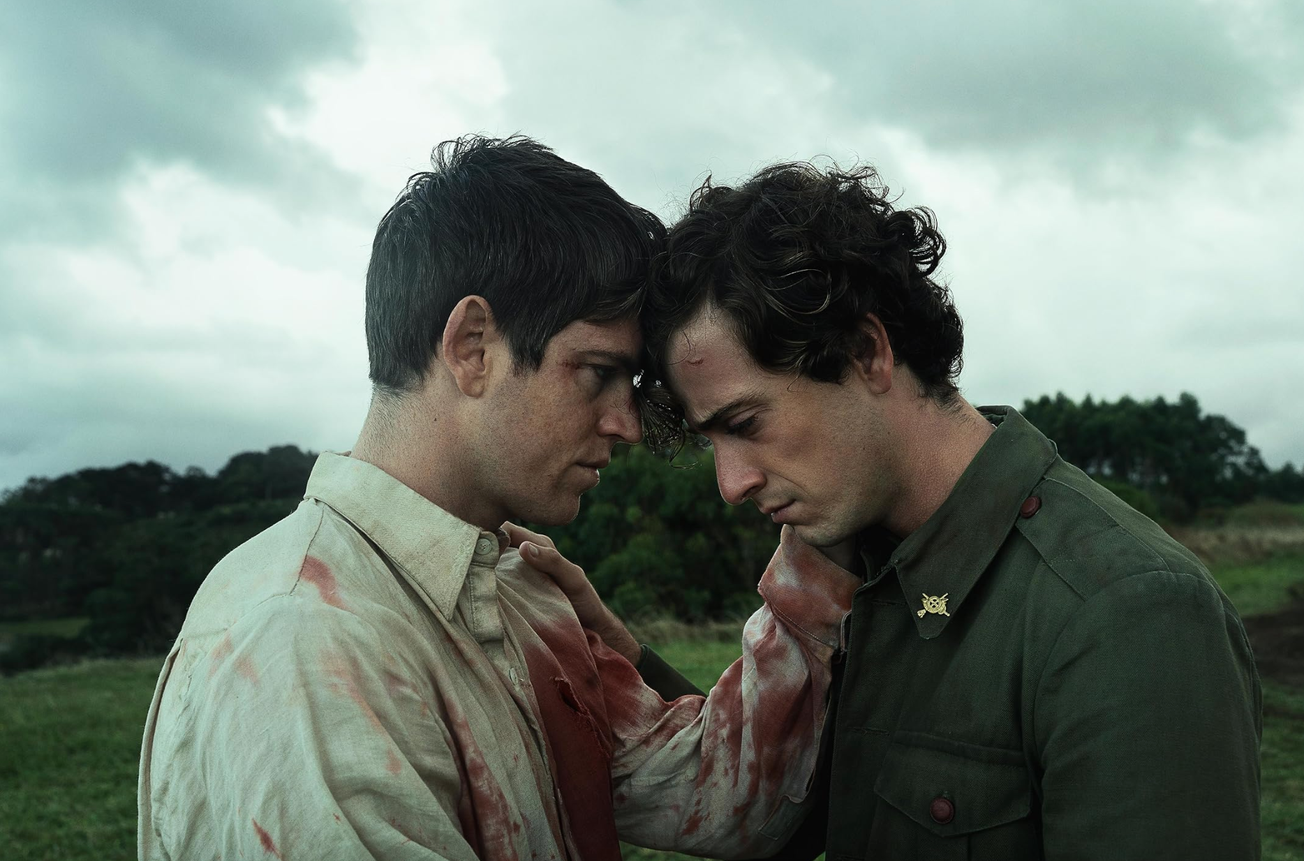
Adrian Chiarella’s Leviticus (2026) features Frank Ocean’s ‘Self Control’ in the final frames of the film, filling the silence as the credits roll. An intimate song of subdued affection between two men, it’s a befitting end to a symbolic story of religious guilt and sexual shame. The two boys share a headphone each as the song floods the speakers. It’s a relief; a way of letting the audience feel the comfort of acceptance that the characters have finally grasped themselves.
And, in the latest instalment of 28 Years Later, Nia DaCosta’s The Bone Temple (2026) incorporates Duran Duran’s ‘Ordinary World’, giving Dr Ian Kelson (Ralph Fiennes) a tangible relic of the time before the rage virus. It’s a motif which aids his relationship with the infected Samson (Chi Lewis-Parry), who, much like the audience, is soothed by the sound, holding on to it like a lifeline. The same technique is implemented across all three films: playing a known or emotionally evocative song to intensify the audience’s empathy for the protagonists.
Another effective kind of horror soundtracking is the recurring needle-drop, where a song is played once early on and later returns, often to signify either evolution or deterioration. Evil Dead Burn (2026) – one of horror’s most successful franchises – features the classical French ballad ‘La Chanson Des Vieux Amants’. The song first plays in a wedding flashback between the protagonist Alice (Souheila Yacoub) and her husband Will (George Pullar), bathing the scene in an innocent, romantic light. It returns for a funeral scene, selected by Will’s belligerent mother (Tandi Wright) so that she might say goodbye to her murdered son.
It is simple enough, using music as a recurring motif that documents the lifecycle of a relationship. In this case, director Sebastien Vanicek uses double soundtracking to convey the irony of love’s destruction, the futility of humans in the face of walking death.
Opposingly, Linda (Rachel McAdams) experiences a journey of enlightenment in Sam Raimi’s charmingly fresh horror-comedy Send Help (2026). Their work trip in ruins on a desert island, the roles are wryly reversed when her boss, Bradley (Dylan O’Brien) is gravely injured, and Linda is forced to show him love in a way that he has never shown her.
In the opening scene, Linda sheepishly coaches herself in her car mirror before another lifeless day as a competent but undervalued corporate strategist, soundtracked by Blondie’s new wave track ‘Rip Her To Shreds’. We feel the euphoria of Linda’s self-actualisation when Blondie’s music returns in the final scene, this time the timeless hit ‘One Way or Another’. Even though we might not agree with her slightly sadistic methods of survival, we find it hard to not bob our heads or crack a smile at the final track, revelling in her deliverance from downtrodden to dominant.
In fact, the recurring needle-drop collides with sadism in The Bone Temple’s predecessor, the first part of 28 Years Later. Although not a 2026 release, last year’s acclaimed zombie-horror opens, bizarrely, with the Teletubbies theme. It is not a track in the commercial sense, but it is known by many, relying again on the dissonance caused by a loved children’s tune scoring Danny Boyle’s signature brutal violence. The theme tune returns for the end of the film, this time an accelerated rock version alongside another eccentric show of graphic violence by a gang of Jimmy Savilles.
This is where the needle-drop becomes most interesting in horror. Where Raimi’s Send Help permits the audience to support and enjoy Linda’s sadism through a lens of injustice, 28 Years Later uses the euphoria of rock music and the light-heartedness of a children’s tv show to make brutal violence strangely enjoyable. In these contexts, music is not trying to be an emotive tool to rationalise character decisions. Instead, they let go of right and wrong, gratifying the viewer with a good song and muddying the waters of horror and pleasure.
 Leah Pollard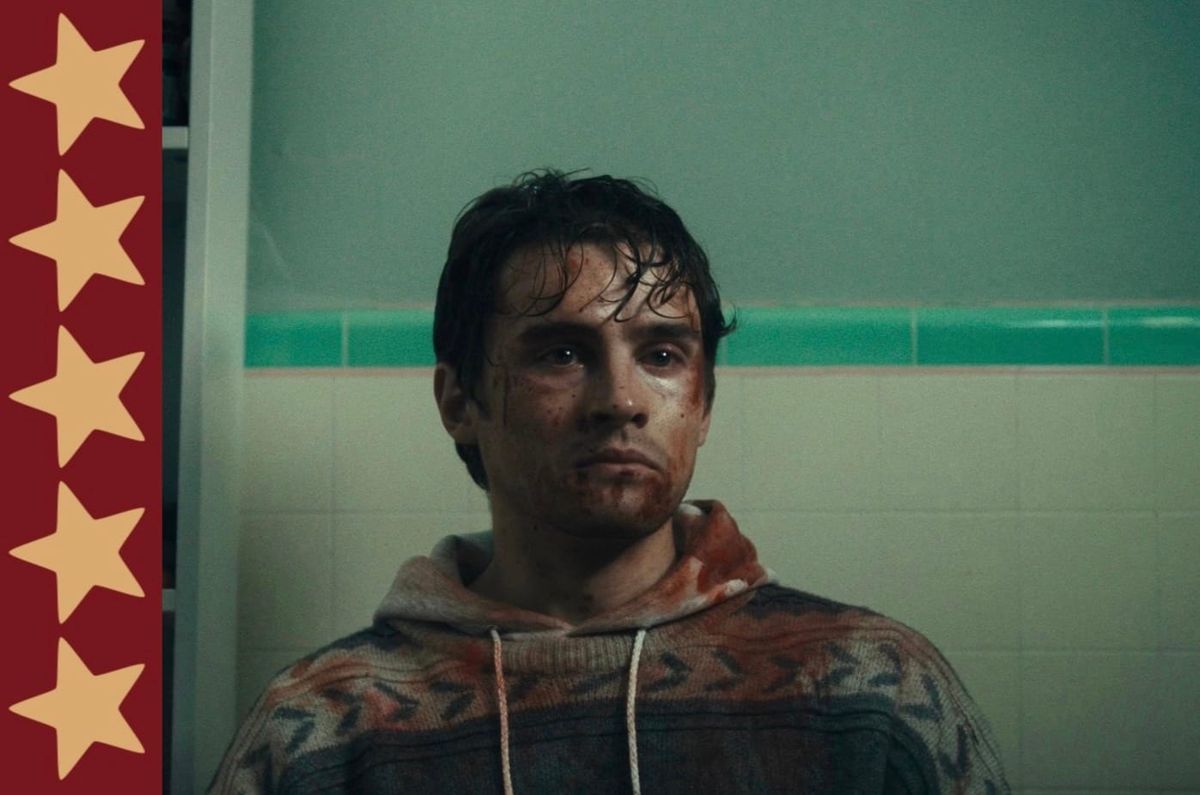
It is not a new technique; we can observe it in many classic violence sequences. See ‘Hip To Be Square’ in American Psycho (2000), Beethoven’s ‘9th Symphony’ in A Clockwork Orange (1971), or ‘Stuck In The Middle With You’ in Reservoir Dogs (1992). It forces the audience into a kind of complicity, their musical satisfaction compromises their perception of violence: we share the pleasure of the sadist, when we would otherwise identify with the victim.
Musical sequences in horror movies can be a way of evoking empathy for antagonists, creating tension in an otherwise unassuming scene, or perhaps most interestingly, act as an invitation for audience complicity. 2026's releases have proven that soundtracks are not just a background aspect of scary movies – they are an essential part of what makes the genre so great.
Featured image: Epigram / Hanno Sie
What have been your standout horror movie soundtracks of 2026 so far?