
By Lia Middleton, Second Year English
Claudia Shnier’s Split Ends stages the destabilising impact of a romantic relationship so intense that it makes you feel your mind is not your own. One that abuses and disorients rational control until childhood rituals are left raw and exposed. Claudia’s story arose from the wreckage of an abusive relationship that unravelled her OCD whilst studying an MA at RADA. Driven by a fearless determination to depict ‘truth’, this play is the ultimate reassertion of control, skilfully crafted and beautifully performed to deliver a gripping, cathartic audience experience.
I walk through the dark, industrial tunnels of the Loco Klub and into their theatre space. There, I’m confronted with a white sheet stretched across the back of the stage with a projection that reads ‘the following play is developed from real life events. Any resemblance to real people, alive or dead, is completely intentional’.
This blend of humour and resolution sets the tone for the play’s opening. While formidable in her muscular frame, wearing black shorts and a crop top, Claudia’s persona is immediately undercut by a projection of her inner self, arguing with her about how to begin the play. The effect is comedic but also reveals a dialogue between the mind and the body which seeks to disempower its subject.
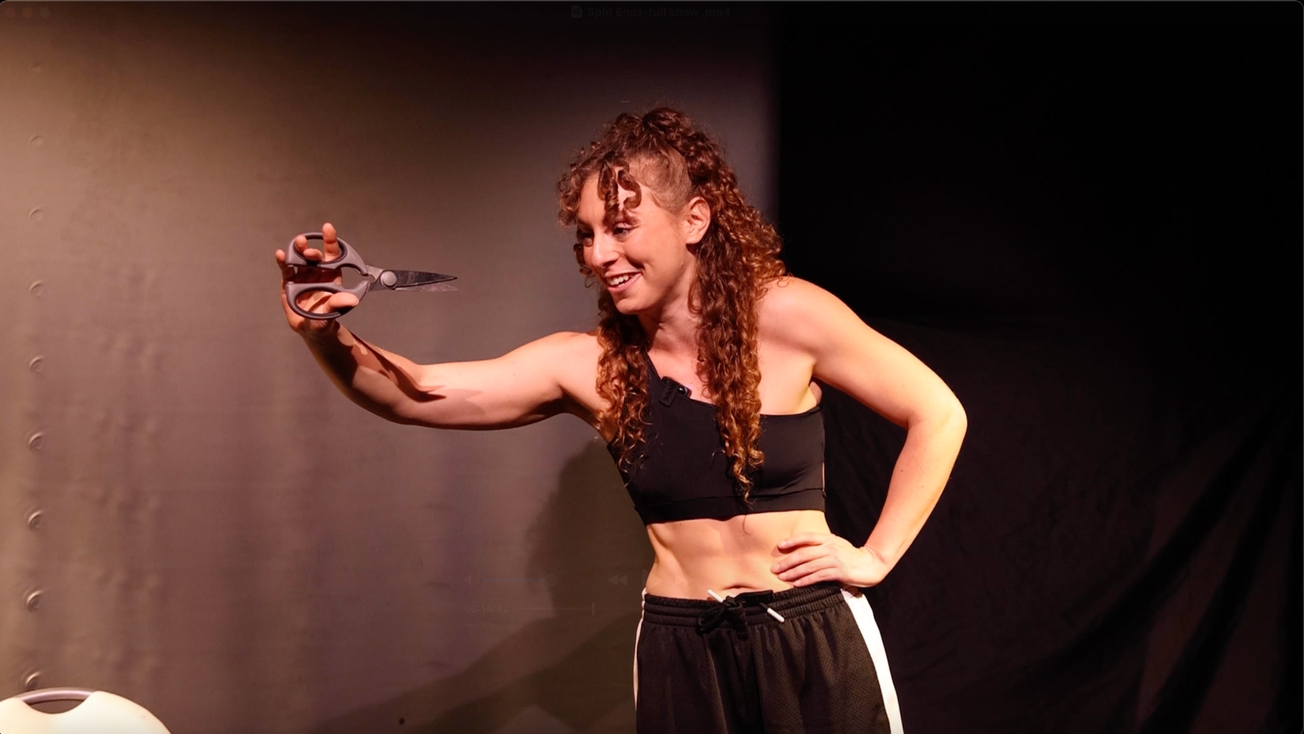
Initially, the embodied feeling of attraction drives the relationship. Claudia puppets a hoover to embody who will become her abuser - a clever choice which again blends humour and repulsion in the absurdity of its power. I loved it when she compared the warm swelling feeling she attained from him to watching her brother dance with his wife at their wedding. A love that seemed so palpable, it was tangible. The hoover feeds this, telling Claudia they are drawn together by magnetism, two parts destined to a whole. What this achieves so effectively is to establish the conditions of infatuation from which manipulation springs.
Both funny and increasingly intrusive, Claudia becomes exhilarated by their relentless text exchange, which builds and builds, until suddenly he takes three days to respond before replying ‘haha yeah’. ‘HAHA yeah?!’ Claudia repeats, incredulous. She plays a call-and-response game with the audience, getting us to repeat ‘yeah’ when she says ‘haha’ - an effective strategy for involving us in her mental spiral. Apparently, we were the first audience to actually respond, which surprises me because Claudia’s authenticity builds a personable and genuine audience connection.
But as the show progresses, its sticky and invasive grip tightens. I found myself recoiling at the dialogue between her and the hoover, as Claudia puppets a pair of scissors to act as his mouth. He tells her, ‘I think I’m used to something toxic, which this isn’t’ and ‘I'm craving something dangerous’, using a sense of victimhood to manipulate her into feeling not enough. When he begins to continuously leave and then come back to her, an addictive cycle is provoked.
The resultant chaos triggers Claudia’s compulsions to cut her split ends. A ritual for control that has affected her since she was a child. Her physicality becomes jerky and spasmodic, her body twisting in on itself and slowly wound up in the hair that constrains her. Even then, Claudia still pokes fun at herself. I found the funniest moment to be a projection where on-screen Claudia is in a black bodysuit and physicalises the ‘thick, black, curly hair’ which her ex leaves shed all over the flat. They seem to multiply beyond control, and she edits herself hilariously, all the while on-stage, Claudia is increasingly losing herself to an obsessive need to contain them.
I briefly contemplated whether the play would’ve benefited from more of an arc. Claudia depicts her descent so viscerally, and yet we don’t really see the recovery in the same intensity. I suppose I was craving a single warm lightbulb moment where we see power seep into her. But I think Claudia makes a choice not to do that in her urgency to portray real life that cannot be packaged into a neat narrative arc. In a jarring reminder of this, in the play’s closing scenes, Claudia projects a section of rehearsal footage and explains that it shows her when her ex walked past the window. Her whole body freezes, and she goes into ‘fight or flight’ mode. Her distress is as embodied as her infatuation once was.
For, of course, we are watching Claudia recover through that act of creating and performing Split Ends itself. In its dual ferocity and comedy, the play creates a unique catharsis and connection between audience and performer that is a mutual empowerment. Claudia’s confrontation with the past serves as a reminder of the control we have over the narratives that we use to define ourselves - that Claudia refuses to let silence define hers is poignant, informative and inspiring.
Split Ends continues its tour in Newcastle (13 & 14/05), Manchester (19 & 20/05) and Falmouth (17/06). More from Claudia on Instagram @shnierclaudia.
Featured image: Sergei Sarakhanov
Will you see Split Ends in any of its later locations?