By Mila Jefferies, Second Year, English
Content Warning: This article discusses violence and child abuse.
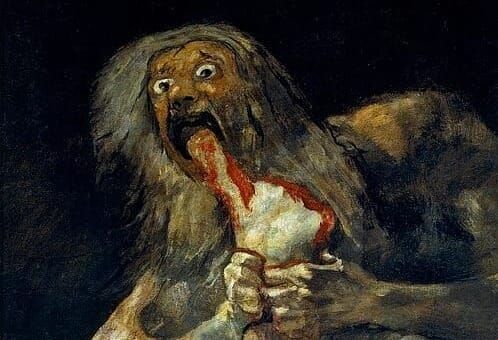
Horrifying. Satanic. Haunting. All common ways to describe Francisco Goya’s ‘Saturno Devorando a un Hijo’; the crazed, ravenous look in Saturn’s eyes as he devours his son is haunting. Why has such an image hung in the Museo Nacional del Prado for over a century? And why does an instinctual, and rather morbid, part of you feel drawn to it?
You are not alone in that feeling. Goya’s painting is inspired by an Ancient Greek myth that, over thousands of years, has been reimagined, repainted and retold. It’s clear why such a gruesome tale keeps resurfacing. Within the taboo, we see a version of ourselves, a reflection of our own lives. That’s the beauty that attracts us to this terrible image: it’s relatable.
The myth itself comes from Hesiod’s Theogony, an epic poem written thousands of years ago. In traditional epic fashion, it’s very long, but the main premise follows Cronus, who hears of a prophecy that one of his children will overthrow him. Consumed by his greed for power, he resorts to eating his children. Rhea, his wife, hides their youngest child, Zeus, who later goes on to overthrow his father, fulfilling the prophecy.
Then, the Romans got hold of the myth, marking the start of the many adaptations. They renamed Cronus ‘Saturn’, and, transformed the God that so mercilessly ate his children into a peaceful, beloved ruler of Italy. They even threw him a festival, Saturnalia, characterized by total harmony and equality. How could a God, guilty of such heinous crimes, have undergone such a drastic rebrand? The Romans acknowledged this contradiction but accepted that their God could have both loving and evil qualities at the same time. They clearly reshaped this myth to resonate within their own culture; it portrayed their God as imperfect, just like humanity. It mirrored their own ideal of paternal authority: a father who is stern but loving.
Fast forward to the Seventeenth-century; the Thirty Years War is still raging in Europe, bringing famines, diseases, and acute suffering. This was when Peter Paul Rubens painted ‘Saturn Devouring His Son’, and his interpretation of Saturn feels much crueller than the original myth. In Hesiod’s version, the children are swallowed whole, a quick, clinical death. But Rubens shows us Saturn devouring his son limb by limb. The child’s death is no doubt slow and agonising. This is intentional. Rubens has reshaped the myth to mirror the cultural suffering he had watched first-hand, at the hands of those in power.
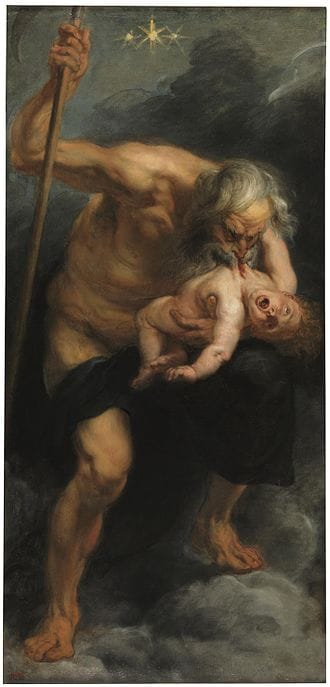
And yet, he paints Saturn himself as rather beautiful. Rubens was heavily influenced by Michelangelo, having studied him in Italy, and Saturn’s chiseled, classical body is a clear reflection of this. Why would Rubens paint such a monster to be so God-like? This guise is unsettling and perhaps that’s the point; it shows that evil is not something we can see, it is disguised within something we’d trust. The irony of this is not lost when we consider that this piece was commissioned by the Spanish monarch himself, a key contributor to the funding of the war.
It seems that the myth got darker with each retelling. Goya took everything these earlier interpretations gave him and produced the most disturbing version yet produced.
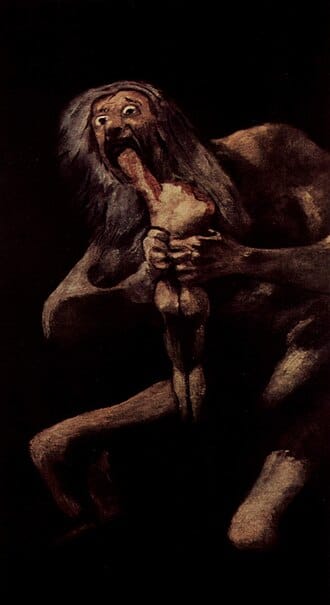
Like Rubens, Goya opts for a more gruesome death for Saturn’s children. But what’s striking is the difference in Saturn’s appearance. He doesn’t look at all godly or composed, but the complete opposite. His skin is discoloured, his body disfigured, almost corpse-like. It’s hard not to read this as politically charged. Goya, like Rubens, used the myth of Saturn to acknowledge the corruption and greed he saw within his own culture, and perhaps his own suffering too. Thus, this deterioration in Saturn’s appearance portrays the hunger for power as a disease; it can never be satisfied, and has stripped Saturn of his humanity, leaving behind a shell of what he once was. Perhaps we could argue that Goya intends to portray greed itself as the true tyrant; Saturn is merely a vessel, a victim.
The myth of Saturn exemplifies that greed, power and tyranny seem to be forever prevalent, across cultures and time periods. Although they might manifest in different ways, they show up in each reinterpretation we have looked at. The Greeks followed their own literary tradition: Saturn’s tyranny serves as a warning against the greed for power, legacy, and the inevitability of fate. Yet, to the Romans, he didn’t serve as a moral lesson, but as a relatable, endearing figure. It’s interesting how two cultures, with relatively similar contexts, could arrive at such a contrast in interpretation of Saturn.
 Rosy Brown
However, Rubens and Goya’s interpretations are more alike, both darker in essence. But the opposing portrayal of Saturn himself is fascinating. When Goya painted his version in the nineteenth-century, he was in his seventies, deaf, severely ill and tormented by the fear of his own madness. He had lived through war, and a very unstable Spanish political climate. I believe that this influenced his terrifying, crazed Saturn; it reflected both the cultural suffering, and Goya’s own internal struggles with his mental health. It represents an innate, primitive fear of growing old, of dying, of losing oneself. Likewise, Rubens’ position as both a peace negotiator and diplomat made him witness to both the uncensored brutality of war, and those in power commanding it. He saw the suffering first-hand and powerfully critiques the façade of trust and ‘goodness’ of the elite within his painting.
So, as Jay Scott Morgan argues, Saturn is ‘a cannibal father, jealous of our freedoms, determined to destroy us, our ideals, our hopes’. So why has this ancient figure found a way to resonate with people across the span of its existence? My answer would be going back to my original statement: Saturn is relatable. Not literally, but we relate to the symbolism he evokes: greed, power, tyranny. This begs the question: what would a 21st century Saturn look like? How could an artist generate the same anxiety as Rubens, Goya or Hesiod? Perhaps our version of Saturn would manifest through a different medium, a viral image or a film. He wouldn’t need his own hands to devour his children, but a warming climate, an unstable economy, or an ideological divide. The possibilities are endless. That is why artists continually return to the myth of Saturn; he is malleable and can be shaped to draw attention to their critiques.
Featured Image: Wikimedia Commons / Saturno devorando a sus hijos por Goya
Do you think we are closely related to monsters?