In his newest film, Boots Riley tricks us by forcing us into a false sense of security. This is a heist film, anti-capitalist and outrageous not in its premise but in its surrealist execution, which is bold and wacky.
I Love Boosters (2026) jokes around with its political intent, getting more ridiculous in plot as the politics themselves become more blatant. Its ideology, though told in ridiculous ways, simply cannot be ignored. It touches on issues with such comedic power, we almost forget that they are there, distracted by the dastardly outrageous plot choices. Then, suddenly, someone’s parents are going at it in front of an audience and you question exactly what type of film you signed up to watch ...
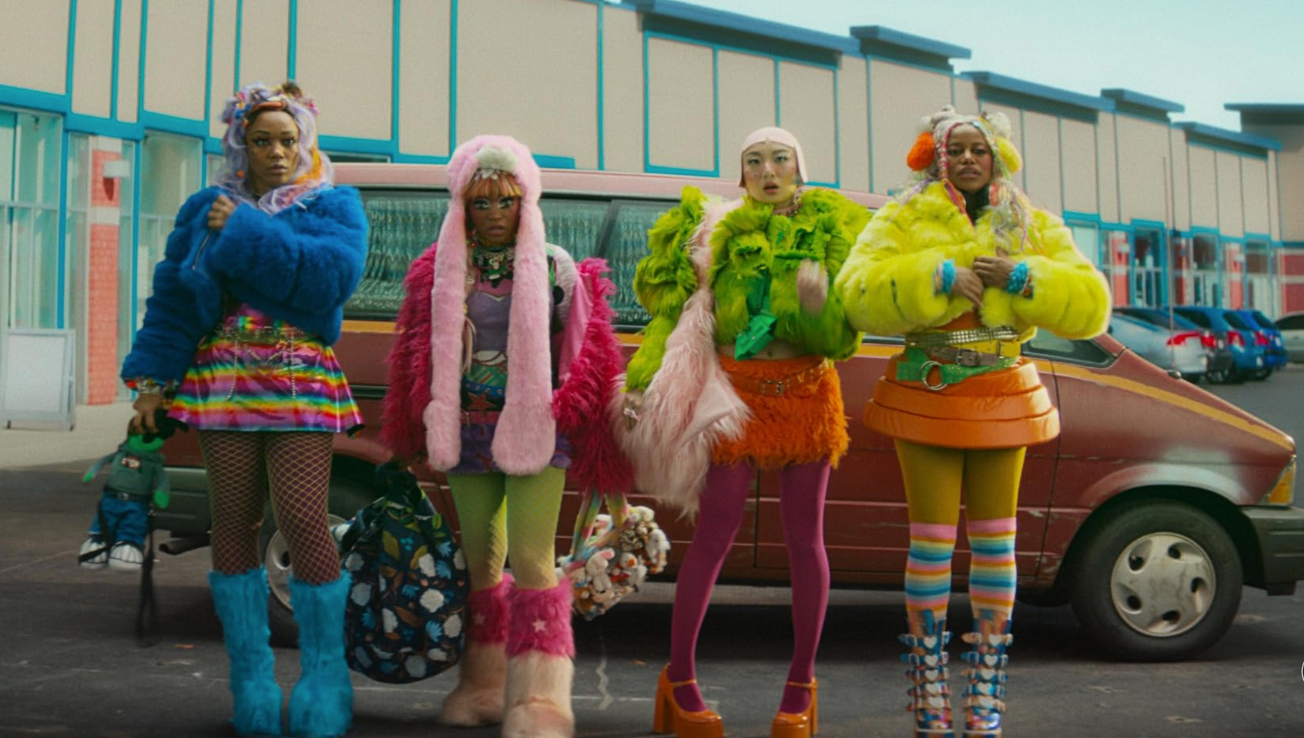
Its vibrant cinematography and maximalist approach gives us simultaneously glamorous and wild outfit choices with even the most ridiculous costuming somehow feeling not too far from appropriate. As the plot thickens, we see the stylistic choices become even more out-there, delving deeper into the criticisms of the fashion world while still giving us fashions to criticise.
The film touches importantly on the destructive power of idolisation too. Having a major star like Demi Moore play our antagonist - Christie Smith - we, like Corvette (Keke Palmer) initially find ourselves starstruck. It so powerfully immerses us as an audience in the exact point it’s trying to make - even down to this aforementioned mockery through fashion: a painful comment on the frivolous nature of fast fashion and continuous trend cycles.
Its use of almost cartoon comedy logic seems to appear from nowhere. Stuck inside Christie’s drastically sloped apartment, Corvette’s legs turn into a literal cartoon as she attempts an escape, losing control and gaining speed with Road Runner-esque style. Setting is of such importance that Christie’s apartment itself becomes a status symbol with everyone apart from her struggling to stay upright.
However, I respect that some viewers may struggle with this sudden flip of tone but I found its symbolism unexpectedly potent. As a society, we do take too much too seriously - a revelation that truly highlights Riley’s anti-capitalist critiques. This film’s subtle nods at power structures marks it as cleverly politically charged and subversive. It is a film so full of political symbolism something could likely be found in every choice, especially through its use of satire.
Will Poulter’s satirical character becomes an unexpected favourite for this reason. The shop manager’s pivotal role in enabling Christie’s evil shows a twisted humour to be found within blind compliance. His weak personality and selfish ignorance shows an important societal reflection towards all of us who let such immoralities slide.
For a film so absurd, I would never have expected to have been so stumped by its twist: the secret uncovering of the grotesque skinless people. As I have said before, literally nothing seemed out of the question. It therefore comments not only on the fashion industry but shows us a literal visualisation of the true human suffering within. The shock of the nonchalance in the exposure and the subsequently ‘poor’ animation marks it a commentary on the lack of individual understanding of it as a real (subsequently realistic) problem by placing it as so obviously false, reflecting society’s chosen ignorance.
The film’s general focus on colour also seemed to add to this. How can a clothing store continually rotate the colours of its merchandise without leading to mass wastage and an encouragement of consumerist hyper-trends? Arguably, some of the concepts did become too convoluted. For example, it became unclear at times what the teleporter (the magic object that all the characters are trying to capture) really does. Being so key to the plot, this is challenging.
Yet this use of political tensions in the creation of such a device so accurately mirrors reality as we live it. The use of hybrid hyper-modernity amongst such real-life aspects felt like a fitting tribute to a forthcoming reality, wherein nothing ever seems to change despite so many advances. Yet it also flips itself in its political focus. Suddenly a character comes in as some sort of ‘sex demon’, this phallic soul-eating monster - truly one can take this only as a patriarchal reflection.
 Charles Hubbard

I Love Boosters’ telling of real-life issues through comedy creates easily digestible concepts, meaning that, once the initial comedic shock subsides, we see the importance of the message. At times, it must be said that the messaging is so blatant it becomes vastly stereotypical - Corvette’s stress manifesting in a ball of paperwork seems hardly original. Overall though, it is a comedy that has far more to offer to an audience than simply just a good old laugh.
Featured image: IMDb / I Love Boosters
What did you think of Boots Riley’s newest film?