By Rosy Brown, Book Club Leader
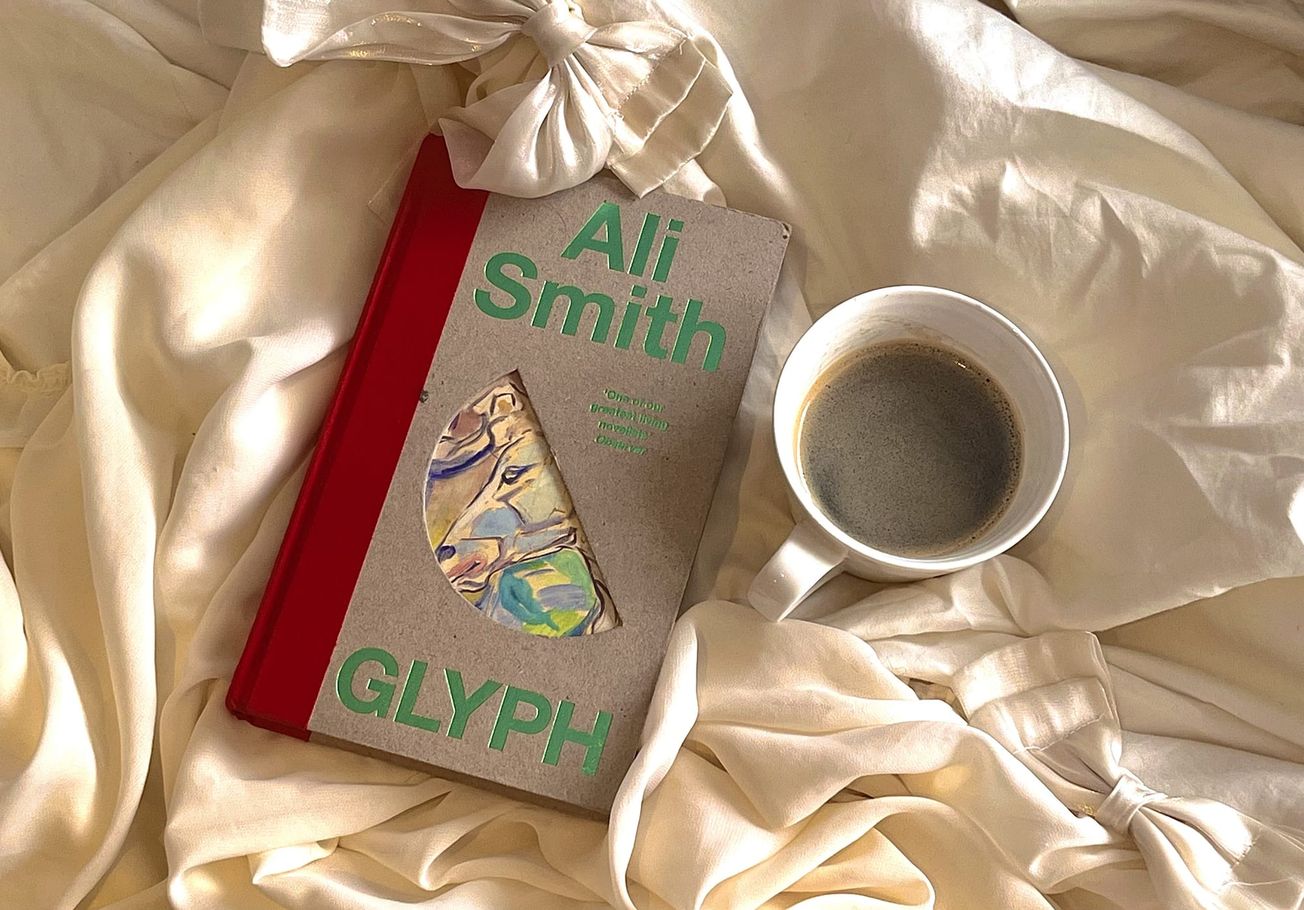
A World War Two soldier completely flattened into the road, resurrected as a young girl’s imaginary friend. The apparition of a sightless horse ransacking a London flat. Two sisters chatting effortlessly after years of estrangement. While it might not be the typical ghost story expected from our Halloween edition, I can guarantee Ali Smith’s latest novel will haunt you for much longer – because its phantoms are entirely real.
Glyph (2026) tells the story of two sisters, Petra and Patricia (‘Patch’) Wild, who are reunited when the threads of stories told to them in their childhood begin unraveling into their adult lives, dissolving their alienation but fraying the boundaries of reality. The novel follows Smith’s homophonically titled Gliff (2025). Although it acts loosely as a prequal to that International Dublin Literary Award-winning, genre-bending dystopia, Smith describes Glyph as a ‘companion’ novel. Neither requires the other as prerequisite reading; though, in my experience, finishing one will have you ordering the other immediately.
Images exist in constant conversation with each other and every idea bleeds into the next, so that by the end of the novel she has carved an entire symbiotic ecosystem out of puns and double entendre.
At its core, Glyph asks what a story is and where it comes from. Are stories not like ghosts – lingering visions woven out of the shadows of the lives we live and all the little details we collect? And where truly is the line between fiction and actuality when the ringing in the ear of a man with tinnitus is louder to him than the tangible radio he plays to try and drown it out?
As one of the most garlanded authors of the last two decades, winner of the Women’s Prize for Fiction (2015), the Goldsmiths Prize (2014), and a four-time Booker Prize finalist to name a few, it is hardly surprising that with this work she has produced another triumph. Her writing is visceral and rich. Images exist in constant conversation with each other and every idea bleeds into the next, so that by the end of the novel she has carved an entire symbiotic ecosystem out of puns and double entendre.
The story is so effectively thought-provoking because, despite its clear candor and blunt politicisation, its core ideas are not delivered to you fully formed. They are built up gradually, disguised by Smith’s playful linguistic command, so that when they eventually emerge, it is as though Smith has reached into your soul and sculpted something inside you.
Moments of striking figurative language, kept as mental souvenirs of poetic craft, return with a somber thud as their thematic resonance slots into place a few chapters later: the journey between two raised orange banks, like travelling between the parting in a large scalp. War after war, treading bodies into the ground.
The story is so effectively thought-provoking because, despite its clear candor and blunt politicisation, its core ideas are not delivered to you fully formed. They are built up gradually, disguised by Smith’s playful linguistic command, so that when they eventually emerge, it is as though Smith has reached into your soul and sculpted something inside you. She tells you something so true that it has been there all along.
Smith presents story as an enduring antidote for reality.
Here, Smith is doing what she does best: yoking past and present with an even more timeless sweep than her most acclaimed novel, How To Be Both (2014), which features the ergodic and aleatory perspectives of a real-life 15th-century Italian Renaissance fresco painter and a fictional teenage girl around 2013 (a must-read if you haven’t already).
Rather than the immediately visible dual narrative, Glyph demonstrates the constancy of the human condition by weaving a tapestry of stories. The novel is an osmosis of legend, myth, and folklore. According to Smith, its three largest influences were The Magic Skin by Honoré de Balzac (1831), A Book of Nonsense by Edward Lear (1846), and Strider: The Story of a Horse by Leo Tolstoy (1886). By jostling this historical pastiche with the markedly modern and striking descriptions of news coverage of the genocide in Palestine, the effects of AI, and the proscription of protest groups as terrorist organisations, Smith presents story as an enduring antidote for reality. The modern anti-war novel, she argues on a recent episode of the BBC podcast Take Four Books , must ‘suggest to us […] that those old stories that have been ghosting us for this whole century are up against it again. That the responsibilities we have to each other are back, stark as anything, exactly the same, and yet they are not ghosts they are real.’
Without giving away too many spoilers, if I had one criticism of the novel it would be the characterization of Billie (Patricia’s 16-year-old daughter). Although her character initially struck me as deeply familiar – her steadfast conviction, sardonic wit, and gadfly skepticism feel entirely true to our generation, driven to cynicism and dry humor out a need to distance ourselves from the mess created by our predecessors – I found myself thrown out of the novel’s grip when she pronounced her sweeping and seemingly unthinking enthusiasm for AI. Though Smith could very well be attempting to comment on the ethical minefield young people find themselves in, this inclusion struck me as incongruous with Billie’s character. Instead, it feels implemented to demonstrate inter-generational tensions in a way that doesn’t carry the same weight as the rest of the story. Ultimately, her opinions on AI make Billie appear more like an amalgamation of political takes Smith wished to comment on than an authentic teenage girl trying to find her footing through shouts and ranted texts about her worldly anxieties.
That being said, this is just one of the numerous current and ancient topics the novel traverses, and it would hardly be the risk-taking, provocative, and playful work that it is without at least one choice that I disagreed with.
 Rosy Brown
Glyph is a confronting, tender, and remarkably human novel. While it might not be full of the gloomy atmosphere and sense foreboding that make Frankenstein and Dracula perfect stories to read in the light of a pumpkin-spiced candle, the terror it provokes is not fictional. It is a forced look in the mirror. And that feels far more important.
For the chance to be included in next month's Book club article, submit your own short review of Glyph, or any of our previous reads, through https://forms.gle/z5dkj2H9oNURevhT6 !
Featured Image: Epigram / Rosy Brown
Have you read any Ali Smith before?