
By Lianne Ponferrada, Comment Subeditor
Fondly reminiscing about my first encounter with the classical world, I recall a posse of queer and clever misfits translating our first sentence, ‘Caecilius est pater.’ We shyly pointed at each other to remember our verb endings (‘I, You sg., He/she/it, We,You pl., They; -o, -s, -t, -mus, -tis, -nt), and were determined to triumph over the privately educated Latinists.
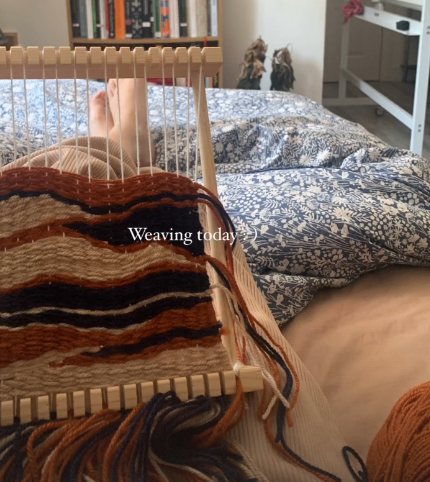
The classical world superseded my academic one, becoming a supremely personal matter. As an agoraphobic adolescent, I lived vicariously through Odysseus’ travels and revered Penelope as a personal ‘Virgin Mary’ figure, so much so, I began to weave. Trapped by anxiety, as Penelope was trapped by droves of Suitors, I too sought temporary escape through weaving.
Yet, between the manosphere pushing falsified narratives about Plato to perpetuate toxic masculinity, Elon Musk’s obsession with Rome, and right-wing influencers using their sub-par knowledge on Achilles to unleash their transphobia, I fear that someone else’s introduction to the classics wouldn’t be as warm as mine.

This conservative approach, one that imparts the message that the classics are for the wealthy, white, cisgender, and heterosexual is not limited to the internet, but is prominent across our contemporary political landscape and are examples of how the legacy of our field’s exclusive history attempts to prevail in the face of Emily Wilson’s “feminist” translations, Sarah Derbew’s work on race in the Ancient world, and initiatives to bring the classics to working class individuals.
When I was preparing for the CLAT (Oxford’s Classical Language’s Aptitude Test), I read An English Grammar for Classical Schools (1848) by Thomas Arnold. If I told you that a book exploring the dullest aspects of the English language were for budding patriarchs, how surprised would you be? (Honestly, I don’t think any of us would be particularly shocked). Arnold’s introduction begins:
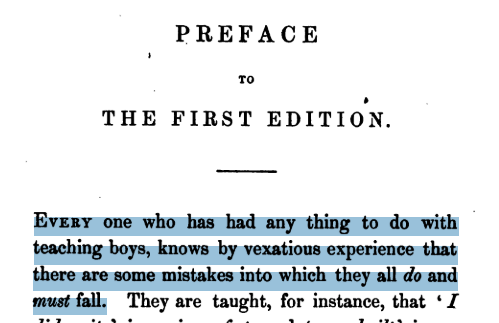
I suppose syntax was just too much for our ‘underdeveloped female brains’. Misogyny seeps into even the most ‘objective’ of texts, illustrating the ideal and/or most common classics student as male.
Other instances where the classics were involved in major cultural and political misdemeanours include Muthel’s production of Aeschylus’ Oresteia, which was sponsored by the Nazi government, a fascist Italy parading around Virgil’s Aeneid, and the memory of Rome inspiring many a European empire. Moreover, the subject holds questionable alumni, such as former Prime Minister, Boris Johnson, who was involved with the infamous Bullingdon Club whilst he studied literae humaniores at Oxford.
At the 2021 Capitol raids, American Republicans paraded classical-themed banners. Mary Beard would soon express concerns about how the alt-right use Greco-Roman imagery:
A lot of professional classicists, particularly younger ones, feel ashamed to some extent, as I also do, of the uses to which the classical past has been put.
Though I’m far from professional, I still feel called to write this plea to keep the conservatives away from the classics in hopes of not only restoring our field’s image, but as a reminder that the Ancient world is too varied to serve a singular political cause.
Narratives, images, and arguments hold endless nuance that short-form content fails to capture, exemplifying the importance of consuming media critically and honing our research skills (which a classical education facilitates). This sentiment is not limited to Nazi-funded plays or signs held at unsavoury riots, but also manifests more subtly in the forms of internet discourse and even memes.
After completing an Ancient Greek exercise or two, I’d reward myself with a cheeky doomscroll, where I found myself chuckling at memes (or, let's face it, borderline Dad jokes) from @thefunnymaenad’s Instagram page. Here are my personal favourites:
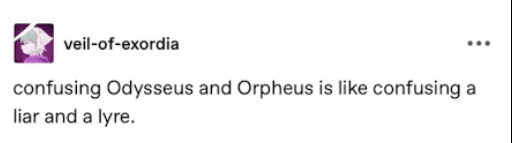
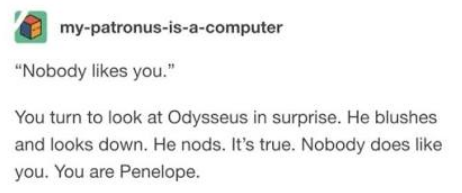
These jokes’ hilarity lay in their truth. Indeed, Odysseus was a spectacular liar, who once went by the name Nobody, and liked Penelope enough to build a bed, embedded into the roots of an olive tree, representing their eternal and unmoving love. Indeed, the lyre is now synonymous with Orpheus and his myth. Though Odysseus is much Orpheus, as much as a liar is a lyre, there are major similarities in their character. They’re widely recognised as devoted, artistic, and passionate characters, which makes the comparison worth making. The truth courses through every aspect of this joke, even in less suspecting ways, which it makes all the more convincing.
Unfortunately, this can’t be said for all Hellenic-inspired memes.
Another popular meme claimed Plato would flaunt his athletic figure in order to silence his opponents amidst debates, suggesting that physical prowess supersedes intellect. It often resurfaces and is lauded in ‘manosphere’ social media spaces. One edition of the meme is as followed:
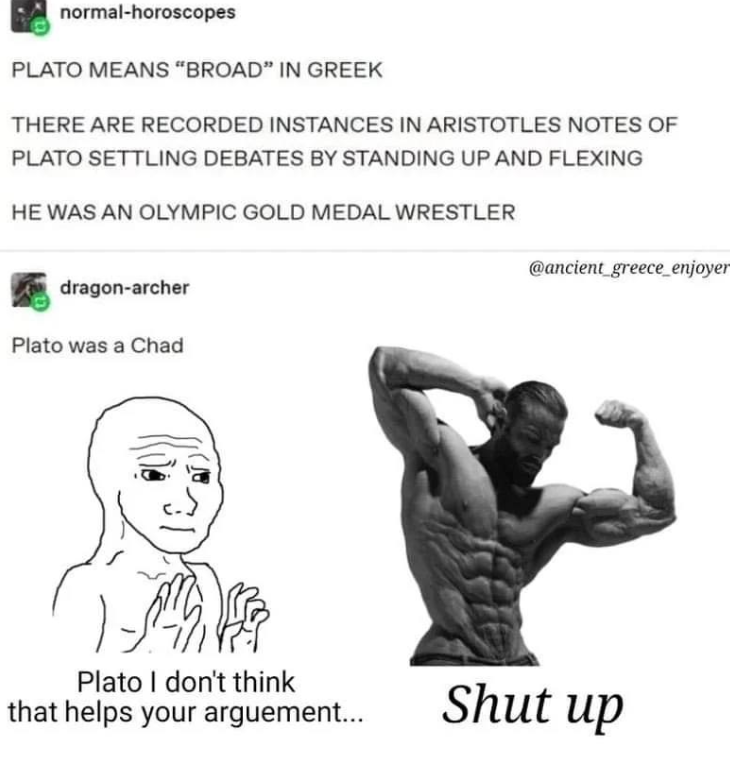
There is a lot to unpack with this image.
Firstly, we’ll address the obvious; there are language and symbols associated with incel culture. These could be ironic, yet the caption’s excitement alongside mentions of ‘Aristotle’s notes’ signify the user’s belief that this meme isn’t a mockery of disinformation, anti-intellectualism, or hypermasculinity, but a comedic and simplified means of sharing a perceived truth. The satire is unclear, transforming the meme into exactly what it could mock.
Throughout the 2010s, the term ‘Chad’ rose to popularity within incel forums to refer to classically handsome and sexually successful men, and was often found on ‘Virgin versus Chad’ memes on 4chan boards.
Whilst the ‘Virgin versus Chad’ meme mocked ‘chads’ and the aforementioned meme uses it as a means of praise, it depicts a similar binary. This dichotomy is made apparent through the images of contrasting depictions of masculinity.
On the left, is a nervous ‘wojak’ who is typically used as the immature or unenlightened figure in memes. In Polish, ‘wojak’ more or less translates to ‘warrior’, whilst the -k suffix may indicate childishness or physical smallness. It is starkly contrasted with a picture of a muscular male model, who would later be known as ‘GigaChad’ after featuring in a 2016 internet meme, who became representative of ‘the ultimate alpha who can never be wrong’ alluding that confidence trumps accuracy.
Without addressing the anecdote, an inherently conservative approach to masculinity is idealised. It is then the narrative that confirms and validates these ideals. Now, instead of @foiddestroyer420 perpetuating toxic masculinity, it’s Plato.
Except, the chances that this happened are highly unlikely…
Aristotle never portrayed Plato in such a way. He revered Plato as a teacher and, eventually, as a philosopher with contrasting views. In his own work, Plato is hardly present with Socrates as the protagonist. Plato’s Seventh Letter, his autobiographical epistle, never mentions this. In fact, this letter advocates for the opposite, writing about the importance of philosophy, hard-work, and learning for a good life:
‘One should show such men what philosophy is in all its extent; what their range of studies is by which it is approached, and how much labour it involves…
‘… whatever his occupation may be, but throughout it all ever cleaving to philosophy’
Despite philosophers’ and historians’ affinity for an amusing anecdote, Plato ending an argument by flexing his muscles, isn’t present across the various biographies and doxographies about him. Moreover, once Plato met Socrates, becoming his most fervent follower, he departed from his former life of politics, wrestling, poetry, and pottery to dedicate himself solely to philosophy.
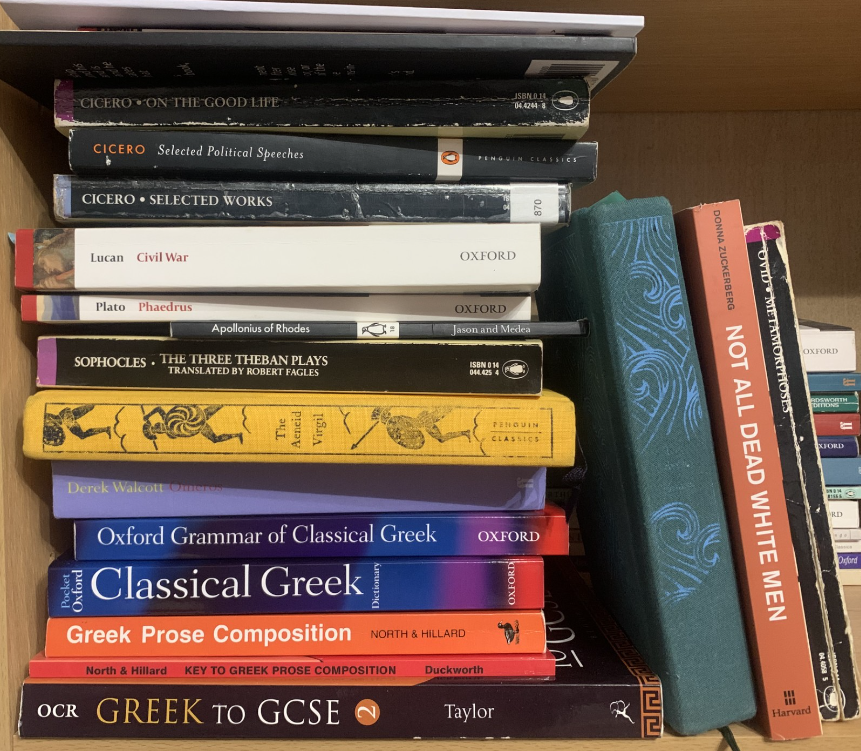
So, where would such a rumour come from?
There are several plausible anecdotes that have been messily stitched together to result in a behemoth Frankenstein’s creature of a lie, when there needn’t be! Whilst I wrote this, my research was guided by free online editions of each text.
Diogenes Laërtius, a prominent biographer of philosophers, noted that Plato’s birth name was Aristocles but was granted the nickname, meaning ‘broad’ on account of his robust figure. He also recorded the alternative origins for this moniker such as his ‘broad forehead’ or the breadth of his argumentative style.
He recorded that Plato did enter wrestling competitions, but cites Dicaearchus, Plato’s contemporary, whose works have not survived. There are some later but equally precarious sources from anonymous authors and Servius the Grammarian claiming he won these games, including the Olympics.
Regardless of whatever boxing experience he had, it shaped the way he approached philosophy. He often likened proper and upright boxing technique to good arguments, and poor arguments to lower forms of wrestling, such as pankration which were done on the ground. This is well put by Corcoran:
‘... proper philosophic argument, like proper wrestling, is concerned primarily with the correct practice and form of the art, with correctly developing an idea.’
The evidence suggests that, perhaps, Plato wouldn’t be thrilled with this mischaracterisation. Who would have known that a renowned philosopher would prioritise brains over brawn?
This unfortunate Plato meme is one of many instances where classical narratives are warped, decontextualised, or even fabricated to perpetuate an unsavoury agenda.
Another instance includes the outrage and thinly-veiled transphobia that some men expressed over rumours concerning Elliot Page’s role in Nolan’s Odyssey. Right-wing men, who were unlikely to have read the Iliad or Odyssey based on their subpar takes, argued that Achilles was ‘the peak of masculinity’ thus the transgender actor would be unfit for the role.
In the Odyssey, Achilles is a regretful soul. He laments over his decision to die so soon for kleos, an aspect of Ancient Greek masculinity that now feels futile to him.
‘I would rather work the soil as a serf on hire to some landless impoverished peasant than be King of all these lifeless dead.’
Regardless, he still drawls about his military triumphs and martial hopes for his sons who are still alive.
‘Come, give me news of that fine son of mine. Did he follow me to the war to play a leading part or not?’
‘For I am not up there in the sunlight to protect him as I once protected the Argives and laid the champions of the enemy low on the broad plains of Troy. If I could return for a single moment to my father’s house as I then was I would make those who forcibly rob him of his position of honour cringe before the might of my unconquerable hands.’
I’m left thinking that the Odyssean Achilles is rather pathetic in the same way someone who peaks in high school is. He’s eager for his sons to succeed in the same way, despite his own suffering.

Even in the Iliad, I wouldn’t consider Achilles as ‘peak masculinity’ (or at least, in the ways netizens do) as he spent several battles refusing to fight after Agamemnon confiscated his sex-slave, Briseis.
In doing so, Achilles demonstrated how necessary he was to the Greek army, allowing several of his own comrades to die on his behalf to prove how much he deserved Briseis. Here, he mimics the behaviour of a large and petulant child, not the virile hero right-wingers seem to think he is.
In fact, the classicist Mellsop argues that the Odyssey warns against excessively ‘masculine’ behaviour:
‘...restraint is a uniquely masculine struggle…’
‘... the prideful suitors, [who] are perhaps the most well-known example of unrestrained, brazen behaviour in the Odyssey. Consequently, they are punished for their arrogance upon Odysseus’ return.’
Though the quotation refers to the Suitors in the Odyssey, I’m sure we can see how this applies to Achilles. Regardless, it was revealed that Elliot Page would play Sinon, the boy who convinced the Trojans to let the Greek’s horse in.
The Greeks aren’t the only culture that the conservative are eager to adopt. My A-Level Classical Civilisations class studied Julius Caesar’s journey to dictatorship with dread as we noticed more and more parallels between him and the wannabe ‘all-American’ dictator, Donald Trump, whilst Elon Musk and everyone’s boyfriends claimed to think about the Roman Empire ‘daily’.
Whilst swathes of men are ‘obsessed’ with the Roman Empire, very few study Latin. I don’t mean this to be elitist. A true classical education, where someone studies Latin and Ancient Greek language, has been and continues to be exclusive. I’m sure many learn about Rome through the many podcasts historians narrate in an effort to make their subject more accessible.
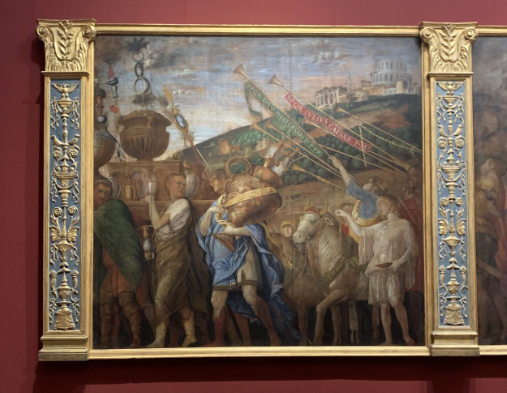
It’s bizarre that so many men claim to think about the Roman Empire to such an extent it has become stereotypically masculine to do so, whilst their tendency to vote for parties that do not advocate against redundancies made within humanities faculties and ones that want to minimise undergraduate numbers has increased.
Considering that universities are so many students’ introduction to a true classical education, so many would be deprived of such a fulfilling and intellectually-stimulating opportunity through these initiatives.
On the one hand, I’m not surprised that our increasingly conservative male population glorifies Rome’s Imperial period, particularly that of Augustus’ reign as it was an era of militarisation, Stoic thought permeated Roman culture, and Augustus’ morality laws pushed ‘traditional family values’.
But, the more I consider this, the more baffled I am.
I’m sure we’re all familiar with the traditional family image of a vehement womaniser and daughter-exiler. That’s the Augustus our ancient historians know and love!

It seems that indulgent behaviour ran in the family, as Suetonius would later write about Julius Caesar’s (who adopted Augustus in 44 BC) homoerotic tendencies:
‘By Caesar, Gaul was conquered, Caesar by Nicomedes.’
Yet, these aren’t the tales I’ve seen anyone fawn over.
 Emma Coleman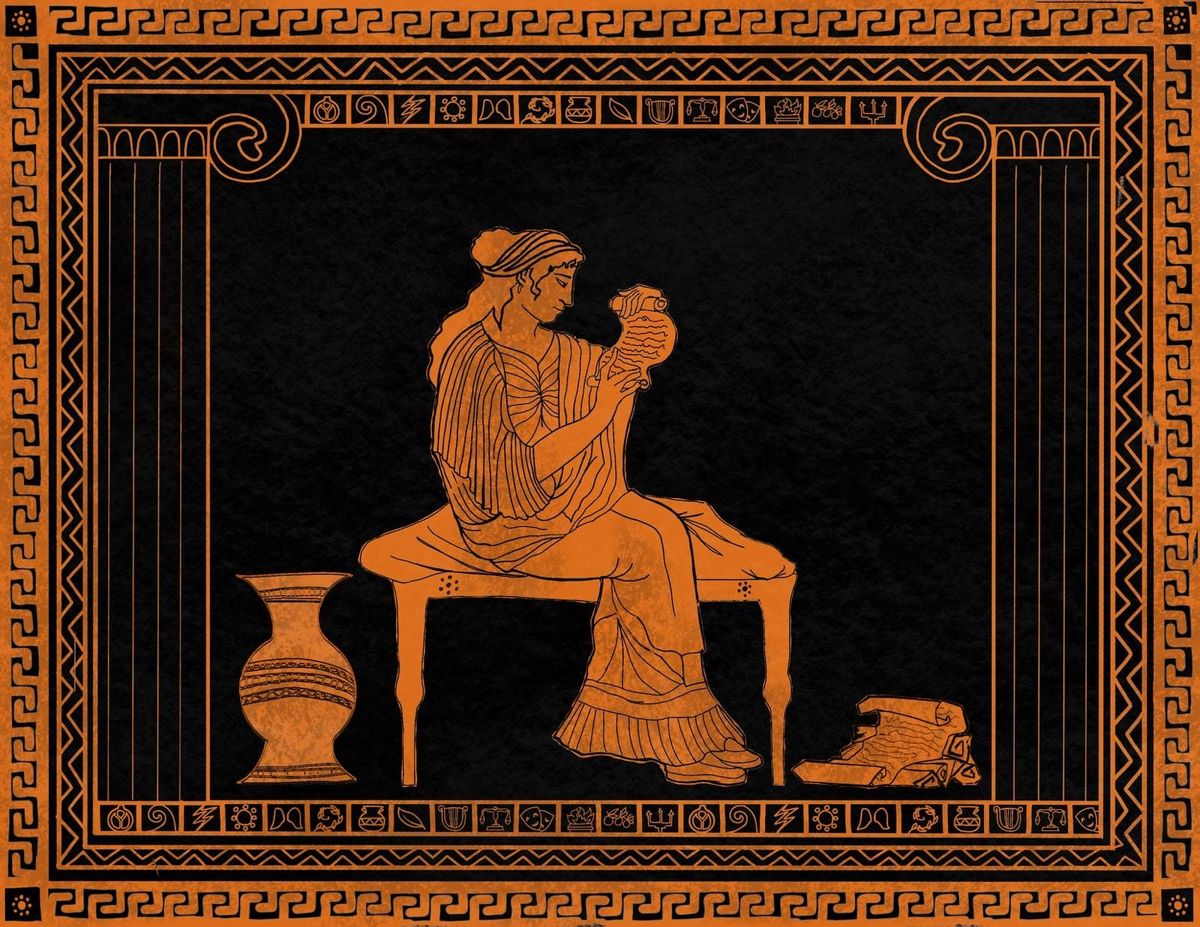
This is where the importance of studying Classical Studies, Classics, or any humanities degree lies. During an Approaches to Poetry lecture, Dr Noreen Masud once said that committing ourselves to studying English Literature would make us, to some degree, immune to propaganda.
It is crucial to engage with media, whether it be silly internet jests or the news, with an extra critical lens (yes, it is indeed ‘that deep’). We must allow our subject knowledge to guide us outside of our seminars and essays. To the Classical Studies/Classics students, perhaps this is our sign to study the Legacy unit in order to explore how our subject is received and by who.
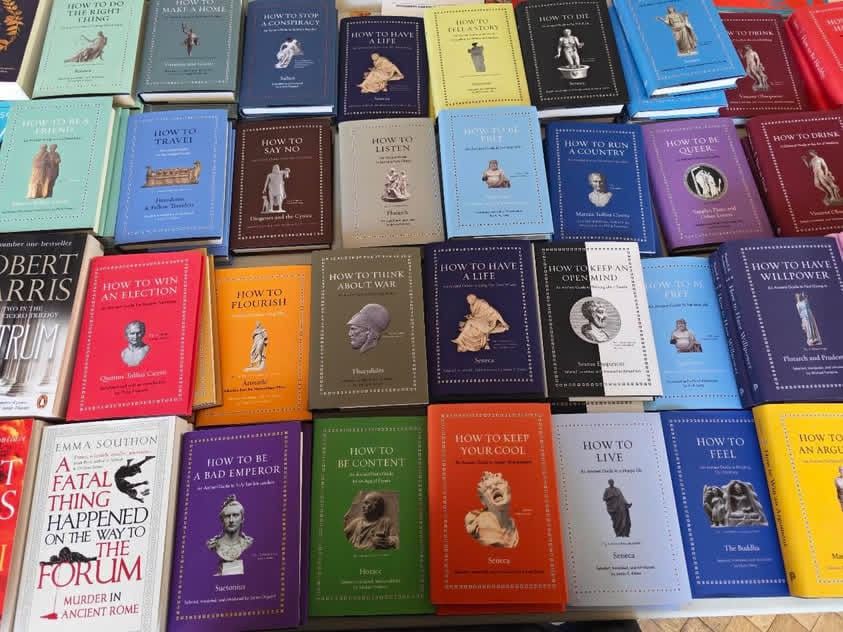
Featured Image: 'The Hellenic Book Service's contemporary selection' | Epigram / Lilly Shi
Has this article changed how you will engage with classical imagery?