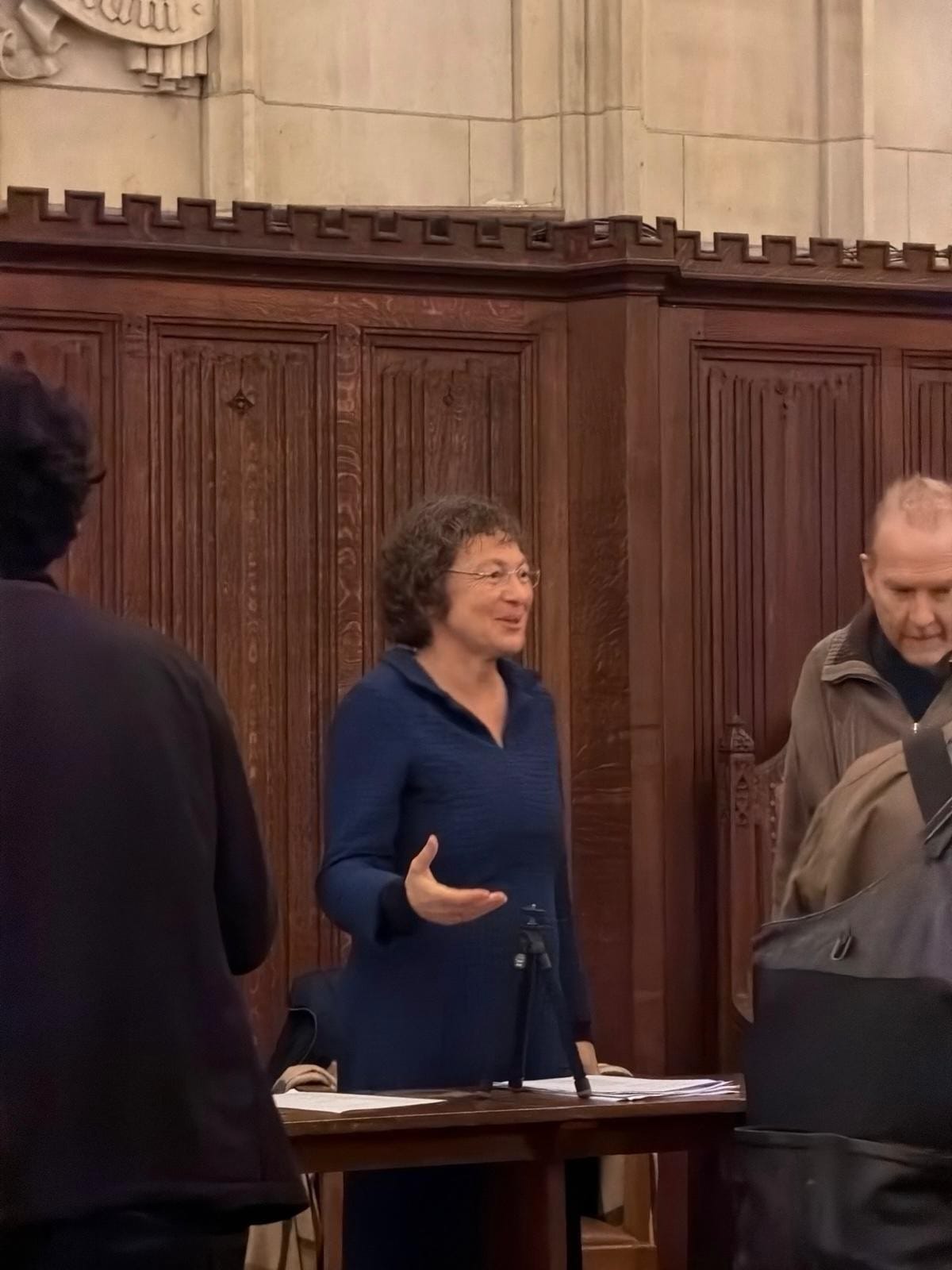
During a visit to Bristol to discuss her latest anthology of antiwar poetry Solastalgia, I attended a poetry workshop and a reading with Julia Nemirovskaya. Julia is a Moscow born poet, philologist and editor of three anti-war poetry anthologies dealing with responses to Russia’s full-scale invasion of Ukraine. She provided an eye-opening perspective on the vital role that art can play at times of suffering particularly in the unique Russophone context.
By Tessa Holmes, fourth year French and Russian
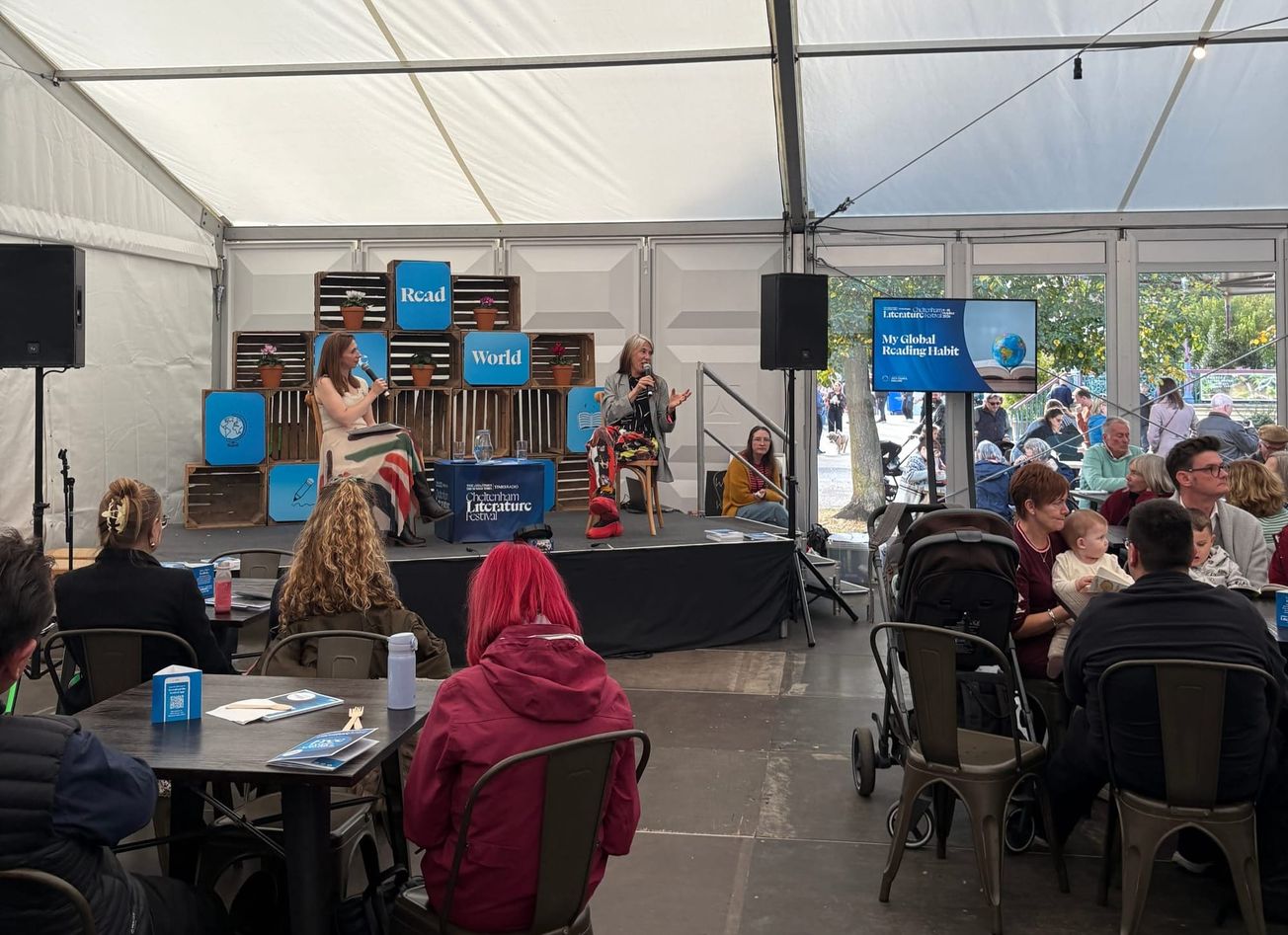
On meeting Julia her body language suggests she was destined to be a poet. Watching her facial features, they seem to move as though feeling for words of inspiration, like hands anticipating obstacles in the dark. This additional poetic sense perhaps links to her superstitious beliefs which we discuss in passing. A poet and a scholar, she visits Bristol from the University of Oregon where she is a professor, to give talks on the three anthologies of anti-war poetry that she has helped to create. Three events, including a reading alongside the translator Robert Chandler, gave the opportunity for Julia to immerse us in the politically and emotionally raw world of antiwar poetry. Alongside a group of volunteer translators located in America, Canada, Germany, France and the UK, under the Kopilka (coin bank) project, they have published two bilingual editions - Dislocation and Disbelief, with the third Solastalgia pending publication.
'To refuse to write in Russian empowers the oppressor, to write in another language excludes the individuals your poetry is reaching for, to refuse to write is to remain silent'
Julia’s writing prior to her works of antiwar poetry focused on minute details to explore wider themes, from pencils to toilet rolls. When asked about her inspiration, she explained these mundane objects struck a chord of guilt in her for not having taken notice of them. In the context of antiwar this expands to what she calls ‘tribal guilt’ which is just one of the connecting themes. For Julia this version of poetic inspiration instructed her to reach further into the poetic community, offering to take on the role of guardian for any works that may be threatened. Kopilka can be considered a protective safehouse for the library of protest poetry that is being licked at by flames.
In Russian culture the poetic tradition is deeply rooted. Catherine the Great wrote plays concealing her opinions safely by claiming that they were entertainment for her grandchildren. Akhmatova, considered one of the greatest Russian poets, continued to write from her native Russia under hardships of the Russian revolution and the Russian Civil War. The Russian language stands out as a painful motif across the anthologies, and considered to have a standalone character of poetic flair in its ability to write the soul. Considering these two factors of tradition and language – amongst others - Julia has devised the term ‘Redemptive Aesthetics’ to categorise the genre, whereby imperialistic themes and poetic devices are torn apart and reconstructed by the wounded poets.
The genre attempts to reconcile the tension which stretches from the front to the back cover of each anthology; each voice carries the anxiety of not wanting to appropriate suffering nor grief yet admitting only to themselves that this is their new reality. ‘Redemptive aesthetics’ is a way to express this paradox of painful emotions. For many poets they no longer live in Russia or Ukraine, a fact that unearths complex feelings of betrayal, mixed with the internal confession that in fleeing home there is also pain. Both facts are intersected by the knowledge that only outside of their homelands is it remotely possible to use poetry as protest. More simply, to carry on with their jobs.
The cultural depth that poetry holds in Russian culture is not exclusive to opposition movements. Since 2022 the Latin letter ‘Z’ has become associated with the pro-kremlin nationalist regime, alongside which the genre of government ‘Z’ poetry has proliferated.
The rise of this propaganda is just one reason why the Russian language has become so controversial and painful. For many born in the Eastern region of Ukraine, Russian would be their mother tongue, and for those who have left Russia it remains their language. Language is a founding principle of Putin’s justification for the war that accompanies the ‘Russian world’ dogma. This weaponisation of language by the Kremlin extends from the marginalisation of the Ukrainian language to this ‘literary’ ‘Z movement’, casting antiwar Russophone poets into an impossible dilemma. To refuse to write in Russian empowers the oppressor, to write in another language excludes the individuals your poetry is reaching for, to refuse to write is to remain silent.
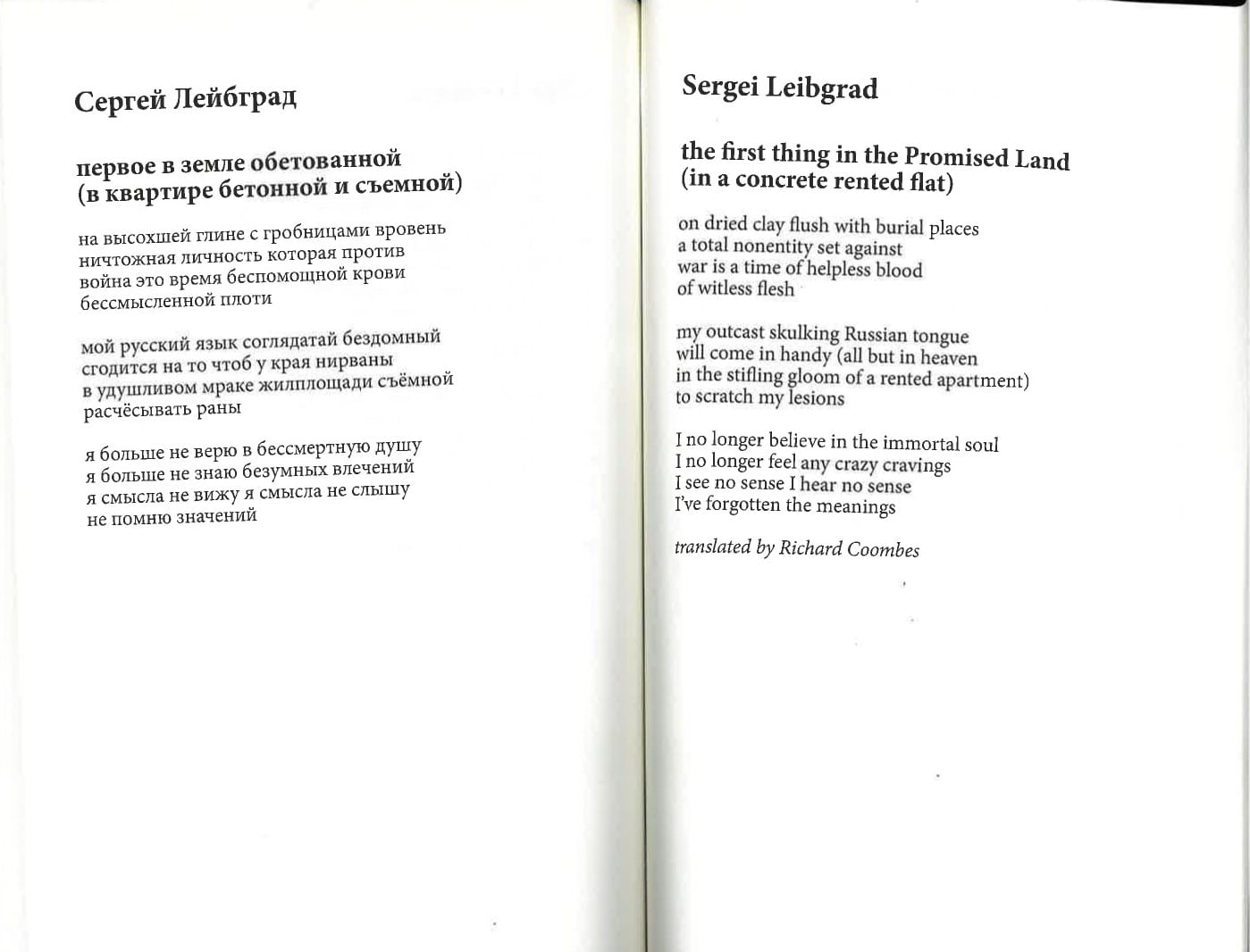
In response, techniques intended to go against the literary style often associated with Russian poetry connect the poems in these anthologies. Many of the poets featured in the anthology refuse traditional styles such as omitting punctuation. The discomfort of language presents also as a theme, in one poem by Sergei Leibgrad he addresses the turmoil of the poet’s prophetic tongue being replaced by a ‘skulking Russian tongue’. In his poem the poets are left without the imperialist signs of religion and are abandoned by the angels.
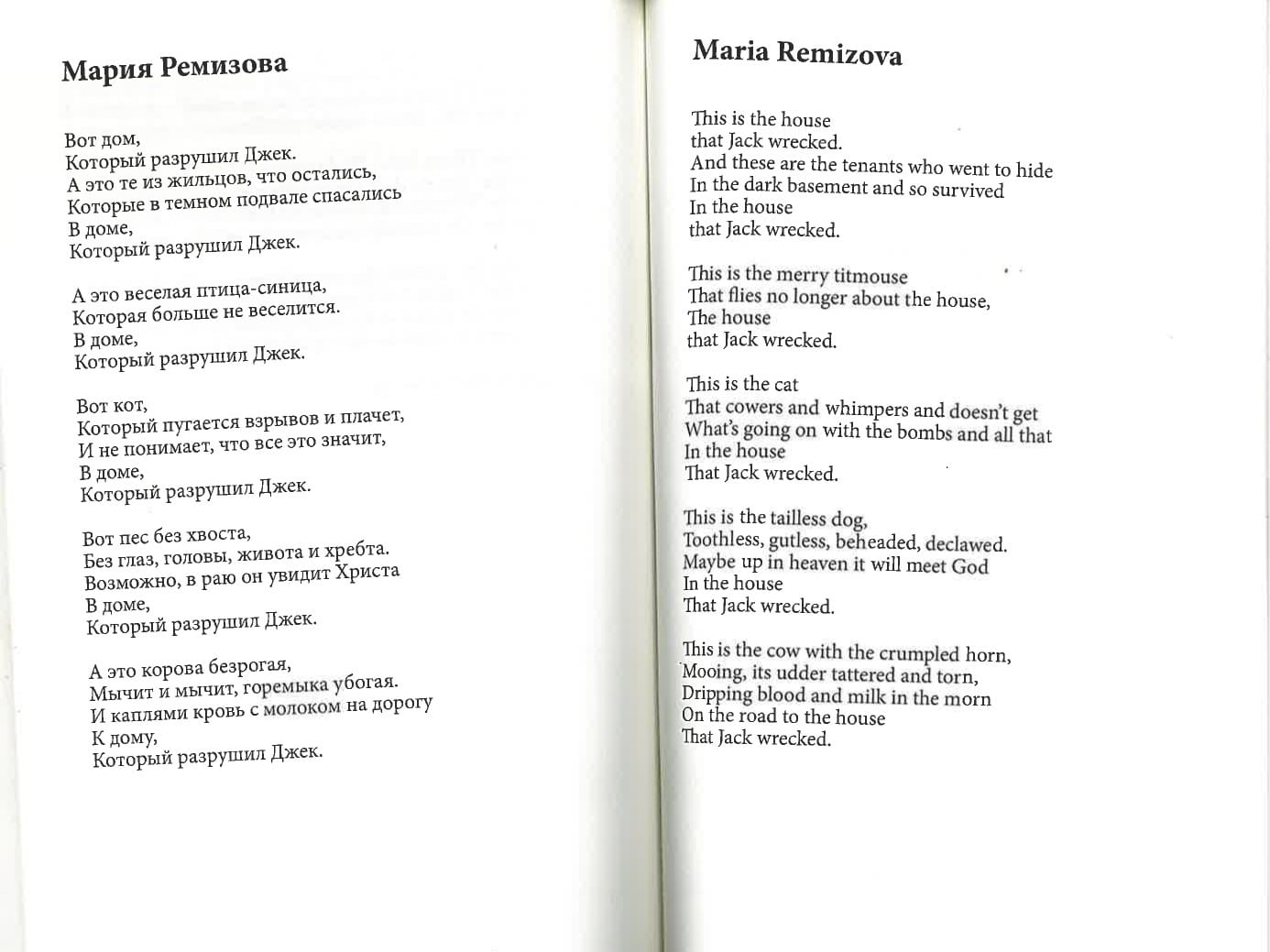
In the seminar we had the opportunity to listen to Julia discuss the antiwar poetry movement and heard her read from the anthology. Before reading, she tells us of one author who recently sent a picture looking back at the house in Russia that she is forced to leave, a feeling that although distant (Julia is a fourth wave migrant having left in the 1980s) is obviously raw for Julia. A complex web of emotions stitched into the idea of home, safety and leaving hangs heavy in the room. Speaking in poetic inference she tells us how on reading ‘This is the House that Jack Wrecked’ by Maria Remizova, the poem always left her crying while editing. The final couplet ‘She clings to the steps in an odd embrace, / A meat fly crawling across her face.’ ends the adaptation of this children’s story. This demonstrates another disruptive technique whereby Russophone poets have upturned the imperialist tradition of intertextuality by appropriating traditional tales. The effect both amplifies the imagery of suffering while avoiding its appropriation.
 Alex Boersma
The outpouring of creative responses to the full-scale invasion has been unprecedented and is an essential collection of works for the often inexplicable themes that flow across the Russian and Ukrainian diaspora in solidarity with those whose lives have been torn apart. For anyone wishing to gain an insight into the Kremlin’s motivations and justifications of the war - as well as the profound effects that have stormed across Ukraine, Russia, the former USSR and the diaspora as a whole - there is no more complete, seizing and accessible source of information than the anthologies Disbelief and Dislocation.
Feature Image: Unsplash/ Max Kukurudziak
Have you read any of Julia's work?