By Charles Hubbard, Second Year Theatre and Performance Studies
Paced like a speeding bullet and made with style to spare, Lucy Marshall’s exceptionally brash and impressively labyrinthine play is perhaps most interesting when viewed as a violently satirical and gleefully subversive skewering of late-stage capitalism and the ghoulish centrist commodification of queer culture.
It’s very rare that you get to experience a text as dense and fascinating as Lotus Lady, especially when it’s being presented to the world for the very first time. Arriving with the swagger and well-justified arrogance of a major canonical work, though perhaps one that is going to take a while to be fully acknowledged as such, Lucy Marshall’s genuinely exceptional return to the directing chair is a work of genius. With two month’s distance from when it was performed, the depth and skill that Marshall was operating at is starting to come into view for me. I believe that Lotus Lady uses the aesthetics of many student-written shows like a human skinsuit to thinly obscure a deeply caustic and rage-filled satire on late-stage capitalism and the war it constantly rages against the queer community and its supposed “allies”. Let me make something clear at the outset here - this assertion, like everything else I will say in this review is my own personal opinion (I know audience takes on this show have varied wildly and it’s a testament to Marshall’s skill as a writer that her text allows for so many different interpretations). To look at Lotus Lady and only see a heartwarming success story of an up-and-coming drag king would be tantamount to looking at Little Red Riding Hood’s grandmother without not noticing her sharp teeth. A wolf in sheep’s clothing indeed - and one that smartly seeks to dazzle its audience with sparkles and sequins before going in for the kill. Again - just my personal interpretation. Feel free to disagree!

I don’t know if I can explain the plot of Lotus Lady without the use of a flow-chart and a phonebook-length list of ‘dramatis personae’ but I’ll give it my best shot - a web of characters planned with this level of flair and intricacy deserves that much effort at least. There’s the titular Lotus Lady (Lily Robinson on typically electric form) - a burgeoning drag king looking to break big on the Soho scene. There’s her closest friend Isla (a disarmingly muted Connie James), a Glaswegian chippy owner besotted with glamorous Parisian belle Meg (an entirely bewitching Isha Yeadon). There’s her dancer friend Kat (an astonishingly lively Hattie Parkinson), who’s sick of giving ballet lessons and just wants a chance to get in front of a legitimate choreographer - or so she thinks. There’s talented but prickly photographer Omar (Pearl Opoku, who takes a brilliantly disruptive approach to their character as written), who gets a lucrative job photographing friendly but mysterious Maeva (a beautifully subtle and heartfelt Amber Russell). And finally, there’s Leanne (a thoroughly charming Cleo French), pseudo-matriarch to the group and literal matriarch to boisterous quasi-teenager Leon (a compellingly off-the-wall Bea Starr). If that seems like a lot to keep track of, fasten your seatbelts - we’re just getting started. What’s important here isn’t the complicated mechanics of the plot but rather the suffocating force that boxes them all in - late-stage capitalism.
That’s right! I’m afraid every champagne socialist’s favourite bogeyman is alive and well in the central characters’ hurriedly constructed bohemian dystopia that falls apart with clanging severity the minute someone dares to mention the torrent of filthy money that its inhabitants are trying so hard to ignore. The characters in the play have assembled such a densely woven safety net of intense irony and persona (a byproduct of the digital age’s demands that everyone “build their own brand”) that the slightest tinge of genuine sincerity is immediately treated like an untreatable medical condition - or a capital offence. When Isla admits to catching feelings for Meg after just one date, her friends look at her like she’s sprouted a second head. As such, all the characters emerge as intentionally rendered ciphers, especially Lotus herself, who we never see when she’s not either onstage or blackout drunk, making her a vaguely queer version of Sally Bowles (so I guess just … Sally Bowles). When we do get firsthand details from her backstory, like her first date with sleazy club owner Sid (a fantastically menacing Charlie Warwick), they’re delivered with such a level of faux-genuity to feel like an even greater fabrication than her onstage persona - whose first name is notably the same as her own.
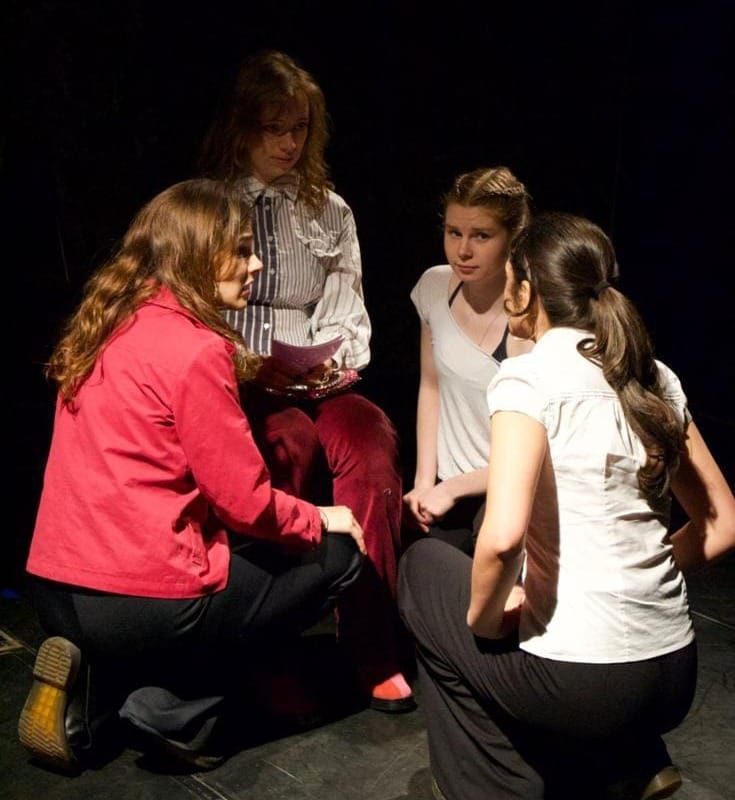
Of course, Lily Robinson’s tremendously magnetic, sumptuously layered and intensely challenging performance is absolutely indispensable here in developing her character’s inscrutability. She is at once transfixing to watch and never lets the audience get close enough to see her true nature. While the entire main cast are all knockouts, the two that shine the brightest, aside from Robinson, are Isha Yeadon and Charlie Warwick. Yeadon already has perhaps the most enticing character of the entire cast, making an enormously outsize impact from her fairly limited time onstage. She leads perhaps the best scene in the entire play - the triple date - with simply effortless verve and gravitas. This sequence sees three flirtatious, romantic encounters between six of our main characters happening simultaneously but in different venues, excellently staged and soundtracked to Billie Holiday’s “Easy Living”, which plays on a loop, forming a cyclical, trancelike pulse. It is the exquisitely crafted skeleton key that deftly unlocks the complicated ideology of the entire piece and it is the scene when, when I watched the play, I first realised that Marshall (and co-director Esme Fleeman) had made something really special - a truly rare feat in the hustle-and-grind culture of student theatre. Warwick has an incredibly refined skill for conveying quiet, veiled danger that is expertly deployed here. We are constantly told that his character is a sleazy, manipulative scumbag and, while Warwick certainly never tries to play him like a saint, he has enough easy charm to invite the audience to just about question whether his reputation still stands. It’s an incredibly well-judged performance - a degree to the left or to the right would destroy the entire concept of the character. I must also give a shoutout to Ruari Tilley, whose steady-hand presence is the perfect palette cleanser to all the chaos happening around him.
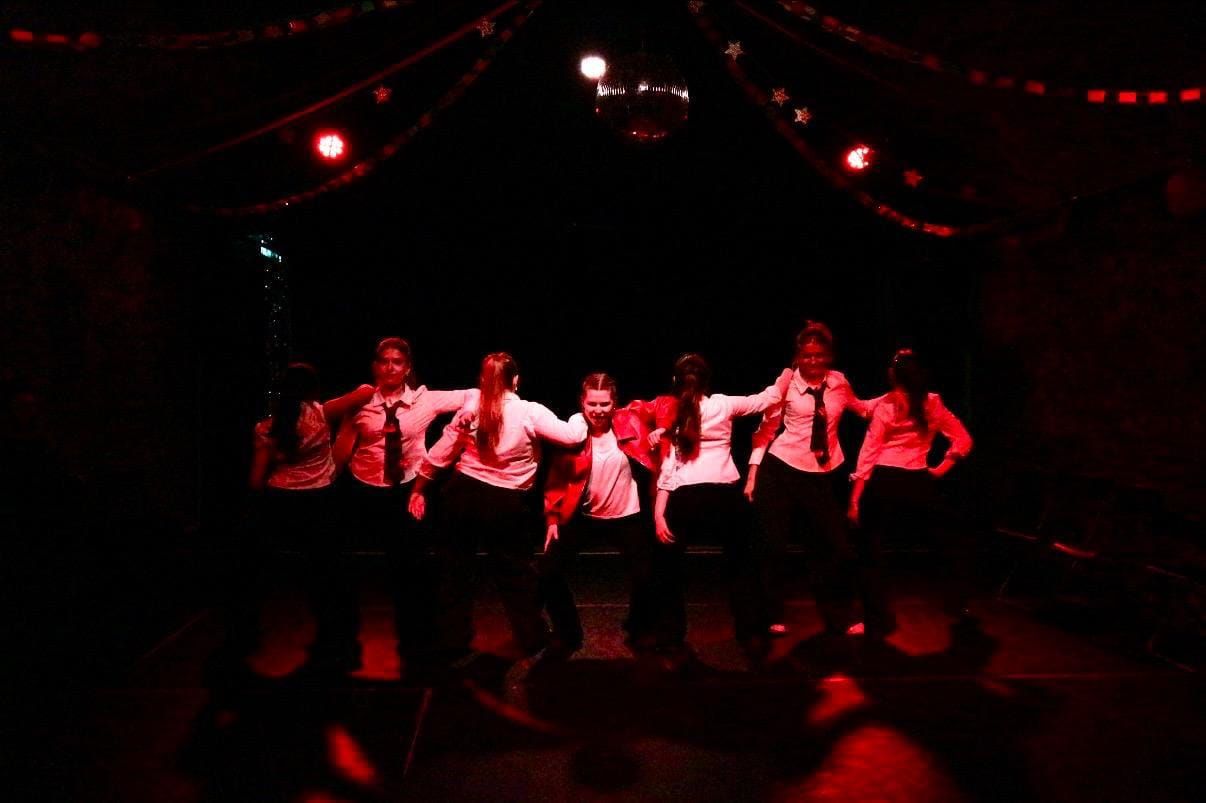
The ensemble here is represented by six actresses (Lucy Bell, Maia Cipriano, Mackenzie Long, Daisy Nissen, Molly Parnell and Thea Weller). Diegetically, they play the role of waitresses at the club where Lotus performs her drag act. However, a possible interpretation is that they represent the insidious influence of capitalism and homogenisation that slowly infects the play’s underground drag clubs. After all, they are dressed, by costume designers Dora Critchley and Maddy Ward, in white shirts and black ties (the armour of the 9-to-5 office drone that exists at the opposite pole to the archetype of the destitute, bohemian artist). They are strongly utilised in the play’s two dance sequences (choreographed by Izzy Long and Ella Waring) soundtracked to songs from Raye’s “This Music May Contain Hope”. The first, scored to “Click Clack Symphony” is a bravura and immediately startling piece of physical theatre that fully embraces stylisation and non-literalism wholeheartedly. This sequence appears to be entirely non-diegetic and an outward representation of Lotus’ inner turmoil. Marshall and Fleeman themselves take to the stage, dressed identically to the ensemble and push and pull Robinson about in Frantic Assembly-esque motions. This particular idea is a brilliant one and could potentially be intended to remind the audience that Lotus isn’t making her decisions independently but rather being puppeteered by higher powers who are controlling her own movement and actions. This applies both to the greater forces of capitalism and homogenisation at play here but also the explicit direction of Marshall and Fleeman themselves. In a play that frequently brushes up against a Brechtian approach, this is the only scene that fully dives into the V-effect.
 Alex Boersma
Lotus Lady is a special kind of play: one that challenges you – but only if you’re willing to be challenged by it. Audiences looking for a fun, heartwarming story about found family certainly got what they paid for (the play certainly wasn’t as much of a bait-and-switch as the excellent God Complex). However, take a peek under the hood here and you’ll find a lot more, even if it was never explicitly intended by the creative team. Marshall’s particular brand of wit and genius is one that is thickly concealed by a surface many audience members won’t want to dive below - and yet the play is all the better for not giving up its cards too easily. Because slowly realising that the play you’re watching is truly a work of brilliance is one of the best experiences an audience member can have and the process of slowly learning to love Lotus Lady has reminded me of the importance of always entering into a theatre with a truly open mind.
Featured image: Connie Weston
Will you see some student plays next year?