By Blanka Gradziel, First Year, Law
Can we expect a mother’s warmth from our fatherland? It is difficult to say when we seem to have grown colder ourselves. Europe appears increasingly divided, chopped down its middle with a meat cleaver.
Elections decided by razor-thin 51—49 margins expose a world in which, even in a democracy, a majority can scarcely claim to speak for the whole. Across Europe, familiar east-west divides can be seen inside countries themselves, pulling populations apart.
It is as though the eagle, a familiar national emblem, has had its wings pinned to the wall: unable to soar, it epitomises a nation trapped in its own divisions. Rather than finding common ground in the heart or spirit of the eagle, its people flock to opposite sides of its back, shouting across a body that ought to unite them. If we cannot unite our countries, how are we to unite Europe? And what does it mean to belong to a fatherland that is unable to embrace its children?
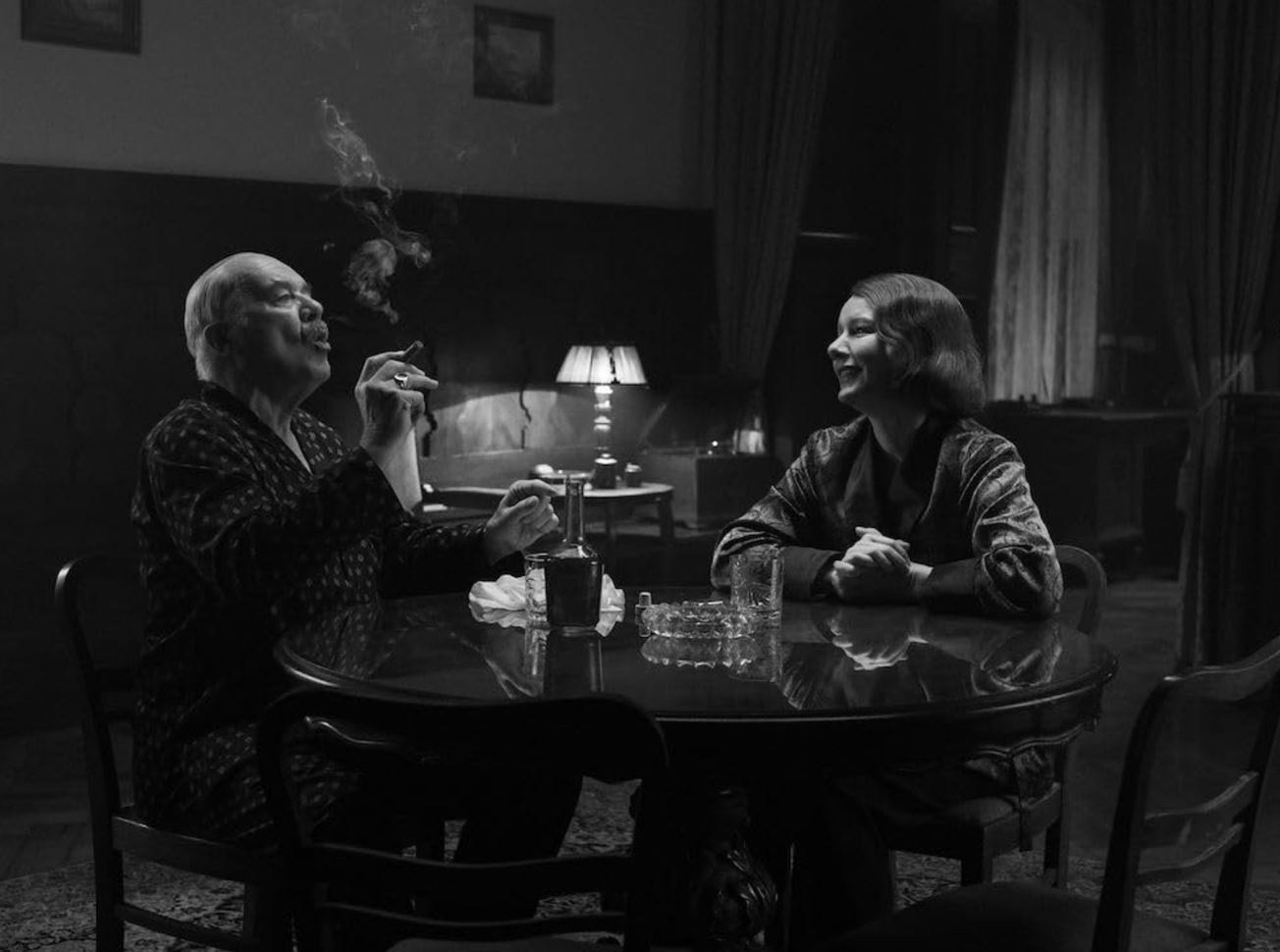
It is this contradiction that lies at the heart of Paweł Pawlikowski's Fatherland (2026), the film that won him Best Director at Cannes for the second time, though this time tied with Javier Calvo and Javier Ambrossi. The Polish-German-French-Italian co-production follows German writer Thomas Mann (Hanns Zischler) and his daughter Erika (Sandra Hüller) on a journey across their homeland. Returning after 16 years of exile, Mann finds a Germany that is both familiar and irretrievably altered. August Diehl also gives a strong performance as Klaus, Thomas Mann's son (and author of Mephisto), while the singing of Joanna Kulig, a frequent collaborator of Pawlikowski's, lingers long after the camera moves away from her.
At one point, Erika tells her father ‘Ich will nach Hause’, translated as ‘I want to go home’. With a dry laugh, he asks her where that is. It is clear that ‘home’ is no longer something he can define. Pawlikowski’s signature Academy-ratio framing confines the two in a narrow visual space, evoking entrapment. Perhaps we have outgrown our homes or discovered that there is no longer space for us at the table. Another auteurist element of Pawlikowski’s work, previously seen in Ida (2013) to Cold War (2018), is his use of monochrome and chiaroscuro. Stripped of colour’s associations with warmth and familiarity, it further communicates the Manns’ complex relation with what and where home is.
Pawlikowski's films are also characterised by a stark contrast between the beauty of their images and the cruelty of the worlds they depict, shaped largely by cinematographer Łukasz Żal. Shot in Poland, the cinematography bathes in the sight of statues, carefully composed human figures, choirs and light breaking through the cracks. Pawlikowski looks at the world with an eye that is almost painterly. Yet, beneath the beauty lies a reflection on countries whose histories are scarred by war and political division, especially within Central Europe.
Family, we often say, is not always bound by blood. Can the same be said of home? Are our homes the land we were born in or rather the places that await us? We have feet with which to keep walking - we were not born supine with our spines fused to the soil. Home takes many shapes and forms. It may be something we carry with us, something we reject or something we discover only after leaving it behind. Perhaps home dances on our tongues when we speak with an accent or it feels like a passport stumbling out of our lips as we strive to rid ourselves of it.
I'm reminded of a line in the film: ‘An actor needs his mother tongue’. There is an intimacy to hearing emotionally charged words in the language we first learnt to feel. Yet, in an interview for Obscurae, Hüller questions this necessity of a mother tongue for acting. A language may sit differently in the mouth, stretch different muscles, taste different, carry a different melody and rhythm, without limiting one’s ability to inhabit a character. I find that a conversation about the fatherland cannot ignore our equally complicated relationship with the mother tongue.
Perhaps we hear home in the music, as in Fatherland’s use of Bach’s cantatas, or remember it through its people, like the spectre-like flashes of Klaus. Music recurs throughout Pawlikowski’s work, whether in the closing scene of Fatherland, accompanied by ‘Jesu, Joy of Man's Desiring’ or in the relationship between the musical director and young singer at the heart of Cold War. Even Pawlikowski's short film Muse (2025) centres around a pianist. Yet Pawlikowski also makes use of silence and long, uninterrupted shots, recalling the contemplative cinema of Ingmar Bergman and Apichatpong Weerasethakul. These moments also invite a Deleuzian reading through the concept of the time-image.
At Sigmund Freud's house in Hampstead, London, I noticed how much of Thomas Mann's work Freud had lining his shelves, alongside authors like Stefan Zweig. I later read of the mutual respect between the two, whose lives were shaped by exile from their native lands: Mann from Germany to the United States, Freud from Austria to the United Kingdom. Can we carry our homes beyond geography? Can our house be in one place, our home in another?
‘My home now is California, but my Heimat, where I belong — that's a much more difficult question.’
— Thomas Mann (Hanns Zischler), Fatherland (2026)
 Bethan Parry-Jones
Perhaps a fatherland cannot provide a mother’s warmth because we conflate geographical and cultural identity with emotional belonging. ‘Home’ is not objective. A border can say where a country ends but it cannot say where a person’s idea of home begins. We inherit a history, acquire a passport or citizenship and still never feel embraced or held. A nation may claim its children but it cannot command their affection – this must be earned with something more difficult than heritage: recognition, responsibility and care.
Somewhere, there may still be a table at which we are welcomed, with a person who asks not where we come from, but whether we would like to stay.
‘Wo ich bin, ist Deutschland’
‘Where I am, there is Germany’
— Thomas Mann
Featured image: IMDb / Fatherland
What films make you think about your sense of home?