By Rintaro Edgecombe, First Year, Film & English
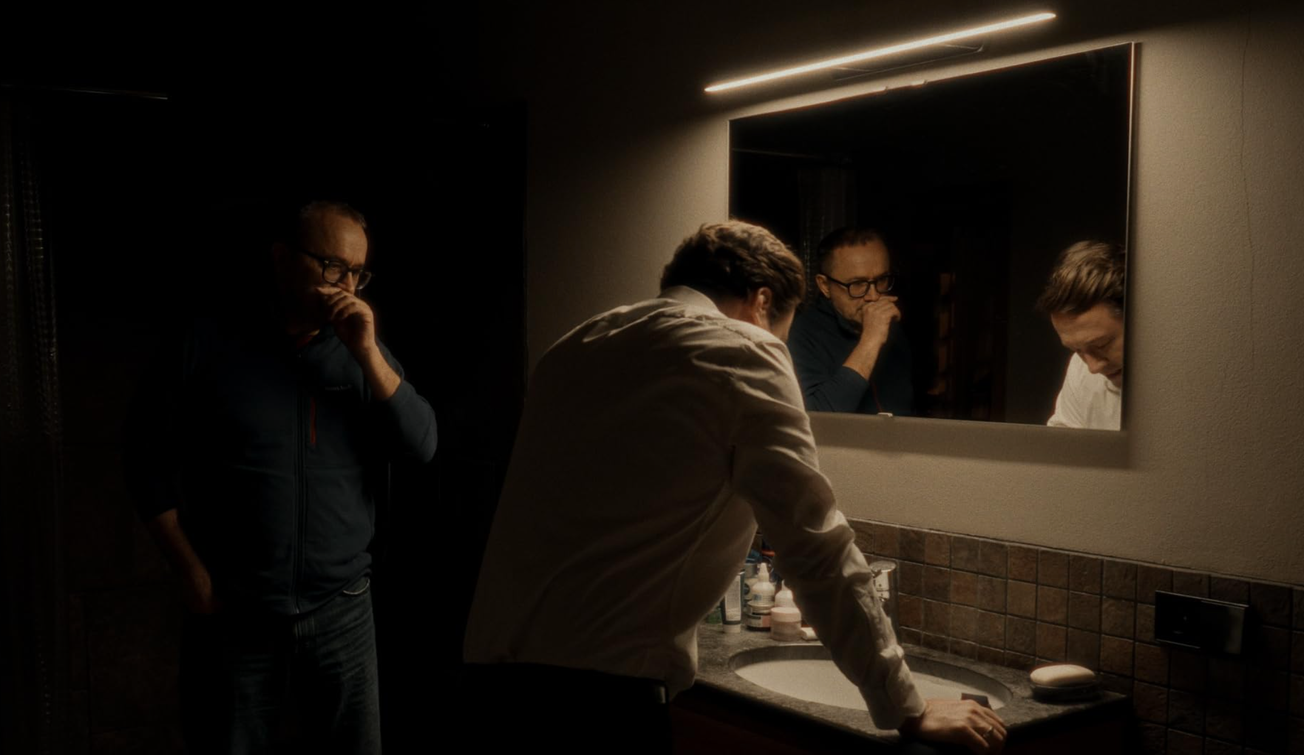
Minotaur (2026), the winner of the Grand Prix prize at this year’s Cannes Film Festival that I was able to watch early thanks to the BFI London Film Festival on Tour, is a film about a company director in modern day Russia whose personal life and the world around him fall apart.
The violence that acts as an underlying tension ripples outward from underneath every turn. Throughout the entire runtime, there is one question that can not be ignored: who or what is the eponymous minotaur? And I think what director Andrei Zvyagintsev ultimately settles on is that the concept is rife in our contemporary era and most noticeable in the direction Russia has been heading towards.
Gleb (Dmitriy Mazurov) is then, like Athens, commanded to give up employees to perpetuate cycles of violence, much like in the original myth. The military complex, forcibly dropping people into its labyrinthine structures, is thus one option for what the film’s minotaur figure is. On the grander scope, it is what makes this political thriller resonate with issues plaguing the modern world. Serving as the backdrop to Gleb’s own story of marital issues, it’s impossible to avoid the boiling tensions which end up taking over the story more and more.
The war in Ukraine is an active component in this tale, consuming people as the country demands it. But Gleb himself is also one such minotaur. He is not divorced from the identity of the world around him. Although he states something along the lines of “he who throws the first punch is weak for starting a fight”, he is just as hypocritical as the power structures he propagates. The violence that gradually arises from his lack of communication with his wife, alongside the influence of the political world’s strengthening chokehold on every facet of the frame over the course of the film, makes it so that the examination of violence becomes one of internalisation.
Mazurov delivers a performance that is cold and emotionally suppressing. Yet his suppression of violent instincts isn’t strong enough. With glacial pacing (not a negative in the slightest, simply suggesting something titanic with monstrous consequences that moves far faster than it seems to the eye), Mazurov puts pressure onto Gleb as a man who has the lives of others on the line as a result of both the wider world and his own individual issues. You can see him cracking slowly so, when he commits the film’s primary violent act, it’s a sudden release of tension as everything he carefully put together in his life comes down before him.
There is also the usage of the frame and the edit, keeping the eye lingering on empty space (both unused areas within the image and conversationally where no one is on the same footing). The characters’ actions have consequences but none come from external sources like they should in a well-ordered world. Instead, whether it’s in their isolated home in a forest where they seem to have no neighbours close by or the haunting rooms of the corporate world, Gleb is on his own to stew in his moral decomposition.
The same can be said for his wife Galina (Iris Lebedeva), whose affair has Gleb in the downward spiral that worsens everything in the family drama which is under the review of Zvyagintsev’s microscope. The isolation of those with a semblance of power is presented as a root cause for their passive evil, be it Gleb and Galina on a smaller level or world powers when the larger picture is taken into consideration. Who or what is the minotaur? Is it possible that, in a world plagued by isolation and intentional division of self from the ‘other’, we are creating an environment for the minotaurs amongst us to thrive?
 Rintaro Edgecombe
It could be easy to make this film a simple story about the victim/victimiser dynamic, which is instrumental to a surface-level reading of the minotaur allusions, but Zvyagintsev doesn’t allow for the story to offer an easily-moulded binary of good and evil. By all means, Galina refuses that label of victim at every opportunity. It doesn’t make Gleb’s turn to violence just but it becomes understandable and that is, at the end of the day, more terrifying. He is emasculated by her, drawing the audience into his insecurities and, consequentially, into the insecurities of the powerful that have their actions tinted by their need to prove their perfectness. The facade of competency needs to be upheld, by any means. No other choice.
They push each other to where the film ends up, blurring the boundaries between victim and victimiser - the minotaur and the sacrificial offering. Minotaur lacks any semblance of catharsis. Its stance on making sure that there is no emotional payoff, grand revelations or resolutions makes this film as powerful as it is. It leaves you to think, to contemplate and to give yourself fully to a heavy sense of existential dread.
Featured image: IMDb / Minotaur
Will you see Minotaur when it gets a wide release?