By Rosie Moore, Third Year, History
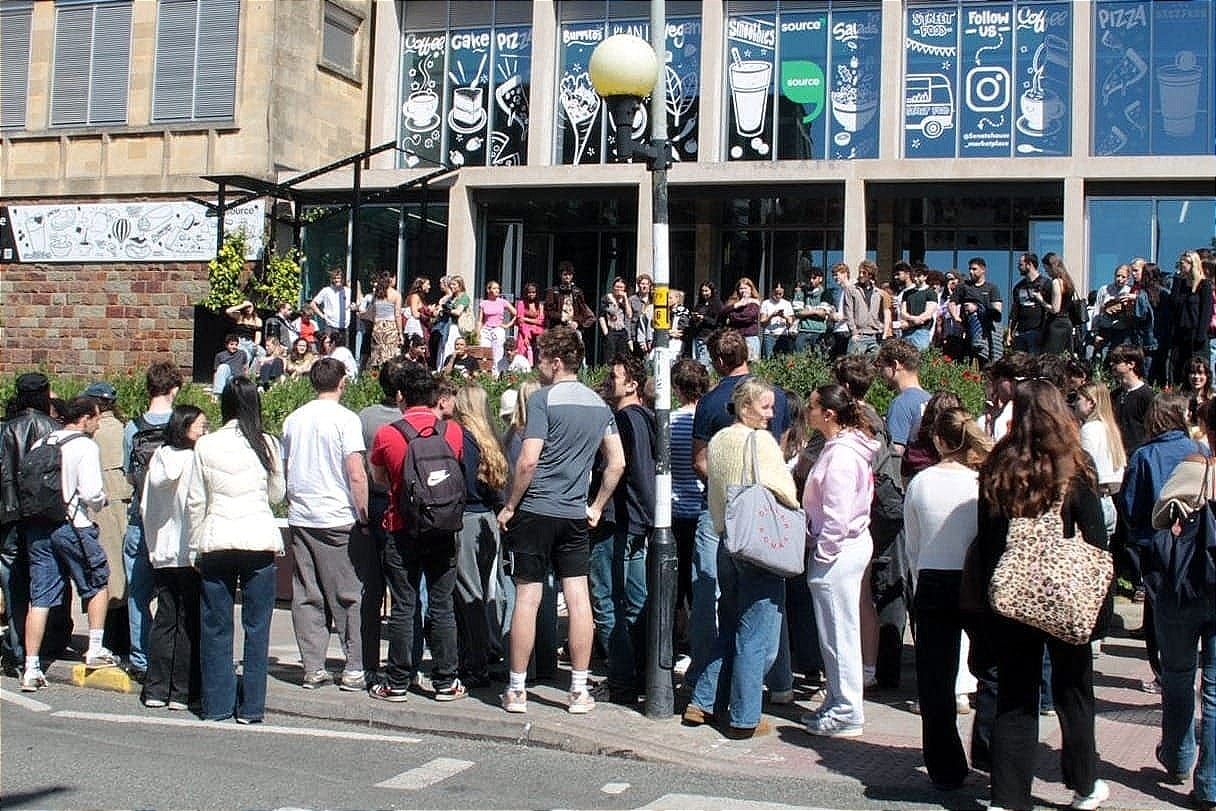
There is a patch of paving outside Senate House. Looks like it's on campus, but really it's a right of way and a road like any other. Normally, there's Marxist society recruiters or earnest second-years thrusting questionnaires at passers-by as part of their Science of Happiness coursework; On a scale of one to ten, how happy are you? And now, how happy are you after this cupcake?
In three years I have seen most things pass through that bit of pavement. Once, shuffling hungover to a nine a.m. lecture, I was handed a DIY rape kit and a chocolate bar. I had not, until the 29th of April, seen this:
ABORTION SHOULD BE COMPLETELY BANNED. CHANGE MY MIND.
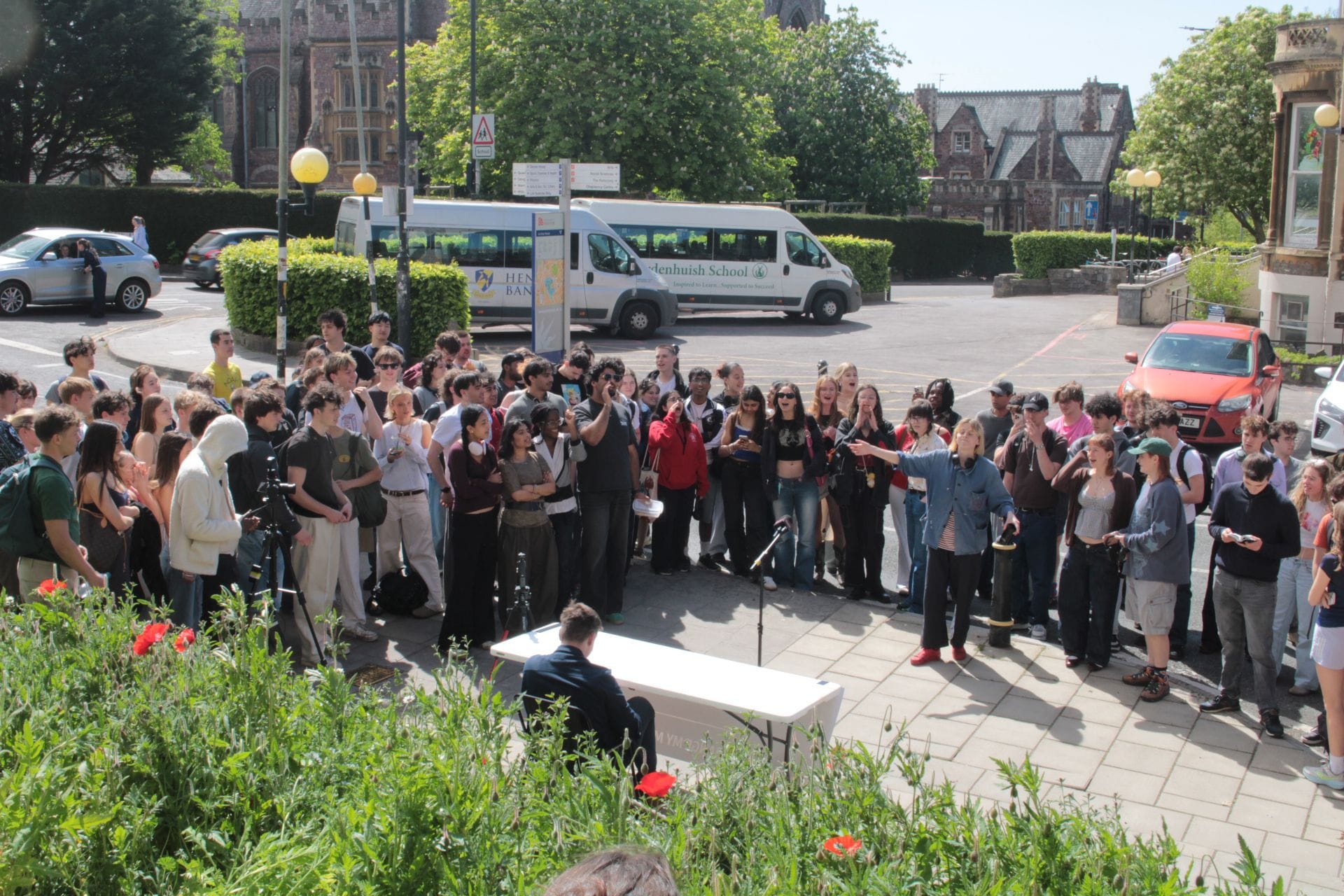
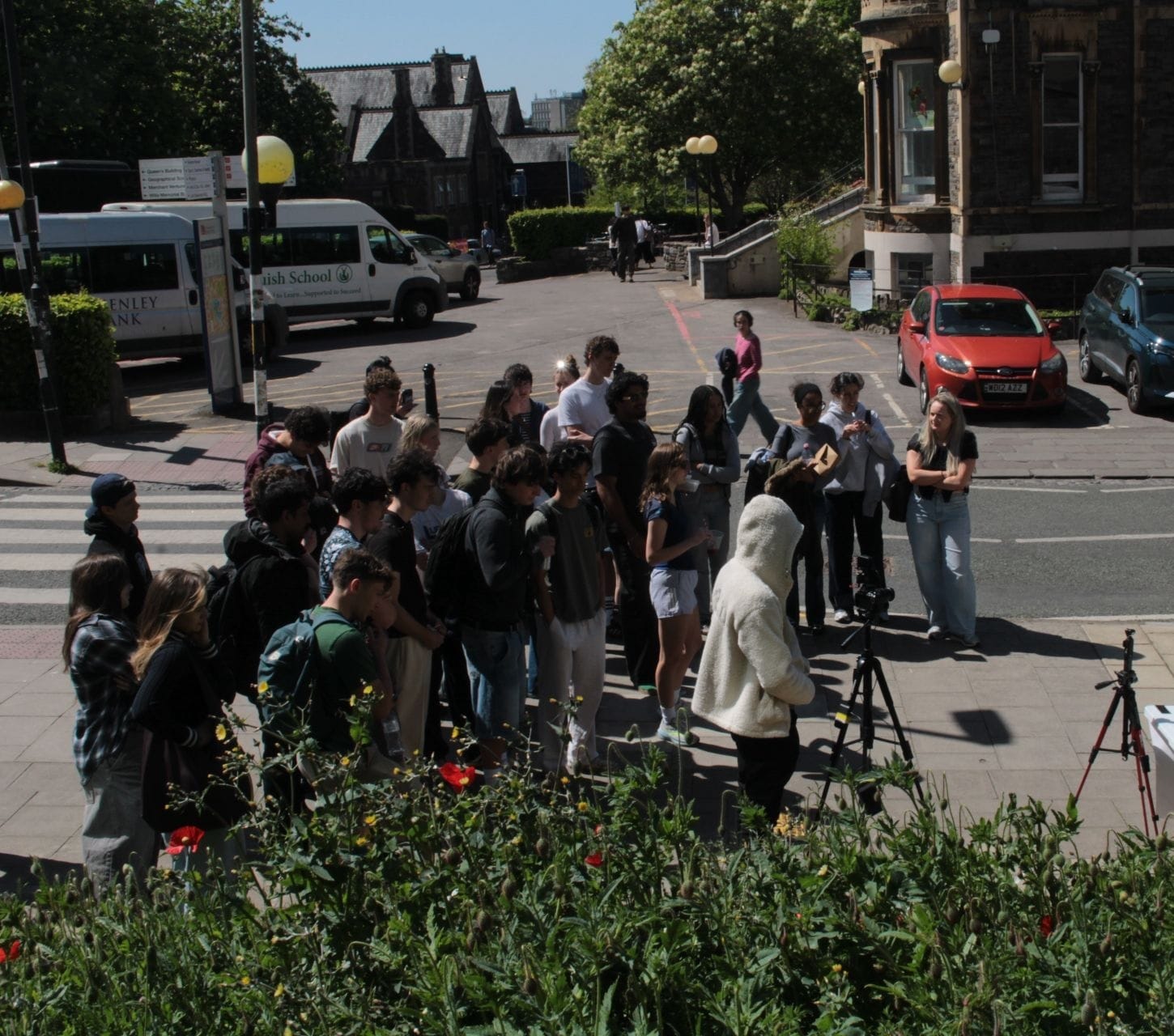
The banner was professionally printed, the sort that warrants a trip to the Toolstation at the bottom of Belgrave Road, and propped behind a folding desk. In front of the desk: a microphone, and behind it: an accomplice, hood up, manning a tripod. The whole apparatus had the air of a man who had not turned up to debate so much as to harvest. He had not come to test his ideas in the agora; he had come to test them in the algorithm.
The folding chair, the Change My Mind sign, the camera angled for the reaction shot. The teenager behind the desk was channeling his best Charlie Kirk for his 135,000 followers on X.
I was not there when he arrived. By the time I had walked down from the ASS, there were whispers of police arriving, which actually meant one officer standing to the side. She had the demeanour of a woman who had drawn the short straw and was now adjudicating what she had correctly identified as content.
 Henry Griffiths
When I arrived, a boy approached the mic, was applauded for his courage, and announced that he agreed; abortion was fundamentally wrong. The applause curdled into the groan of a crowd that has realised it has been had. People sat on the grass and ate their meal deals. They watched and muttered and rolled their eyes at each other in the international semaphore of don't engage, it's what he wants. Everyone around had caught onto the game; rage-bait the students, capture their reaction, post it, and monetise the clip of the ‘woke liberal mob’ losing it at a man who ‘only wants a civilised debate.’ I, like several others, was smug in my moral superiority that I had caught on to his ploy and checked out.
That was going to be the article I was writing. We won. We Bristol students, hyper-diligent of the content economy we live in, were rising above it. We did it.
In the few minutes it took me to walk back to the ASS to write my first draft, feeling a proud member of Gen Z, the afternoon turned. Rumours circulated of food being thrown. The banner was seized. There were chants, and a Stand Up to Racism contingent arrived. The afternoon had taken on the energy of something no longer being watched but participated in.
Later that evening, the young man who had spent the afternoon courting opposition retreated, predictably, to the place that pays better for it. Bristol, he wrote, was ‘one of the worst universities’ he had visited. He had been targeted, his equipment grabbed at, food thrown at him; he had also, he was careful to note, captured a large audience and not been hurt in any significant way.
The right, he concluded, ought to ‘take back’ universities like this one, where the response of liberal students had left their conservative peers intimidated and shut down.
The whole enterprise was contained in that single tweet. A man who had driven to Bristol with a tripod, a banner, and a microphone (which didn't actually work by the way), in order to produce footage of left-wing students ‘behaving badly’, was reporting back that left-wing students had behaved badly and that this proved that universities needed taking back.
They insisted, in public, that a man with a banner debating women's bodily autonomy was not a neutral feature of a Wednesday afternoon.
The outrage is the product and the grievance. He is allowed to be furious. The people he came to make furious are not, because their fury, by the terms of the operation, becomes evidence of his thesis. You cannot win a debate whose rules are written in the edit.
None of which is to say debate itself is the problem. Debate is the point of a university; it is, more or less, the point of a democracy. The question is a narrower one. It is whether a folding chair, a prop microphone, and a tripod constitute an invitation to debate, or an invitation to perform one, and whether we owe the second the same courtesy as the first.
The students who took the banner are not the villains of this piece, and I want to be careful not to write them as if they were. They did what I did not. They insisted, in public, that a man with a banner debating women's bodily autonomy was not a neutral feature of a Wednesday afternoon. The fact that this is precisely what he came to film does not make them wrong. It makes the situation a trap, which is a different problem, and one whose solution I am not at all sure I have.
I sat on the grass, relished in my moral superiority, and wrote about it. They stood up to it. Both responses fed him something. Mine fed him an audience; theirs fed him a clip. There is no clean exit from a stage you are already on.
The bit I keep getting stuck on is this idea of the power of the shrug. The notion that there is something principled in not engaging, watching passively, delighting in one's own decision not to be a puppet in the game. I was very pleased with this at lunchtime, but I can hardly say it was a strategy. It is a posture, and it only looks like a strategy from a distance, on a sunny day, when nothing has yet escalated.
The moment the banner came off the desk, the shrug became a choice about whether to keep shrugging, and that is a different thing entirely. You can call it the staying-seated principled or you can call it cowardice, and on a given afternoon you might be right either way. What you cannot do, I think, is call it a victory.
There is a moment in Louis Theroux’s The Manosphere that aired recently on Netflix that reminds me of a similar idea. Theroux is in Marbella doing pull-ups in the sun with a 23-year-old influencer called Harrison Sullivan who posts as HStikkytokky to roughly a million followers and has built a career coaching teenage boys to be, in his phrasing, ‘fucking boys rather than soy boys or gimps.’
Mid-pull-up, Sullivan asks Theroux, like a man who needs an enemy to perform against, whether he is one of the soy boys.
Did you just look at my arms? Theroux replies, mildly. Sullivan flusters. Half-laughs. Has nothing. The bit only works against a particular kind of horrified mark, and Theroux, almost gently, has refused to be one. The clip dies in his hands.
I was, when that documentary came out, the person who declined to watch it. I told my parents, with some hauteur, that I was not going to spend a Sunday evening paying my Netflix subscription to platform a man who coaches boys into cruelty as a personality. I felt very clean about this. It was, I told myself, a small refusal of the same content economy I am now several thousand words into writing about.
It took a conversation over the kitchen table at Easter, with my Mum gently pointing out that Theroux's whole career is the trick of dragging this stuff into daylight and watching it wither under polite scrutiny, for me to clock that my refusal had been a posture too. The documentary did something my superiority did not, which was deny the operation its in-group mystique. It made the trick legible. You cannot make people stop performing, but you can, at the margins, make the performance look stupid, and that is not nothing.
Which is, I suppose, what I am trying to do here. The piece you are reading will not stop him. It will, by some metric, register as a number on his spreadsheet. But it is also the other thing, the slow, kitchen-table version of what Theroux did to Sullivan in Marbella. Naming the trick. Making the performance look, on close inspection, slightly stupid.
He drove to Bristol on a Wednesday in April to produce a clip, three days after a man with a manifesto walked a pump-action shotgun into a black-tie dinner in Washington. He also produced this, which is something else, written slowly, in a library, by someone not sure she got it right and increasingly suspicious of anyone who is.
Cara Hene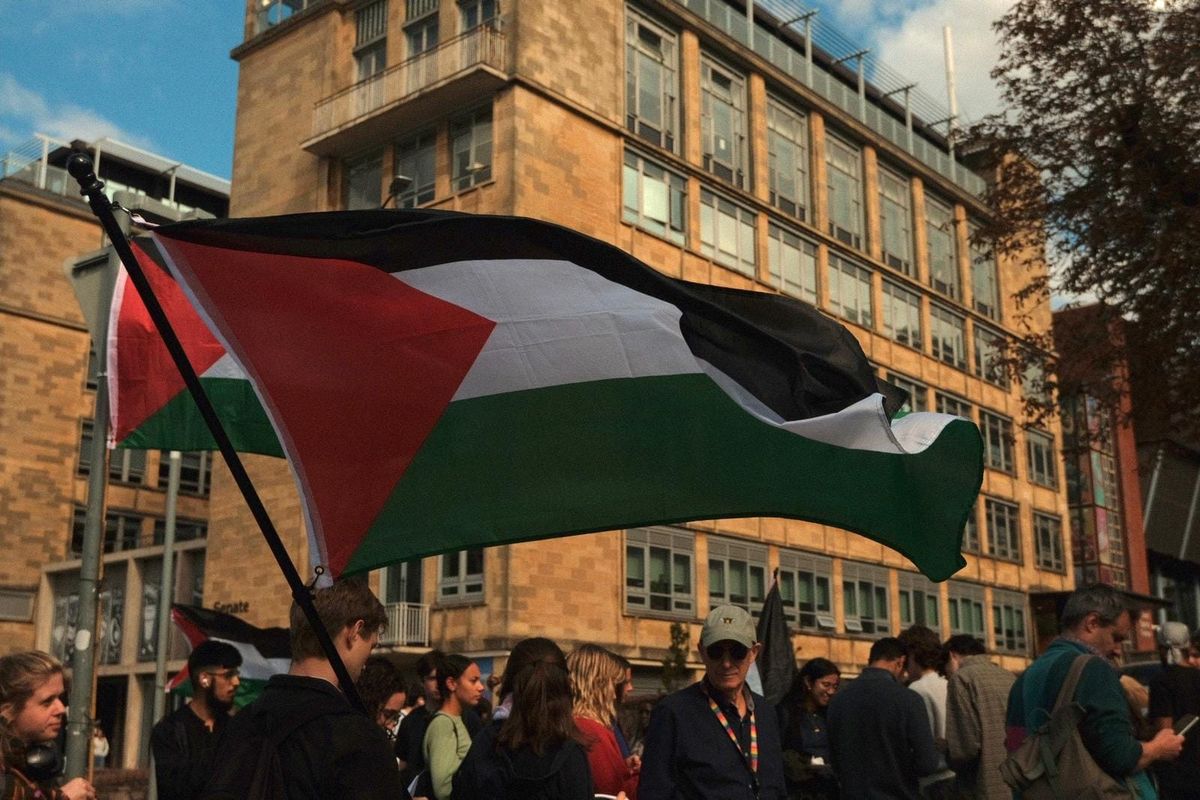 Scarlett Smith
The framing has been quietly captured. The watcher is no longer the neutral position it imagined itself as; the fighter no longer guaranteed the high ground. The girl who took the banner and the girl who wrote about her taking it were on the same stage, lit by the same light. The only honest answer I have is that I do not know which of us got it right, and I am suspicious of anyone who says they do.
The pavement outside Senate House will, on Monday, host a bake sale, or a clipboard, or someone else with a folding chair and a worse idea. Students will walk past it on the way to a nine a.m. lecture in years to come. What we do then is, I think, the only part of any of this that is actually ours.
Featured image: Epigram / Lenny Osler