
By Lianne Ponferrada, First Year, English Literature and Classical Studies
I wouldn’t say I’m ashamed to be a ‘femcel’ but ‘chronically single’ isn’t something I’d want tattooed on my forehead. But, I, among many others in the community, are tired of being constantly misunderstood.
The Guardian continually misinterprets the femcel plight, describing them as ‘influencers [who] urge their followers to give up on gender equality and use men for financial gain’ whilst a more recent article claimed Kristoffer Borgli’s The Drama was “femcel cinema”, despite depicting a married couple. Meanwhile, The Independent claimed that we ‘valourise sociopathy.’ I’ve been called a ‘misandrist’, an ‘extremist’, and even a ‘misogynist’ for being active in femcel forums. I’m here to say that they couldn’t be more wrong. All I am is a woman unlucky in love.
Strangely enough, The Guardian’s original article acknowledges that ‘femcel’ is a portmanteau of ‘feminine’ and ‘incel’ yet groups us in with women who promote a lifestyle that is dependent on finding a partner. Do words have any meaning any more? Do they mean less when they come from women? People underestimate our likeness to incels, excluding the abhorrent misogyny, entitlement to female sexuality, and violence.
Actually, I’d argue that femcels are the truest form of incel.
Many male incels are quick to invalidate the femcel’s plight, claiming that femcels are “fakecels”, and that it is rather easy “to get laid as a woman.” I find the irony palpable, especially because the first incel was a queer woman from Canada. In 1997, Alana launched the ‘Involuntarily Celibate Project’ a website for both lonely women and men to share their dating grievances. There were some men who failed to understand that women were unique individuals, but otherwise, it was a supportive and kind community. Alana would shorten ‘involuntarily celibate’ to ‘invcel’. For easy pronunciation ‘incel’ became a term that could apply to anyone who struggled to find a mate, but male incels co-opted an innocent cause from a well-meaning woman.
In a survey I posted on r/FemcelHub, I asked if anyone had experienced a particularly painful romantic rejection. One responder confessed that a self-proclaimed “incel” suffering from a porn addiction rejected her advances. Another recalled a time where she felt she found a man who was from a similar ethnic background, was just as neurodivergent, nerdy and “unattractive”, as her, just for him to favour a “white, blonde, popular, and attractive girl”. These women recognised that they were not owed romance from these men, but questioned how patriarchy has warped their dating attitudes.

Moreover, several women opened up about how not being conventionally attractive hinders their dating journeys, one even opening up about how they felt as if getting plastic surgery “would make everyone's day nicer [due to] having a more pleasant face.” Despite this, women are frequently told to “give him a chance” even if she isn’t attracted to him.
Popular media such as Beauty and the Beast, Scott Pilgrim Versus the World, and The Hunchback of Notre Dame encourage women to look beyond a man’s appearance, whilst The Breakfast Club, The Princess Diaries, and True Beauty have narratives where women, who are kind and talented, have to undergo makeovers to become worthy of love. This double standard depicted in the media suggests that this is likely to be socially constructed, rather than inherent, otherwise the media wouldn’t have to repeatedly reinforce this stereotype.
According to the nasty Reddit male incels, I could “easily find a man on Tinder”. My dating app experience has ranged from dull to dangerous. I was ghosted by women and men on Bumble, asked what colour my underwear was on Tinder, and I had a particularly irksome experience on Hinge, encountering a Tommy Robinson supporter and someone who within one conversation revealed that he was eager to ‘smack me’ whilst I was blindfolded. Across all apps there seemed to be an affinity for “slightly autistic girls” (No, Daniel, that is not how autism works.)
 Crystal Calo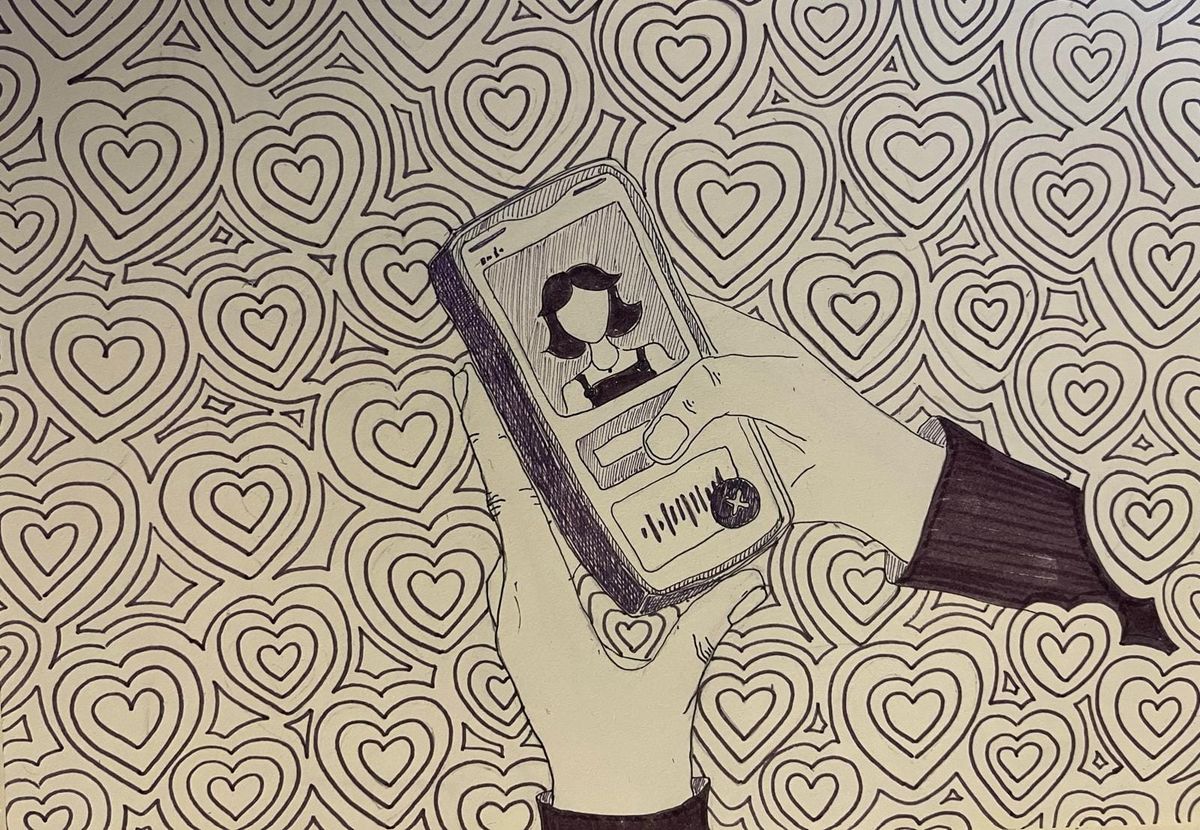
Talk about ‘dating app fatigue’. As unpleasant as these experiences were, I was not surprised in the slightest. Men are becoming more conservative and thus becoming increasingly comfortable with articulating their racist, misogynistic, and ableist views. Many women make the active choice to not date these men, but I feel as if we’re hardly acknowledging that neurodivergent and/or women of colour in particular are pushed out from the dating realm because these men have little tolerance for us.
I was instilled with so much anxiety that I swore to never use one again, which brought me to the end of my dating journey. Putting myself at risk wasn't worth the shag. This is an experience that has been widely discussed among femcels who feel that our only options for sex are to play into degradation from creeps or not have sex at all.

Still, I have never claimed to “hate men”. Even the misandrists I have encountered, when asked to explain their hatred for men, said that men are not naturally vindictive and are socialised in a way that allows them to be (unlike incels, who are quick to view women as innately evil).
With the majority of my friends in happy relationships and dating gossip as integral to the communities I’ve found myself in, r/FemcelHub became a safe haven from all things smutty to romantic. There certainly aren’t any Filipino aunties badgering me about my non-existent boyfriend there.
 Kitty Atherton
Waving my white flag, I’ve planned my future cats’ names and bought myself a loom to catalyse my future as a spinster, whilst I watch my peers hand-in-hand with handsome men. Maybe I’m being dramatic, and I am on the younger side, but it seems that when it comes to sex and dating the odds are not in my favour. When I’ve exhausted all options, what’s a girl to do?
Featured image: Unsplash / Christian Agbede
Would you consider yourself a femcel?