By Olly Francis, Second Year Theatre and Performance
DramSoc’s latest offering is thematically fascinating, technologically ambitious, and, at times moving.
Body Parts is an incredibly welcome addition to the student-written programme of work in Bristol. Written by Iola King Alleyne and directed by King Alleyne and Madeleine Morgan, with Daisy Nissen as producer, this play, in collaboration with Alensi Studios, merges live performance with facial mapping projection, imbuing the piece with fascinating depth. It has a sense of groundbreaking experimentation, not dissimilar from the augmented reality work of Ed Atkins, which positions Body Parts as something part performance, part installation: and great effect. It is this technological experimentation and ambition, paired with the poetry of King Alleyne’s writing, that sets this show apart.
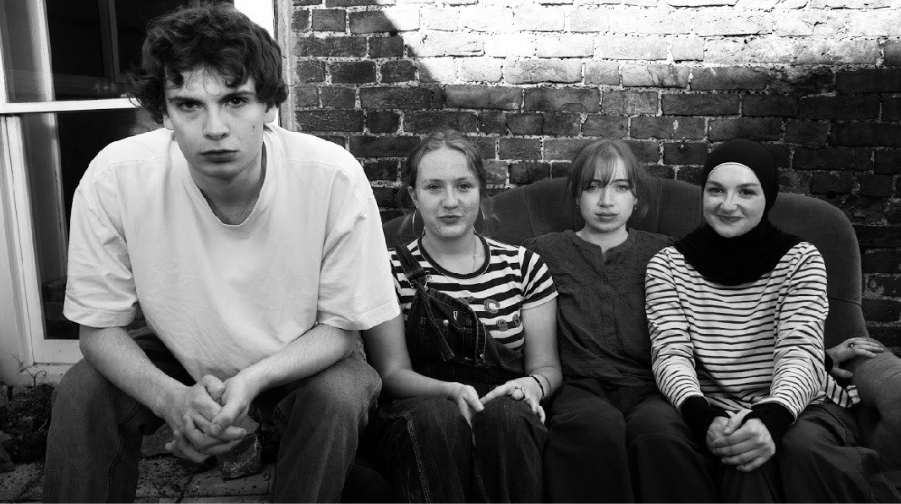
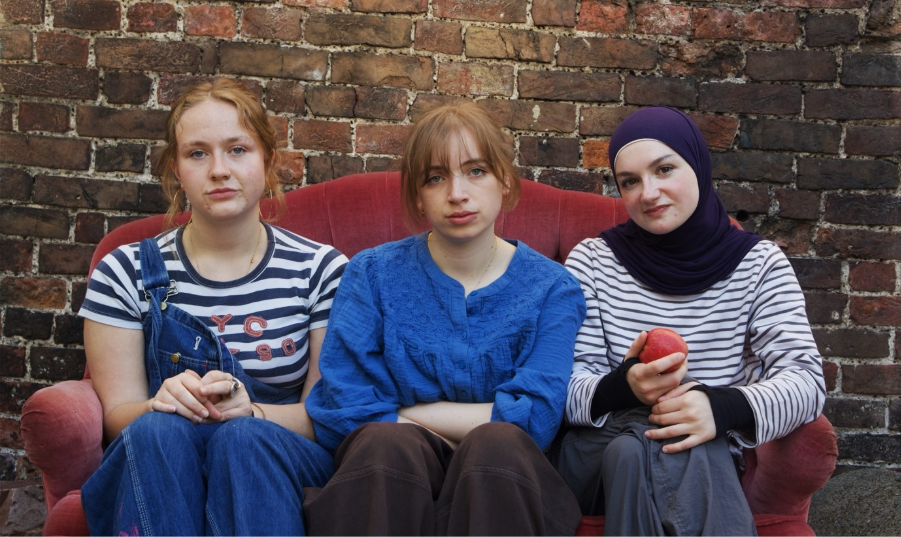
Following the death of her husband, May (Lily Robinson) and her daughter Margot (Méabh Brolly) travel to rural Scotland to visit her other daughter, Carmel (Cleo French), who has bought a house with the inheritance from her father’s death. We then meet Russell (Tom Bayman), Carmel’s situationship of 12 years, and it is from here that the story escalates. Characters grapple with ideas of faith, grief, birth, religion, connection and the self, all set against this augmented landscape.
It is a testament to the writing of King Alleyne that these complex intertwining thematic ideas don’t feel overwhelming, and she approaches these intellectual concepts with deftness, like pieces of a puzzle that all come together just at the right moment. The writing also holds a sincerity, at times even moving, especially as May finds out about her daughter’s historical pregnancy, and we observe May grappling to come to terms with herself as a mother, a widow and, most of all, a woman. But, for a narrative which initially seems like a character study on grief, where does the titular Body Parts of it all come into play? To me at least, the body seems to a growing uniting factor of each of the play’s conversations, very slowly emerging to reveal the layers of the piece. Indeed, within the dialogue there are consistent to the body, such as references to Margot’s religious clothing, ideas of weight and aging, May’s life drawing classes as well as much smaller clues. In every scene, small parts of the body start to emerge, which start to foreground a much deeper exploration than may initially meet the eye.
The piece was grounded in four fantastic performances. Robinson is mesmerising as the mother figure May, acting with delicate precision and control. Her performance is injected with a brewing pain, an emotion always threatening to emerge. The play’s brilliant opening conveys her tentatively examining the facial mapping projection of herself with the rich imagery of the monologue pairing with this nicely. It forms a compelling mission statement for the piece ahead. Her moment with Bayman, when she discovers her daughter’s historical pregnancy threatens to steal the show. Bayman is equally good, offering a charismatic comic foil to the splintering family. It is through his scenes that much of the play’s interesting thematic discussions emerge such as in a conversation about faith and religion with Margot. Also strong is French as Carmel, battling to prove herself to her family, coming into her own in a fiery defensive moment with her mother in an early scene, as well as a formidable turn from Brolly, submerging herself in faith with wit and longing. All the performances work well together, and they particularly come into their own in their monologues, as the play shifts into a more meta-physical space.
The script’s underlying references to the body are centred and enhanced by the facial mapping projections by Alensi Studios. They turn a piece that could be read merely as an exploration of a grieving family into something far greater. Through ideas of religion and the mind, the body very slowly starts to become something both tangible and meta-physical, starting to suggest a play truly concerned with a yearning for the self, a desperation to find and locate one’s true self. The uncanny not quite life-like animations of the actors are mesmerising in charting age, and an almost ineffable forensic analysis of oneself that unearths questions about what the self is and what it becomes, both something tangible and intangible. The marriage of writing and tech, draws out the play’s intellectualism, and both compliment the other, creating layers to the play, potentially inviting audience members to search for meaning, just as the characters search for themselves.
Under the direction of King Alleyne and Morgan, the story becomes increasingly layered, the narrative a façade for the thematic discussion that lurks beneath its depths. Perhaps it would have been additionally effective if the facial mapping could be a live feed which may have added another perspective to this search for the self, given an interplay between a performer acting live with their augmented self, but the constraints of a fast turn-around Fringe slot may limit this. On occasion some ideas felt slightly underdeveloped, for example the abrupt ending of the play in which the actors crawl onto stage as dogs growling at Margot. This stylistic turn into something more absurdist and physical could be very fruitful in generating an interplay between the animalistic primal set against the technological augmentation, and perhaps this idea could have been given more time.
It’s possible that the time constraints of a fringe piece limit the scope of Body Parts’ ambition. I think that there is a slight tension between two performance forms at play here: narrative piece and more abstract piece. Perhaps the play would have been more effective as a series of loosely connected vignettes, which may have allowed the play to fully submerge itself more in the complex thematic ideas it generated, as opposed to narrative. Furthermore, whilst the characters were compelling, I didn’t feel that there was enough time to unpack them and what resulted was non-naturalistic moments fighting against the wider narrative.
Nevertheless, Body Parts is overall wonderfully experimental, with remarkable writing, performances and staging which transforms one’s notion of a typical bare bones Fringe play. It is confident and strident, exceptionally ambitious in its ideas and delivery, creating a fantastic result a sense of yearning that was immensely moving. Body Parts is at its strongest in mediating this balance of all its thematic ideas, juggling them deftly with nuance and great performances. It will certainly be a standout at Fringe.
 Emma Coleman
Catch Body Parts at the Edinburgh Fringe from the 24th-29th of August at the Stephenson Theatre at theSpace @ Surgeons Hall. https://www.edfringe.com/tickets/whats-on/body-parts.
Featured image: Body Parts by DramSoc / Connie Weston and Daisy Nissen
Will you watch Body Parts at the Fringe?