By Rintaro Edgecombe, First Year, Film & English
Godzilla Minus Zero (2026) is the latest entry in the colossal Godzilla film series, which has now spanned over 50 years. This one is specifically the follow-up to Godzilla Minus One (2023), which transplanted the evolving Godzilla mythos back into postwar Japan, where it all began.
However, this time, there seems to be an additional threat alongside the return of the titular kaiju, throwing the already struggling nation into a state of further disarray. By all means, it might not be too untrue to say that this is an expansion of everything in Minus One. On all fronts, this has more of everything: more characters, more bombastic kaiju action and, most importantly, this is more focused on the characters present in the ensemble cast. This film isn’t so much about the kaiju on the posters but rather the characters who have to engage with the presence of these eldritch and incomprehensible threats, be it their more overt attacks or the aftermath that comes from them.
What I’m about to say may be considered contradictory. The allocation of time on fleshing out the characters gives way for what are easily the best scenes in the film but also some of the weakest. This falls in step with some Japanese media in the sense that it is rather melodramatic and characters often say out loud the specifics of how and what they feel, repeating certain points that are clearly easily-absorbable without the need for obvious exposition.
The performances are then led into this more heightened expressiveness that removes space for nuance. This seems like an odd complaint for a kaiju film but I think it’s only noticeable because Minus One was capable of towing that line a lot more effectively. There’s one scene in particular that rings out as being almost cartoonishly framed due to its editing and performance that goes larger than at any point in the rest of the film.
However, on the other side of the coin, there are numerous scenes where dialogue is practically removed entirely and the visuals are allowed to tell the story. Although not present at all times, these are moments where the gravity of the narrative is so gargantuan that there appears to be an inherent trust from director Takashi Yamazaki that the audience simply has to understand without being spoon-fed what makes his telling of this character impactful.
These are anti-war films first and foremost and, like the best in that field, they become powerful when the imagery relies on the civilian perspective - the innocents. And this film has scenes specifically where the horrors of war on innocent people are laid bare before the audience. If the film were able to stick to this kind of tonal register for longer, without having to use dialogue to coddle and over-explain characters, the character drama may have even surpassed Minus One.
While the collage of perspectives here gives a more comprehensive look at postwar Japan, the ensemble isn’t handled as deftly as the original’s single-protagonist story. The expansion of Hidetaka Yoshioka’s role as Noda to being one of the two primary perspectives this film dons is something which gives the basic story a slight leg up over this film’s predecessor. Noda, since Minus One, is a character evidently consumed by guilt over being a technical officer whose work led to the sacrifice of many Japanese soldiers. But the stakes are even greater for him in this film.
Survival has been one of the clear thematic fixations of Yamazaki’s take on the historic Toho kaiju and Noda’s previous attempts at surviving without need for sacrifice are made out to be smaller as tensions rise again here. I think, because his character is one of the more interestingly conflicted ones in the ensemble and that Yoshioka is able to deliver the gravitas of the impending terror with such believability, he comes out unscathed by the choppy exposition and overly-melodramatic character beats. His promotion to co-protagonist is definitively one of the facets of this film where it does surpass Minus One.
However, Ryunosuke Kamiki’s Shikishima (the sole protagonist of Minus One) has his narrative agency reduced a bit. The family dynamic he has with Minami Hamabe’s Noriko and Sae Nagatani’s Akiko (which does eclipse Noda’s moral quandaries in importance) is where the film settles its thematic point about the importance of survival in bleak circumstances and the conflict does gradually arise for him but it’s far less consistently attritional.
The resolution of particular conflicts he has with other characters don’t feel as fleshed out as the film moves past them quickly in order to cover the other characters in this ensemble. And because not as much time is given to him this time around, the broadly-portrayed grief and despair becomes incongruent to the somewhat stoicism that Kamiki is largely left to stew in. This branch of the narrative does build to a point that made me very emotional but the road to get there certainly isn’t smooth.
 Ella Saxton

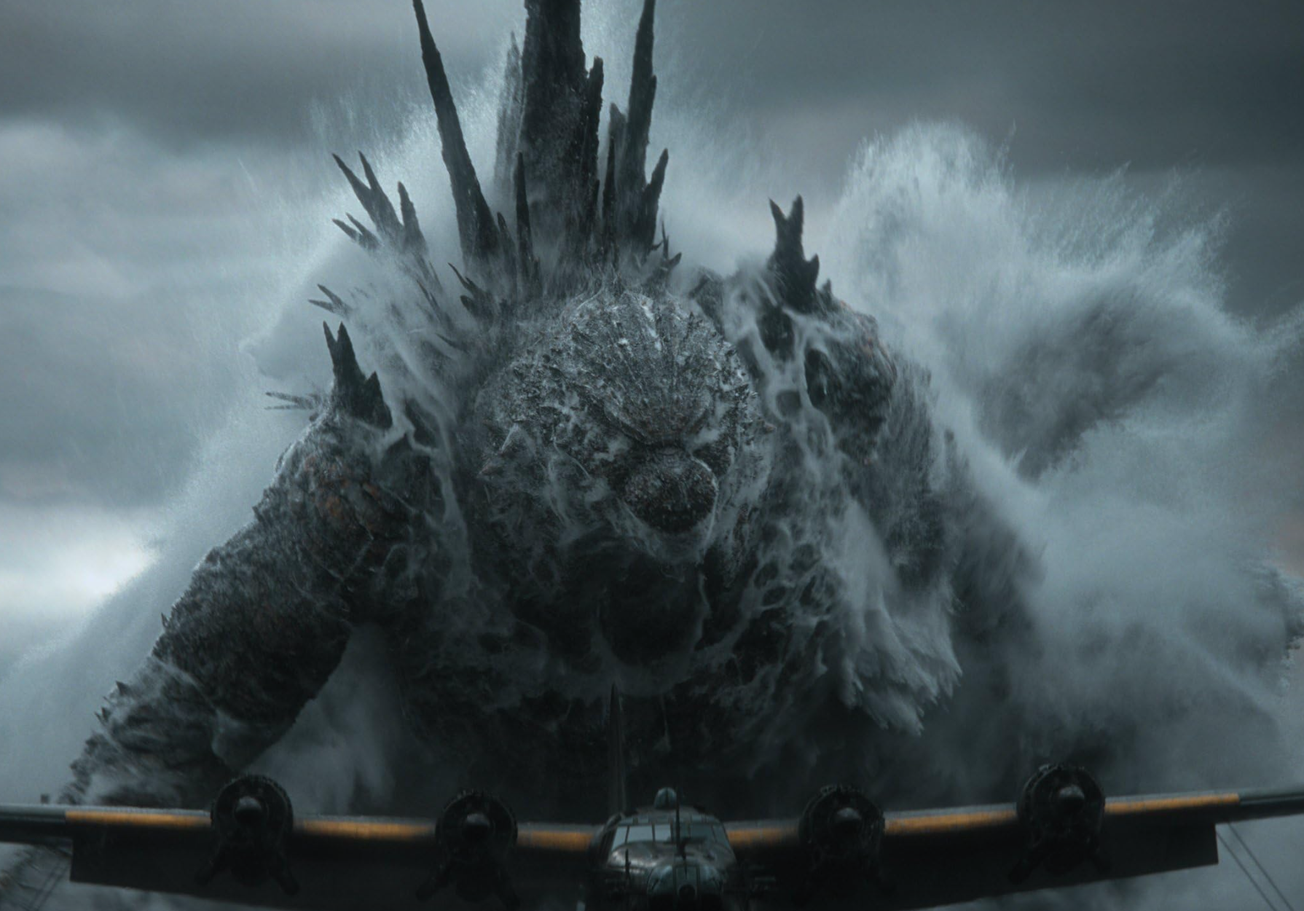
I would be remiss to write an entire review on a Godzilla film without discussing the fight scenes. The sound design is so all-encompassing in the theatrical setting, plunging the audience into this life-threatening monstrous bout that you are terrified for. I think this classifies as a horror/action film and, for one, the sound is what really evokes that primal sense of fear. Then, following up the genuinely perfect action of Minus One, Yamazaki once more makes a feast out of the scale of the kaiju, especially how insignificant human life looks in comparison.
To call Godzilla a force of cosmic horror might be too much of a stretch but I think the character is capable of being this existential threat that truly makes people look completely minuscule in the grander scheme of our never-fully-knowable existence. The fact that Godzilla is captured on camera, with top notch VFX, especially in the third act, and that the scale is maintained to conjure this perception of powerlessness is fascinating.
Featured image: IMDb / Godzilla Minus Zero
What’s your favourite Godzilla film?