

By Lottie Merchant, Second Year, English
Jordan Peele's debut film Get Out (2017) remains one of the most unsettling films of the last decade, and one that just seems to get more relevant with each year that passes. This is because the horror lies so uncomfortably close to reality. The progression of tension in Get Out mirrors the spectrum of racist expression: beginning with awkward microaggressions and escalating into overt psychological and physical violence. Through Gothic horror conventions, Peele transforms the lived realities of the Black experience into a nightmare, exposing the hidden tensions of a supposedly "post-racial" America.
As Lanre Bakare argues in his guardian article, Get Out is such an effective commentary because its villains are not “neo-Nazis” or “southern rednecks”. They are wealthy, middle-class white liberals. The film takes aim at a sanitised form of liberalism that celebrates diversity while avoiding any confrontation with systemic racism. Beneath its horror premise, Get Out asks an uncomfortable question: what happens when racism evolves beyond perception, rather than disappears?
Peele establishes this idea immediately in the film's opening sequence. Andre Hayworth (LaKeith Stanfield) walks alone through an affluent white suburb at night, acutely aware that he does not belong. The extended tracking shot follows him almost continuously, forcing the audience to remain aligned with his perspective. Horror cinema has long used this technique to build anticipation, but here it serves another purpose. The audience experiences the suburb not as a place of safety, but as a place of threat. The setting itself appears idyllic: wide streets, manicured lawns and elegant houses. Yet through Andre's eyes, this familiar environment becomes hostile. Peele reveals how in most ‘white’ horror films, this suburban space would be positioned as a ‘safe haven’, a place of equilibrium and order. But here, with Andre, it is a site of horror. That feeling of something being slightly off runs throughout the film. The suburb looks safe, but it doesn't feel safe. The audience is encouraged to recognise that Andre's fear is not irrational. It is socially and historically conditioned.
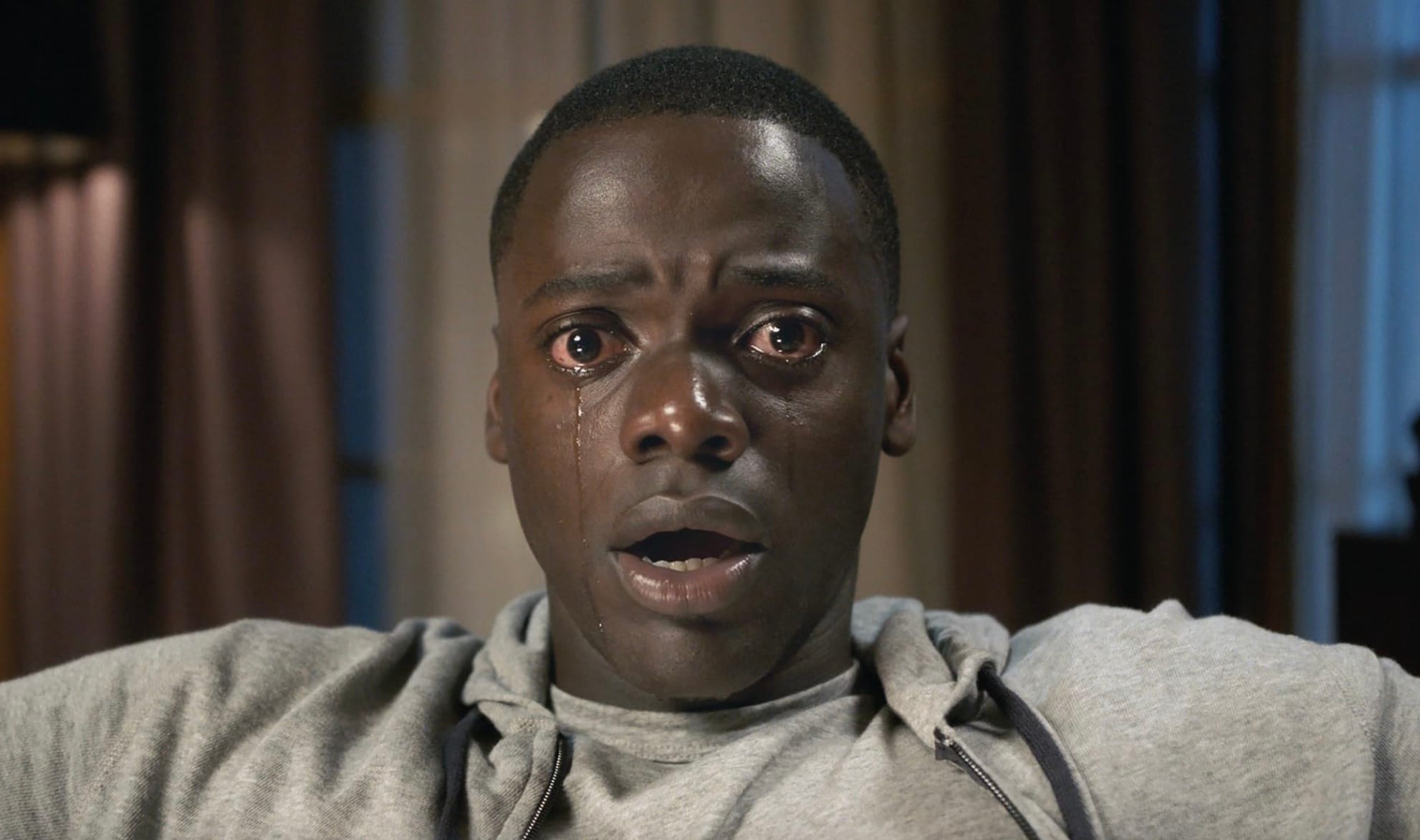
The same dynamic continues at the Armitage estate. At first glance, the house resembles the perfect family home: spacious, welcoming and picturesque. Yet it functions as a modern Gothic haunted house. The horror is concealed beneath a façade of hospitality. Rather than relying on jump scares, Peele builds tension through everyday interactions. Dean Armitage's (Bradley Whitford) infamous claim that he "would've voted for Obama for a third term" immediately exposes his performative liberalism. At the family gathering, guests repeatedly reduce Chris (Daniel Kaluuya) to his race. They ask intrusive questions about Black physicality, fetishise his body and treat him as an object of fascination.

These scenes are some of the film's most uncomfortable because they feel so familiar. None of the comments are openly racist. Instead, they create a creeping sense that something is fundamentally wrong. Peele's editing emphasises this by cutting rapidly between conversations, presenting the remarks as a relentless stream of disrespect. Every interaction feels like another warning sign. The feeling of suspense you feel from the horror elements in Get Out parallel the lived experience of microaggression, a slow build-up of comments that culminate into overt, violent racism.
When the film finally reveals the Coagula Procedure, the source of that discomfort becomes clear. White consciousness has literally colonised Black bodies. The horror of possession becomes a commentary on slavery, fetishisation and scientific racism. The Armitage family's project is horrifying not simply because it involves bodysnatching, but because it transforms historical forms of racial exploitation into contemporary horror.
This tension peaks when Chris encounters Andre again at the Armitage party. Now operating under the identity of Logan King, Andre appears culturally and temporally displaced. His speech is archaic, his mannerisms unnatural. Yet when a camera flash briefly breaks through his conditioning and he screams "Get out!", the film delivers its harrowing titular line. It works as a horror set-piece, but it also exposes the violence hidden beneath the surface and the film's central concern: the erasure of Black identity. What separates Get Out from many contemporary horror films is its ability to use genre conventions as social commentary rather than decoration. The haunted house, the slow build-up of suspense and the constant feeling that something is wrong, become tools for expressing experiences that are often dismissed, minimised or ignored.
 Ella Saxton
Like the Armitage family themselves, Get Out constructs a façade. It presents itself as a horror film while operating as something far more incisive. Peele uses Gothic conventions to expose the violence concealed within everyday interactions and familiar spaces. Eight years after its release, that is exactly why Get Out remains so unsettling.
Featured Image: IMDb / Get Out | Illustration by Epigram / Sophia Izwan
What did you think of Get Out?




%3A%20Revisiting%20the%20real%20horror%20of%20Get%20Out)