
By Rintaro Edgecombe, First Year, Film & English
Your Mother Your Mother Your Mother (2026) appears to be the latest in a recent trend in Hollywood filmmaking where the action genre is allowed to let more director and star-led stories take priority.
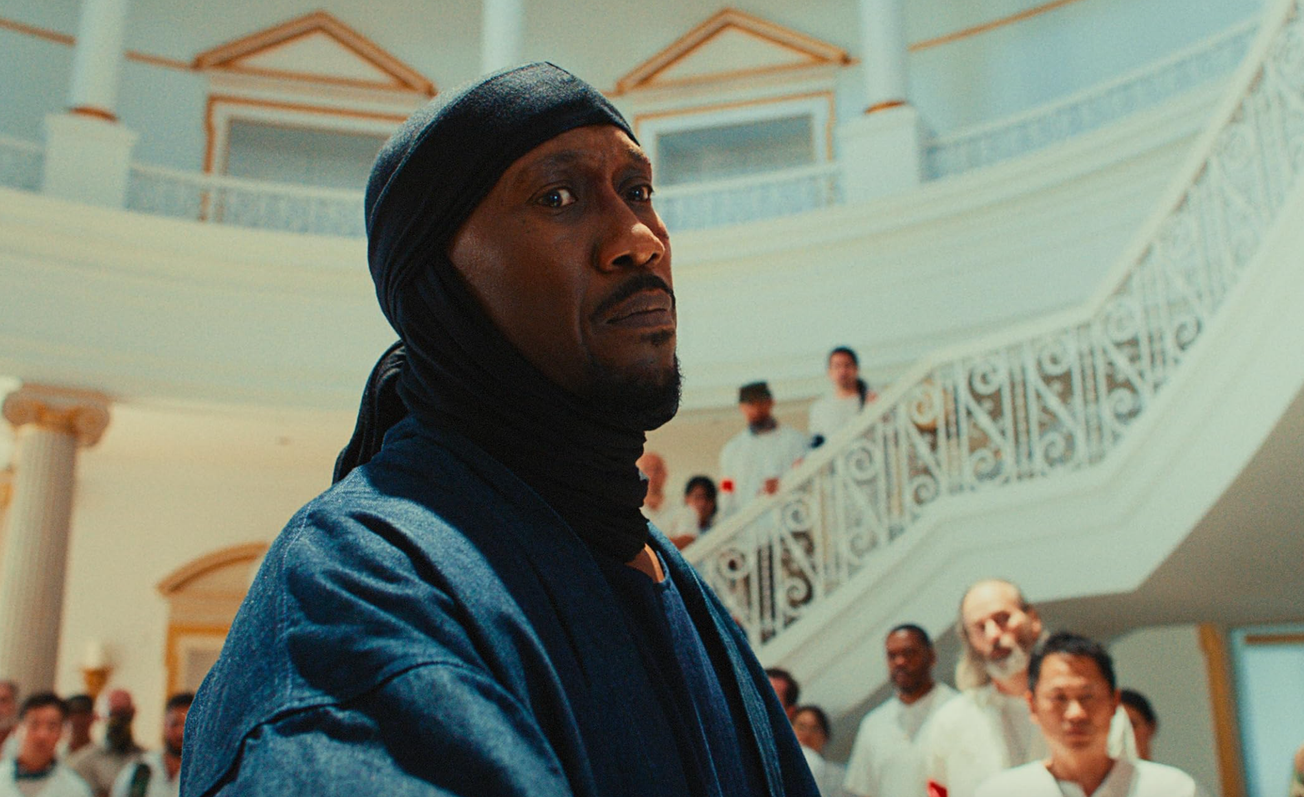
This one feels especially modern in a way that hasn’t really ever been done before on this scale from a major movie studio. The film follows Latif (Mahershala Ali) - a devout Muslim hitman in Houston, Texas whose faith is caught in conflict following the death of his wife and rising tensions with his employers. Expectations ought to be managed with Your Mother Your Mother Your Mother. I know I called this an action film (a matter I will return to) but, if you go into this film thinking that it’s going to have a runtime largely dedicated to fight sequences, you probably won’t be as satisfied. Rather, it’s the character component that keeps you watching.
The intersection between Latif’s relationship to Islam and his remaining family - the two remaining pillars of his life - is the central driving engine here. Writer-director Bassam Tariq doesn’t let the audience forget that. Every single factor in the film leads directly back to that intermediary ground where those two points converge. The motivation that propels Latif into the web of religiously-ingrained Texan crime isn’t necessarily the derivative ideas of revenge and whatnot that could have otherwise left this film as pretty standard genre fare. Instead, it’s the Odyssean pursuit of breast milk for the sake of his infant daughter’s survival.
That motivation and the title both stem from an Islamic hadith that furthers our understanding of the impact that Latif’s wife’s death has had, completely shaking his devout perspective that is already complicated by his violent occupation. It’s the contradictions in Latif that make him one of the most compelling film characters of the year. I, for one, am not religious but being able to tap into that worldview is one thing I do adore about narrative storytelling.
Crucially, this is also a hyper-modern film, taking place in the modern day and thus featuring developments in the gradual loss of faith that feel rooted in hypocrisies or ideologies that maybe weren’t so pronounced in prior times. The tantalisation of adult content readily online and the scenes set in hollowed-out strip clubs become a constant reminder of the shifting attitudes to having that faith. The way that Latif’s children come in contact with that world and his attempts at protecting them from these more ‘sinful’ forces, despite his own work, is fundamentally what I thought was the most interesting.
His odyssey through the religiously-tinted criminal underworld leads him into these existential moral boundaries that his family oppose him on that he pushes back against. Vitally, it doesn’t vilify the vast majority of these pieces of the world (aside from John Cho’s Pastor Kwan). There is an inherent understanding provided to these individuals caught in possibly amoral situations, reflective of Latif himself, that provides interesting foils to his journey of self-rediscovery.
It’s impossible to see the colour grade of Your Mother Your Mother Your Mother, to listen to the Son Lux score, which combines spiritual-sounding vocals and a more experimental approach, and not find it to be inherently beautiful. Even if the film is set in a location which, on its own terms, does not have connotations of beauty, the vibrancy and specificity of community echo through every fibre of this narrative. Everything is emboldened by the sensation of yearning that the score has ripple outward. The specific feeling the music conveys is ethereal and I can’t quite fully put a descriptor to it. It’s new and it’s different.
It portrays the Islamic faith through the prism of Latif’s overwhelming grief without allowing that grief to overpower that larger-than-life presentation that film is able to give his story. And the divine cherry on top is Ali, who has never been better. The man’s a movie star - or at least he should be. He’s charming where he needs to be, taking a foot off of the gas to provide that paternal feel needed to ground the family while it’s in disarray. I find Ali to be such a warm screen presence anyway and this uses those parts of his onscreen persona to get that family man across to the audience.
But this performance is on a whole other level thanks to his stoicism. Feelings don’t leak out of Latif. They are contained - locked down. Tariq’s script doesn’t overuse dialogue, instead featuring numerous scenes where the mood can seep outward from a point and linger. Ali is magnetic in those moments, clearly compartmentalising how he feels and expressing it through the eyes.
Then, from time to time, you get the colourful action that the first scene of the film promises. It’s cleanly done. Latif is clearly proficient with his sword and so, when he’s able to be in a fairer-leaning fight, the camera is swift with its movement. However, the real joy of the fights is in watching Latif as the underdog, seeing how many opponents he can go up against and still fight anyway.
 Rintaro Edgecombe
While the relationship between faith and violence never wanders too far from the front of the mind, this is a samurai film in 2026. There’s only so much I can try to contextualise before simply saying that watching Ali terminate foes is satisfying for even the caveman part of me that enjoys basic action flicks here and there. It’s a fusion of both cinematic worlds, similarly to the way that the muslim community of Texas combines that Americana with the pivotal emphasis of faith.
There may still be a few possible contenders coming up in the next few months but this is my film of the year thus far. Handily, too. I love films which tackle faith in a new, unseen way. Same with films that seek to examine the modern day in all of its cruelties and ignored beauties. And it’s a samurai film too. This feels, although not directly, like it was made for someone with tastes like mine.
Featured image: IMDb / Your Mother Your Mother Your Mother
Will you see Your Mother Your Mother Your Mother?