
By Jana Bazeed, PhD First Year, Philosophy
Homer’s sea is ‘wine-dark’. To modern-day readers, the phrase is undoubtedly strange – the sea is usually blue, green, grey, brown, or some unpleasant mixture of all four. It is not, as far as I know, generally wine-coloured. So, why did Homer describe it that way?
The question has resurfaced with Christopher Nolan’s The Odyssey, bringing the poem back into the cultural spotlight (and, inevitably, the wine-dark sea with it).The entertaining answer is that the Greeks couldn’t see blue. This is almost certainly false. There is no evidence that Homeric Greeks were biologically unable to distinguish blue from red.
The more plausible scenario is that they divided up what they saw differently.As a philosopher of physics, I am perhaps obliged to point out that the sea is not, strictly speaking, blue either. Physics gives us wavelengths, spectra, reflection and absorption. It does not give us a wavelength with a label attached saying ‘blue’. That happens somewhere between the eye and the brain. Colour is then a surprisingly good place to think about the relationship between language, perception and reality.
A well-known example comes from Russian. English has one basic word for blue, while Russian separates siniy (roughly dark blue) and goluboy (roughly light blue).Experiments suggest Russian speakers can be faster at distinguishing shades across this boundary. Alas, we have no reason to believe Russian speakers see extra wavelengths. As far as we know, their eyes have not been issued a superior colour palette. A more reasonable explanation is that language seems to affect what distinctions they are more likely to notice.

Enter linguistic determinism versus relativity. The strong version, linguistic determinism, says language determines thought: if your language lacks a category, perhaps that category is less available to you. But, that seems too strong. I do not need a word for a particular shade of green to see it. I also do not need a word for the very specific embarrassment of waving back at someone who was not waving at me. I have experienced it often enough regardless. Evidently, language does not put a hard limit on what we can perceive. Yet, it might influence what we pay attention to. And this is where the weaker idea of linguistic relativity becomes more interesting. Language may not determine perception, but it can make certain distinctions more salient. Once something has a name, it becomes easier to point to, remember, compare and discuss.
There exists an obvious complication, though: what if the causal relationship could run the other way? Maybe Russian has separate words for light and dark blue because that distinction was already useful. Language, on this view, is not imposing categories on an undivided world. Rather, it is reflecting categories people had reason to make. This reflectionist position feels intuitive. We do not randomly decide we need twelve words for snow; distinctions usually become linguistically important because people already have a reason to make them. But once the distinction has a word, we may become better at noticing it. Language can be both a reflection of perception and something that feeds back into it. Which brings us back to Homer.
The ‘wine-dark sea’ does not mean ancient Greeks saw a totally different physical world. It may show how they categorised what they saw. Oînops need not be a modern paint-chip colour term; it may suggest darkness, sheen, texture, or some visual quality associated with wine. We do this constantly in English. We call someone ‘green with envy’ without thinking they have become measurably greener. We call a person ‘blue’ when we mean sad. We describe light as ‘warm’ even when temperature is not really the point. This does not mean reality is necessarily subjective. The sea has a physical composition whether or not Homer had a neat word for it, and a spectrometer will not get confused because someone says turquoise. But perception isn’t measurement. Physics can tell us which wavelengths reach the eye. It cannot, by itself, tell us what it is like to experience those wavelengths as colour. That also involves biology, cognition, and possibly language and culture.
Maybe the question is then not whether Homer could see blue, but whether ‘blue’ was the most useful way for Homer to divide up the visual world. That is the unsettling thing about words, we like to think of them as labels for categories that already exist. Sometimes they are, but sometimes the labels help decide which boundaries we notice. We see something, name it, and then find it easier to see the next time.Three thousand years later, we are still arguing about the colour of the sea. The sea, naturally, remains entirely indifferent.
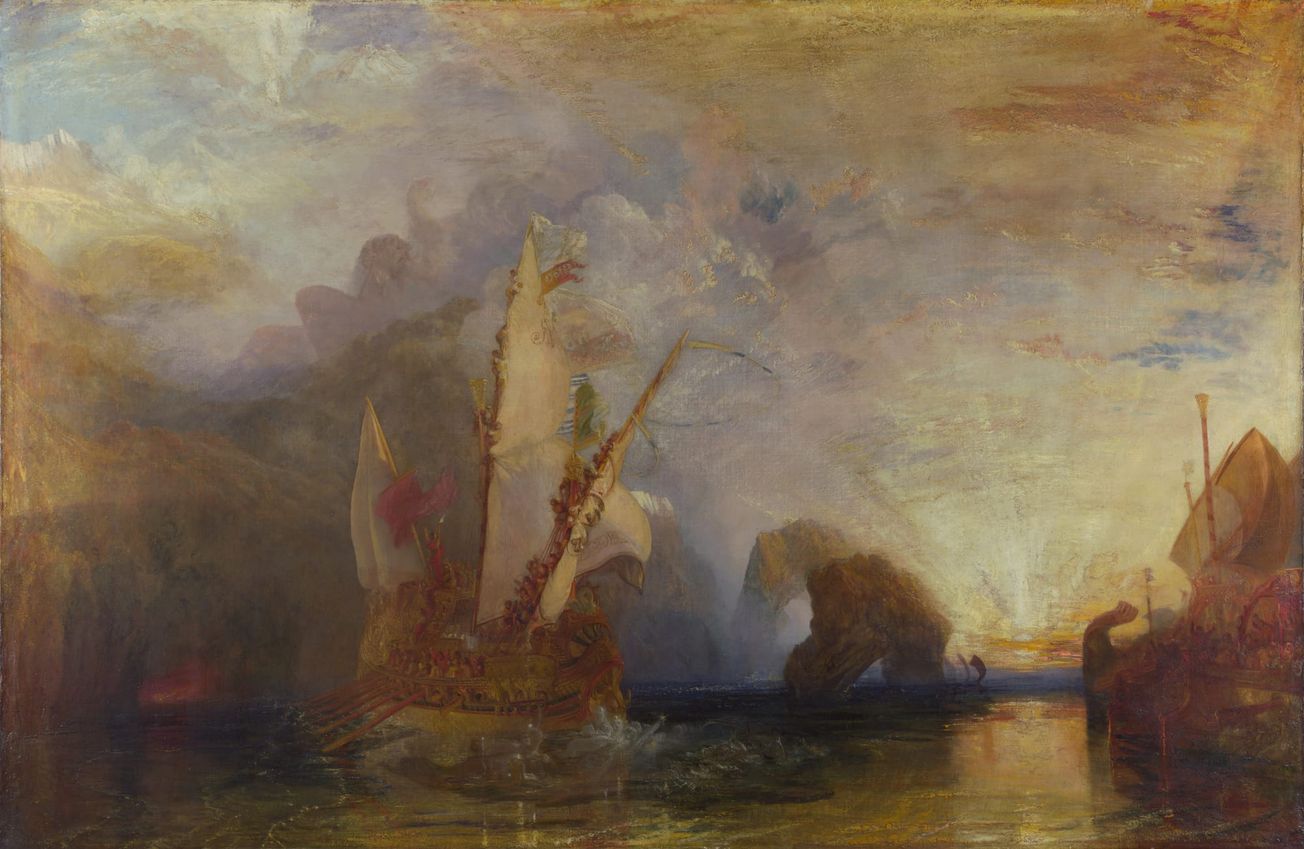
Featured Image by: J. M. W. Turner / Wikimedia Commons








.jpg?ref=epigram.org.uk)

