By Rosy Brown, Book Club Leader
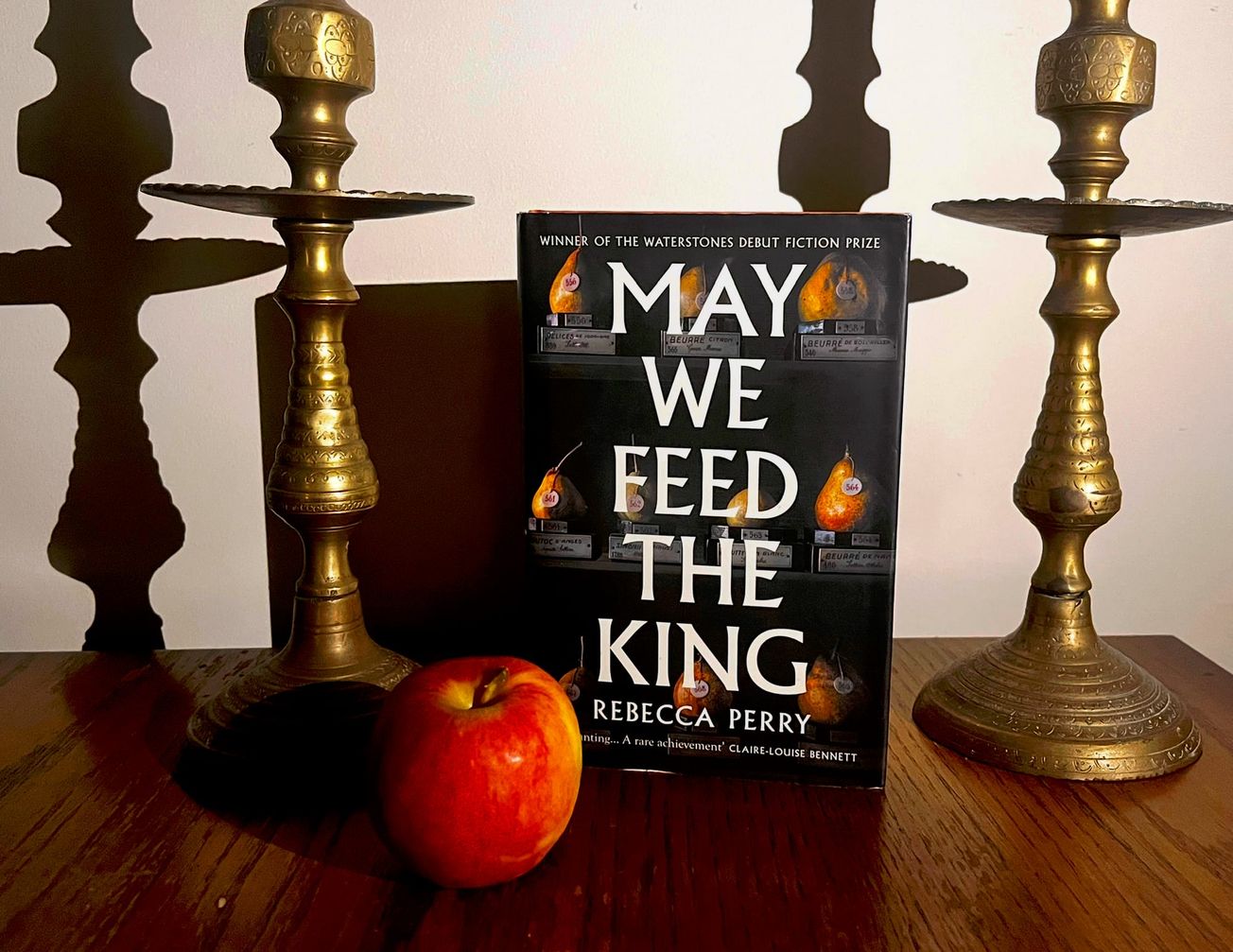
An unnamed museum curator dressing the past into banquet scenes, using historically accurate replica food ordered online. A reluctant King watching the flowers from his window: holding all the power in the country yet forced to pacify his simplest desires. A court teeming with stories, predictions, plans, and dreams; everything inferred. Rebecca Perry’s novel blends history with the present, the incorporeal with the material, and leaves a thousand questions unanswered. But if you allow yourself to stretch out in those empty gaps, there is true beauty there.
May We Feed the King makes two worlds one in its dual narrative, where desire, longing, and grief remain unsaid yet permeate everything - even the bounds of time. Feeling leaks between chapters. We readers try to slot it all together, only to look down at our hands, brimming with atmosphere, synecdoche, and description – ornate and intimate like dissecting a French macaron – and find we are still missing pieces. We can never assemble a comprehensive history out of traces.
As a novel about the elusive architecture of memory, May We Feed the King is the perfect November read for a student approaching assessments – reminding us that we don’t always need to enclose the answers wholly and that sometimes, moving between them, in the unheard space, is much more rewarding.
Perry’s first novel combines the figurative aesthetic precision of her T.S. Eliot Prize-shortlisted and Michael Murphy Memorial Prize-winning poetry collections – Beauty / Beauty (2015) and Stone Fruit (2021) – with the symbiotic jostling of multiple points of contemplation seen in her lyrical memoir On Trampolining (2023), to build a successful eclectic explosion of forms and vignettes. A chapter of dense setting description where all dialogue is spoken in movements – the leaning of a face into an embroidered bodice – is followed quickly by a shift in formatting: a script of a secret meeting between the King’s Advisors, each statement isolated by great gaps on the page like they are being spoken into the dark; sometimes just one word, one sentence standing alone, glimpses caught in a void. This shifting structure and focus accelerate the pace of what is largely a story built out of subtext, and each emerging contradiction acts to confront us both in our formal expectations and in the messy picture they paint of the past.
History cannot contain him, so neither does Perry. She simply lays the table. We must pick up a faux pear and note its weight ourselves.
The narrative begins with a woman who retreats into history, her inner life surfacing only in glimmers: an empty chair at the dining table while she grimaces at her plate, a dream about oysters whose verisimilitude exceeds anything real. Just as we settle, the book switches to the third-person, head-hopping story of an unwilling King, who must run from a dreaded future into the stasis of a garden, or into any equalising gaze that refuses to look up at the crown. In her meticulous yoking of these two stories into one temporal realm – the interval between past and future, like a cooked meal set and waiting to be devoured – Perry asks us to confront something: if we can enter a modern mind and still only scramble to read between the lines, why would we ever believe we ‘know’ a King?
The greatest art contained in the novel, I believe, is its evasion of hypocrisy. Perry could easily have reached the same conclusion, that the past is unknowable, by painting a complete portrait of a King whom records neglected: a man with a resolved story the chroniclers missed. Instead, she insists that no single King ever existed. He was one man to his Wife, another to his Advisor, another to his Young Attendant (their titles are archetypes, history’s flattening of people into relative symbols). History cannot contain him, so neither does Perry. She simply lays the table. We must pick up a faux pear and note its weight ourselves.
Innominate portraits appear only out of shadows; people are reflected off their clothes, off the crumple of paper left in a corner. Something is missing. Something is hollow. We can’t breathe in the smell. We can only trace the story, hovering above it, sweeping deep inside it, through gossip, and whispers, and things we might have seen in the flickering light of the King’s window. We approach the world as an investigative historian, and we leave it a confused child. I suppose history, in its vast unknowability, makes us all small.
But there is so much to devour in the absences, in the jarring of two vivid accounts of the same story, mangled and tilted by whoever’s eyes we are permitted to enter. For a haunted man of little significance, the King’s momentous coronation is but an empty hour in which time seems to stop: he may lie with his wife, he may forget all that he saw attending the last King. The ‘full picture’ always collapses these anecdotes into each other, but real history is multiplicitous. In this astute meditation on the paths that led to our own lives, Perry crafts an uncanny space that is both distanced and microscopic. She demands a reader who is curious enough to remain in the dark.
“Someone looking in through a crack in the door and into the King’s room, and in turn inside the King’s own head as he sits at his desk spinning his quill between his thumb and forefinger, would see what the King is thinking. [...] There are places in the garden’s beds that need to be filled. Now is the perfect time – the earth is warming up beautifully. The gaps, the bare ground, full of possibility.” (p.155)
Some critics, such as Johanna Thomas-Corr of The Times, have argued that Perry’s prose ‘prioritises poetic imagery, sensations and atmosphere over narrative, portraiture or historical enquiry’, and that its mood, though strong, ‘never quite approaches the dominion of the real’. Even Thomas-Corr concedes, however, that this might be ‘entirely appropriate’ since ‘kings and queens really do inhabit two realms, one real, one symbolic’. I would take this one step further: Perry’s world, though flickering, is definitively real, if we are willing to redefine what that means. Her historical enquiry doesn’t stop at monarchy. It concludes that we all have a place in history, and that every imperceptible action or feeling we have matters to the whole, even if that makes it far too vast to comprehend.
 Rosy Brown
A celebration and acceptance of ambiguity, delivered in light-footed, dancing prose, May We Feed the King is more than fuel for a student hungry for rich description. It might just make you a better scholar too.
For the chance to be included in next month's Book club article, submit your own short review of May We Feed the King, or any of our previous reads, through https://forms.gle/z5dkj2H9oNURevhT6 !
Featured Image: Epigram / Rosy Brown
Did the ambiguity of May We Feed the King fill you with productive questions or were you left feeling hungry for something with more tangible ‘substance’?