By Rochelle Troyanovsky, 3rd year Film and English.
From deadline dread to bedroom claustrophobia, these Gothic classics understand student life and will help you survive university's strangest horrors. Some will take a whole weekend; others can be devoured before your next seminar. All of them will make your student house feel slightly more haunted.
Shirley Jackson’s Hangsaman (1951)
"Pretending to be words like 'normal' and 'wholesome' and 'honest' and 'decent' and 'self-respecting' and all the rest, when even the words aren't real. Imagine, being people." (pp. 177-178)
For a full weekend immersion, this short novel is a slow-burn, deeply disorienting descent into madness set in a stuffy, elite New England all-girls college campus. Our protagonist Natalie Waite finds herself completely isolated in a world of snobbish student cliques, toxic peer dynamics, manipulative professors, and the dark woods surrounding the campus. Jackson turns the ordinary transition into adulthood into a surreal, hallucinatory maze where you can no longer trust your own shadow. For anyone who has ever arrived at university expecting reinvention and instead found themselves wondering whether everybody else received the instructions beforehand, Hangsaman is an unsettling reminder that loneliness can make even the most ordinary environment feel uncanny.
Arthur Machen’s The White People (1904)
“'Sorcery and sanctity,' said Ambrose, 'these are the only realities. Each is an ecstasy, a withdrawal from the common life.’” (p. 1, https://gutenberg.net.au/ebooks06/0601371h.html)
Is more knowledge always better? The White People takes the fear of discovering something you were never supposed to know and turns it into a eerie, dreamlike puzzle box of an uncanny story that explores the nature of absolute evil. Told partly through the diary of a young girl, Arthur Machen’s story gradually reveals a world of mysterious rituals, strange languages and unsettling encounters with the supernatural. The more you discover, the less certain you become about what exactly has been discovered. It weirdly captures that experience of falling down a Wikipedia/JSTOR rabbit hole when following one harmless reference leads you six tabs deep into something obscure, disturbing and absolutely impossible to explain to your housemates.
Charlotte Perkins Gilman’s The Yellow Wallpaper (1892)
“It is the same woman, I know, for she is always creeping, and most women do not creep by daylight.” (p. 654, https://www.nlm.nih.gov/exhibition/theliteratureofprescription/exhibitionAssets/digitalDocs/The-Yellow-Wall-Paper.pdf)
In this short, devastatingly brilliant read, our unnamed narrator is confined to an attic nursery with barred windows and hideous yellow wallpaper. Forbidden from writing, working, or socialising, she begins to see things hidden within the design, eventually spotting a terrifying shape moving behind the pattern. If you feel trapped in the same room for days on end, staring at textbooks, and feeling the crushing weight of someone else's expectations as your bedroom-as-sanctuary becomes bedroom-as-prison, read this story instead.
Edgar Allan Poe’s The Conqueror Worm (1843)
“It writhes!—it writhes!—with mortal pangs
The mimes become its food,
And seraphs sob at vermin fangs
In human gore imbued.”
Running in circles trying to chase deadlines, feeling like a puppet in a system you can't control, and realising that time is ticking away? Student life may leave you without any substantial time to read for pleasure, which is an opportunity to explore shorter literary works. One of Poe's most nihilistic poems is set in a surreal theatre where an audience of angels watches helpless human figures perform a strange, repetitive drama, when a blood-red, crawling monster writhes onto the empty stage from the darkness. The atmosphere is thick with madness and an overwhelming sense of helplessness. The Conqueror Worm takes less than three minutes to read but leaves a lingering, existential dread that lasts all season.
Angela Carter’s The Company of Wolves (1979)
“That long-drawn, wavering howl has, for all its fearful resonance, some inherent sadness in it, as if the beasts would love to be less beastly if only they knew how and never cease to mourn their own condition.” (p. 141)
For the week when your bad decisions are starting to feel less like accidents and more like feral choices. The Company of Wolves takes the classic story of Little Red Riding Hood and tears it to shreds, leaving you in a brutal, northern winter where the frost bites like teeth. When our unnamed, red-cloaked heroine finds a charming hunter in her grandmother's remote cottage, she quickly realises the handsome traveller is not as wholesome as a children’s fairy tale would suggest. It’s a story where the line between the hunter and the hunted completely dissolves, as the characters negotiate who gets to be whose meat. And if you enjoy it, Carter’s collection The Bloody Chamber is full of similarly dark, quick, feminist reimaginings of familiar fairy tales.
Charles Dickens’ The Signal-Man (1866)
“It was the mental torture of a conscientious man, oppressed beyond endurance by an unintelligible responsibility involving life.” (p. 319, https://www.gutenberg.org/files/1289/1289-h/1289-h.htm)
Want to get spooked during your train commute? Wondering if that ringing in your ears is just stress, or a warning of an impending crash? Charles Dickens’ short story takes place in a damp, cold, and shadowed railway cutting that feels like a literal trench to hell. A lonely railway signalman begins seeing a spectral figure beside a red danger light near the mouth of a tunnel. Every appearance seems to precede disaster, leaving him trapped between the certainty that something is wrong and the impossibility of knowing exactly what. The trains roar past like mechanical monsters, completely deaf to the human panic happening in the lonely shack beside the tracks.
M. R. James’ The Stalls of Barchester Cathedral (1910)
“The knotted cord is quickly seen to be a halter, held by a hand all but concealed within the draperies; while the sunken features and, horrid to relate, the rent flesh upon the cheek-bones, proclaim the King of Terrors.” (p. 278, https://gutenberg.ca/ebooks/james-barchester/james-barchester-00-h.html)
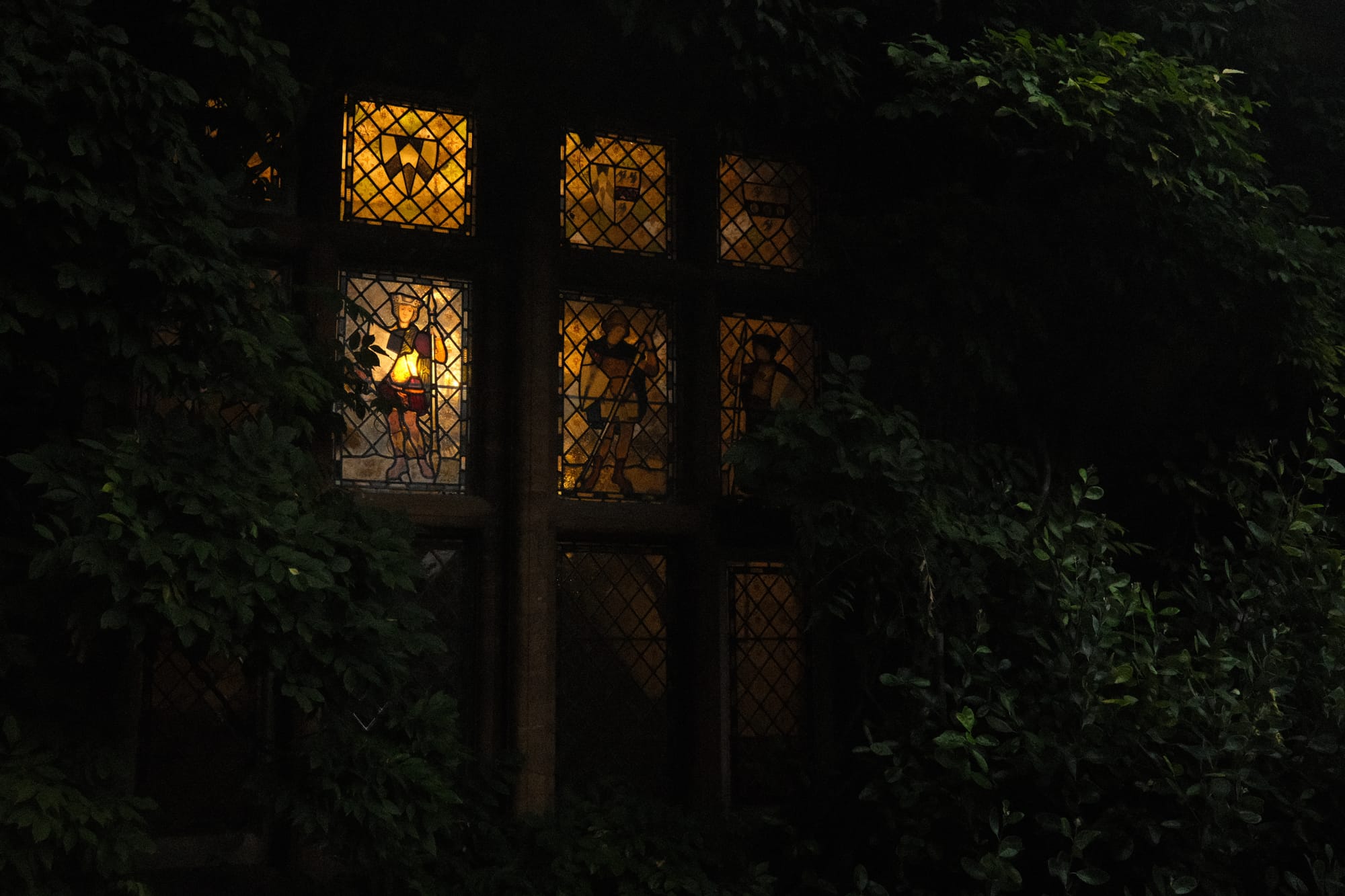
When it comes to old-school ghost stories, nobody does it better than M. R. James. The Stalls of Barchester Cathedral is about an ambitious clergyman who, after murdering his elderly predecessor, gets a promotion, and with it the beautiful, intricately carved wooden choir stalls. Soon, the carvings, which depict a cat, a monk, and a figure of Death, begin to show unsettling signs of life. It is an incredibly creepy tale that will make you reconsider becoming too jealous of your classmates’ successes or sitting in old wooden chairs.
After all, university is already full of Gothic ingredients: living with strangers in an unfamiliar place, losing sleep, being closely watched, obscure rules and the constant suspicion that everyone else knows what they're doing. Fiction makes us feel less alone in finding the ordinary world less horrifying. But if you hear something moving around downstairs at 2 a.m., perhaps leave the investigation until morning.