By Lewis Burley, Third Year Theatre and Performance Studies
In its preview form Spotlights’ Edinburgh Fringe show God Complex presents itself as a familial sitcom about mythological Greek Gods. But this veil does not present the defining characteristic of the production. As it progresses it intelligently utilises its mythological concept to explore the darker and complex themes of misogyny and toxic masculinity.
God Complex is the culmination of years of planning by co-writers and directors Leah Pollard and Felix Glanville. Their brainchild has the excellent conceit of what if the mythological Greek Gods, with no one believing in them, still existed and how would they respond to the modern world. This concept becomes fertile ground for Pollard and Glanville’s sharp eye to engineer brilliantly constructed jokes which at points act as thematic veiling for their willingness to engage with sensitive themes that less assured productions would shy away from. It is this duality that not only sees God Complex as an extremely welcome addition to the new writing programme of work in Bristol. But supported by the producing team of Lia Middleton, Katie Shallcross and Hannah Bates, it is a production which, in flashes, demonstrates why it is worthy of the Edinburgh Fringe slot.
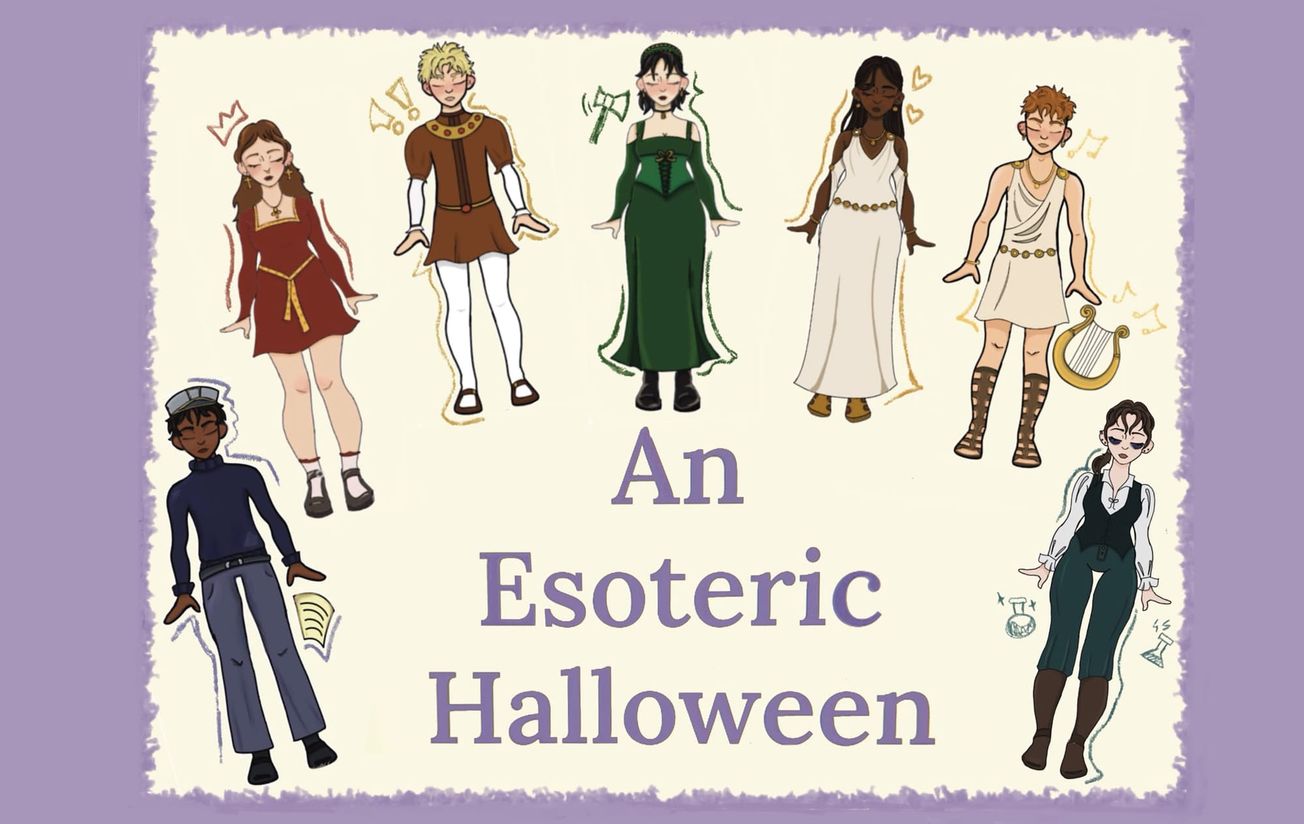
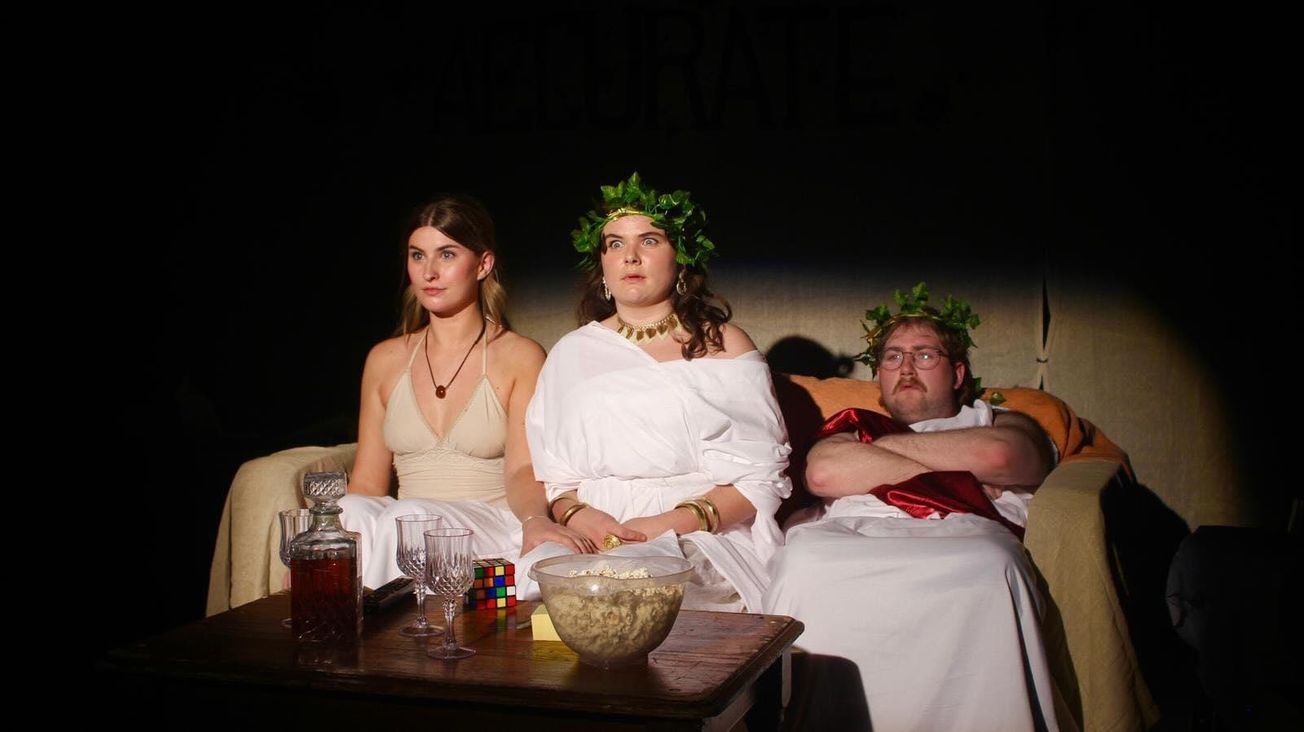
The production employs the sitcom genre staple in its promotional image (created by Mollie Furey) of the core cast of characters all together in frame, staring down the camera lens, posed in a way that tells you a broad defining trait of each character. It's a common trope within Bristol student theatre, but here it becomes the first act of luring the audience into a familiar setting before taking them down a more uncomfortable path. The sitcom presentation is not just in the promotional material, entering the Richmond's Pegg Theatre you are greeted with a sofa sitting centre stage. The piece of furniture becomes the predominant area of character action invoking parallels with classic sitcoms such as Friends. A white sheet hangs behind the sofa with the painted statement "This Is Not Mythologically Accurate", which works nicely to hint at the creative liberties Pollard and Glanville have taken with Greek mythology, while also setting the comedic tone which is present throughout the majority of the production.
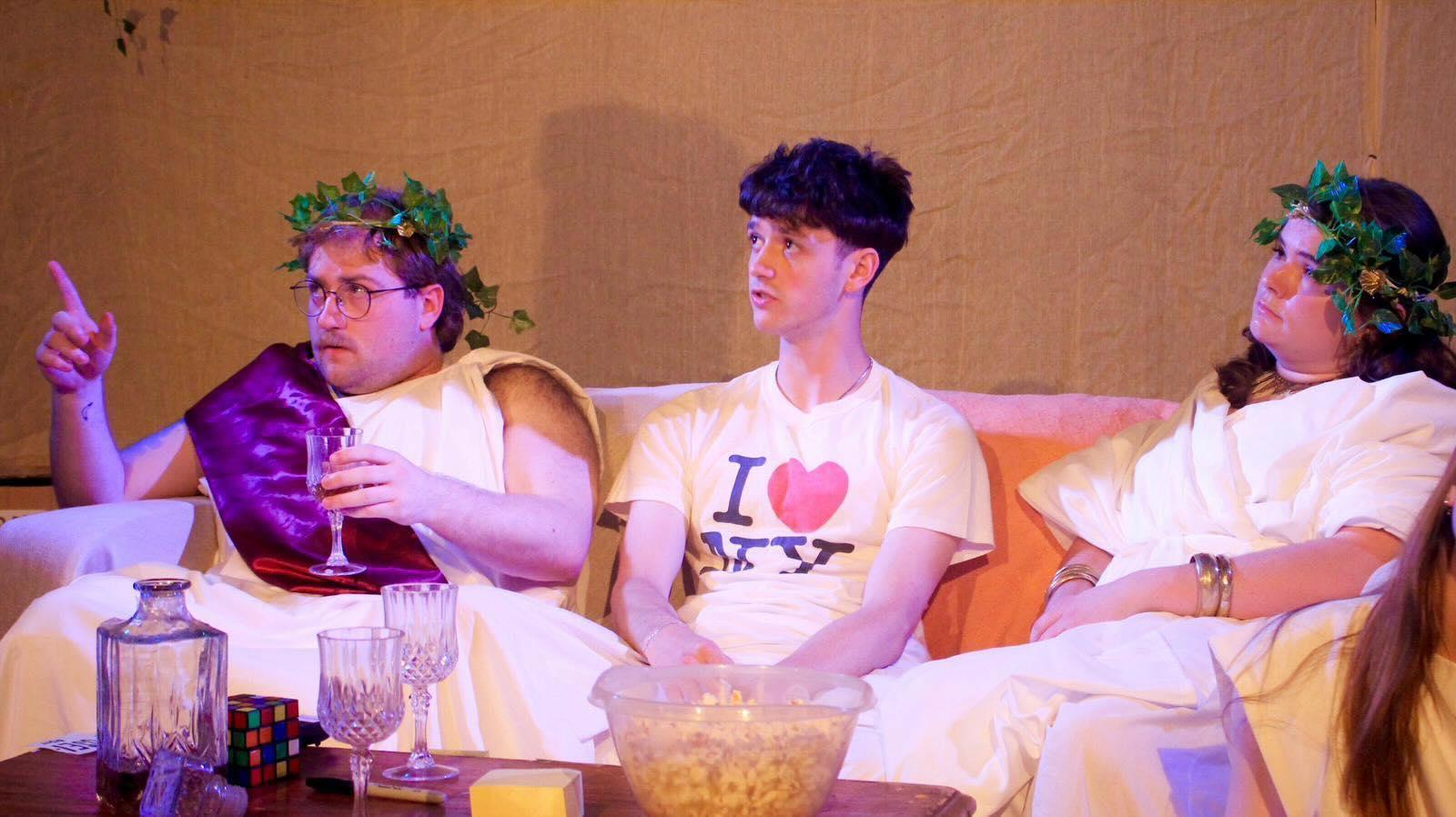
The creative liberties Pollard and Glanville have taken sees an ego-fragile Zeus (James Davies) infatuated with Aphrodite (Beth Griffiths) who in turn is infatuated with Zeus’ wife Hera (Kathleen Keaney). Hera’s increasing openness to Aphrodite’s overt advances becomes a harbour for Hera from Zeus’ tyrannical outbursts. Simultaneously Artemis (Hattie Parkinson), despite being continuously mocked by her brother and their father Zeus, attempts to help her brother Apollo (Ezra Sandiford) who has fallen in love with a mortal he doesn’t realise is an online therapist. After a failed meet the parents which turns into a family therapy session and boozy party in Olympus the threads of a love triangle, failed romance, and the through line of misogynistic aggression tie up into a revelatory conclusion.
Pollard, Glanville, and their assistant director Pearl Opoku have worked successfully to direct wonderful performances with a highly talented cast. Davies is a commanding head of the gods, eccentrically portraying Zeus’ megalomania with the usual influential presence you can feel from any seat in the house when Davies is on stage. Parkinson is as strong as ever in the role of a bookish Artemis, once again proving she possesses vast amounts of talent. From the eyes alone Griffiths excellently plays Aphrodite almost in a mesmeric state of dalliance. Griffiths also doubles as Medusa who, with a bag over her head every time she is on stage, brings a stoic physicality to the mute Gorgon. As Apollo Sandiford creates a strong brother-sister rapport with Parkinson’s Artemis, the pair squabble and jab at each other constantly in a relatable sibling dynamic. Despite having conviction with more frivolous scenes, during moments of dramatic revelation Sandiford’s assurance waned. A standout was Keaney as Hera. Keaney beautifully portrays Hera’s doubt and hesitancy during a monologue to Medusa which is full of conviction, while also displaying sharp comedic nous throughout in a brilliantly accomplished performance.
Although not completely faultless, the quality of the script and writing talent of Pollard and Glanville is the star of the show. They display a great confidence and knowledge with Greek mythology which they exploit to devastating comic effect, a highlight being Hera trying to explain and play the game Who Am I with the mute and bag-covered Medusa. They introduce each character and the tenants of life in Olympus well enough that the production is comprehensible to those with little to no knowledge of the Olympians.
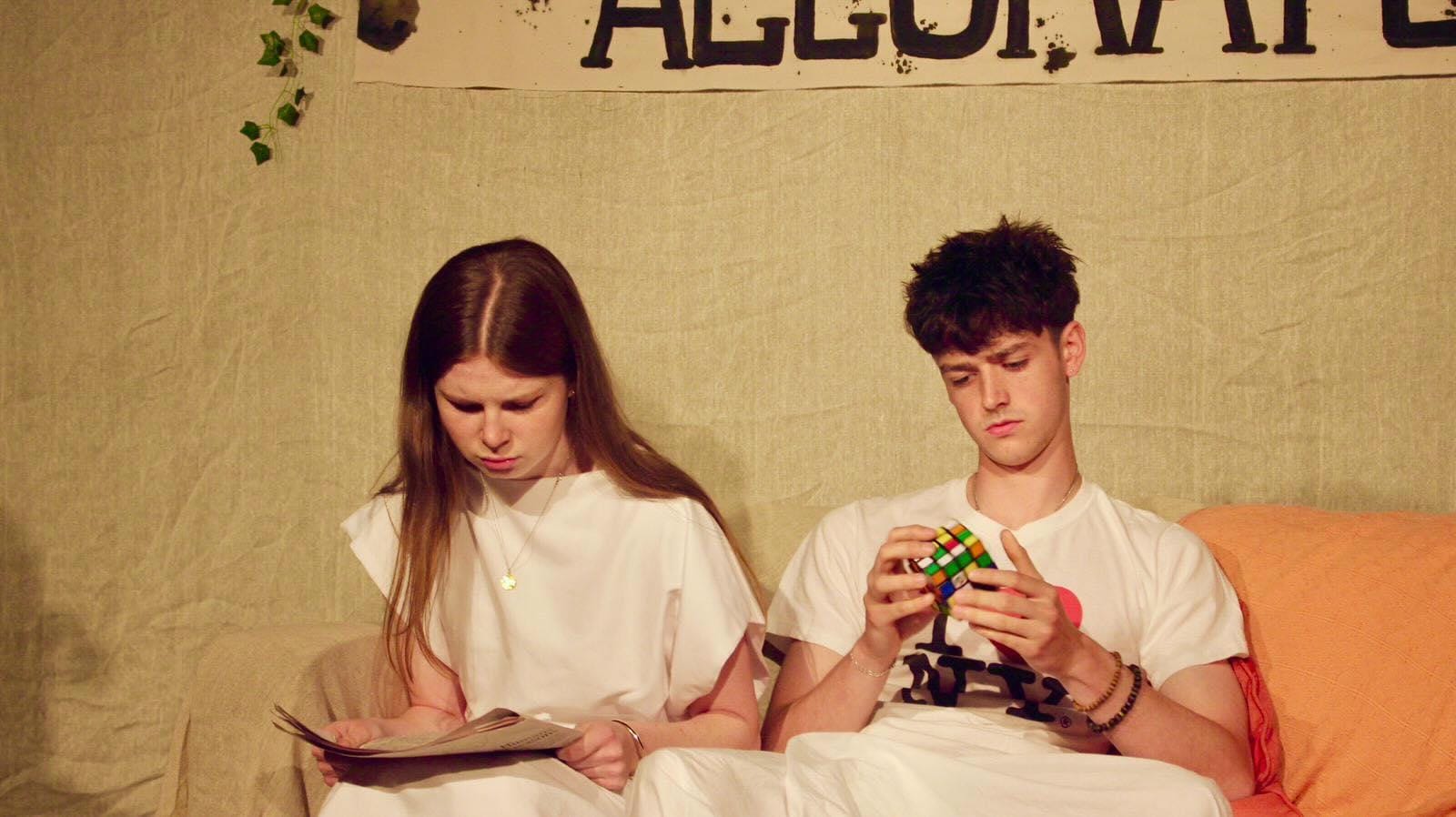
With the concept of Greek Gods in modernity, they draw comedy from the absurdly archaic hyper patriarchal structure of Zeus at the head of the family with absolute supreme authority. This is epitomised in Hera who, having only just started reading, wrestles throughout the piece with the idea and the temptation going against her commitment to Zeus and his imposed patriarchy when Aphrodite openly flirts with her. It is with the father-son relationship between Zeus and Apollo that God Complex explores contemporary toxic masculinity within the framework of the archaic hyper patriarchal structure of Greek mythology. Throughout the performance every character is draped in togas by the design and costume team of Anna Fibbins, Phia Jones, and Maddy Ward, however Apollo sports an incongruous I Love New York t-shirt. He plays with a Rubik’s Cube, openly espouses his infatuation for mortals much to his father’s chagrin, and falls in love with one virtually through a laptop. The production can’t help but signal that he is the most contemporary or human-esque character. When Artemis questions him for reacting to being rejected by his therapist by sleeping with his father's favourite Aphrodite, he aggressively berates her. Rising above Artemis to exclaim why he is better than her, a ramble which is punctuated with the line ‘I’m bigger than you!’. The hostile direction of the sibling teasing brings forward the question of the undertones of the ribbing in previous scenes. Together with his contemporary character, his Zeus-like reaction to replace the loss of an emotional love with meaningless sex and aggression to being questioned, Apollo becomes a parable for boys learning and reproducing problematic behaviours from fathers and older men and the continuation of toxic masculinity and misogynistic vitriol.
It is an igneous format to explore such a subject, if only there was more. This was what was meant previously by flashes. Pollard and Glanville have formulated a brilliant device but power it up just too late to truly explore and satisfyingly conclude the ramifications of the final act’s revelations. Despite a dynamic and witty script, Zeus’ rage and confusion of not knowing how to work modern tech like a TV or a laptop becomes rapidly repetitive and the jokes suffer from diminishing returns almost instantly. At points the direction lacked dynamism and wit, with extended periods of static sedentary sofa bound action which slowed down the pacing and limited the vitality of the piece. Thankfully the talent of the cast and the astuteness of the script was able to shine through to keep the production engaging when the blocking lacked initiative.
Despite a few blemishes (and what show doesn’t have them), God Complex is an extremely impressive, tightly written, and brilliantly acted play. Pollard and Glanville cannot be commended enough for devising such a nuanced and thematically rich concept. The beauty of this preview run in The Pegg means the company has time to tweak and alter the production to ensure the show is in the best shape before the Fringe in August. If you are attending the Edinburgh Fringe this year God Complex in its final form may just be a must see.
 Charles Hubbard
God Complex is running from 24th-29th August in venue 43 theSpace @ Symposium Hall – Annexe. Tickets can be purchased here: https://www.edfringe.com/tickets/whats-on/god-complex
Featured image: Spotlights / Mim Clements
Will you see God Complex at the Edinburgh Fringe?