By Megan McLean, MA Environmental Humanities
Pressure (2026) documents the true story of the plight of determining the meteorological conditions for the historic Allied parties’ invasion of Normandy - more frequently referred to as D-Day.
It is understood to be a pivotal turning point that led to the Allied forces winning WWII so the film is consequently undercut by this ‘pressure’. The title wields a dual meaning, both alluding to the slight change in conditions that allowed the soldiers to storm the beaches but also the tension that is laced throughout the film.
The film's opening shot undeniably aims to set this tone with an overhead shot of the beaches of Devon (in actuality Camber Sands). While the landscape is scenic at first glance, the crimson of fresh blood slowly mingles with the teal shores of the failed Exercise Tiger (the tragic trial run for D-Day). From the outset, the solemn atmosphere is established.
We are then placed into the home of James Stagg (Andrew Scott), who is having a final quiet morning with his heavily pregnant wife (Tamsin Topolski). After they say their goodbyes, she becomes emphasised by her absence as Stagg tries to contact her on the secure military base. Stagg is a reserved, devoted character that gives a lot of time to his decisions and is far more stoic in contrast to the more boisterous characters of Dwight Eisenhower (Brendan Fraser) and Irving Krick (Chris Messina) who are assertive and self-assured.
The first scene with Krick highlights his charisma and a light-hearted air. He entertains his team with a lively rendition of ‘Boogie Woogie Bugle Boy’, even managing to get a smile on Kay Summersby’s (Kerry Condon) face, who is otherwise appropriately serious in her role as the personal secretary to Eisenhower. Messina is a delight to watch and the arc that director Anthony Maras screenwriter David Haig set him on is satisfying as a viewer. Despite some writing that I can only describe as petty bickering, Scott and Messina play off of each other wonderfully.
The crux of the film is the fundamental disagreement between Krick, who was previously Eisenhower's sole confidant in determining the conditions for army raids, and Stagg, who has entered as a specialist meteorologist endorsed by Winston Churchill. Krick applies his tried and tested method of analog forecasting, largely considered unscientific due to its reliance on the weather following similar patterns year-to-year. Whereas Stagg uses the current data that, despite public weather forecasts being paused, was still being scrupulously collected. Ultimately, it is his approach that Eisenhower places his faith in, despite the conditions at the time of his decision not representing what Stagg was forecasting and the decision being rather unpopular.
On the originally proposed day for the attack, the army officials are attending a church ceremony as Stagg sits under a tree waiting. Suddenly, the rain starts and it intensifies into a humongous storm. Eisenhower leaves the church and meets eyes with Stagg, giving him a solemn nod as his doubts of making the wrong decision wash away with the rain. As the rest of the officials start filing out of the church, a superimposition of Krick begins as he begins to toil with the reality that would have occurred if his overconfidence had been followed. It signifies a shift in his and Stagg’s relationship, which catapults them to their ultimate collaboration.
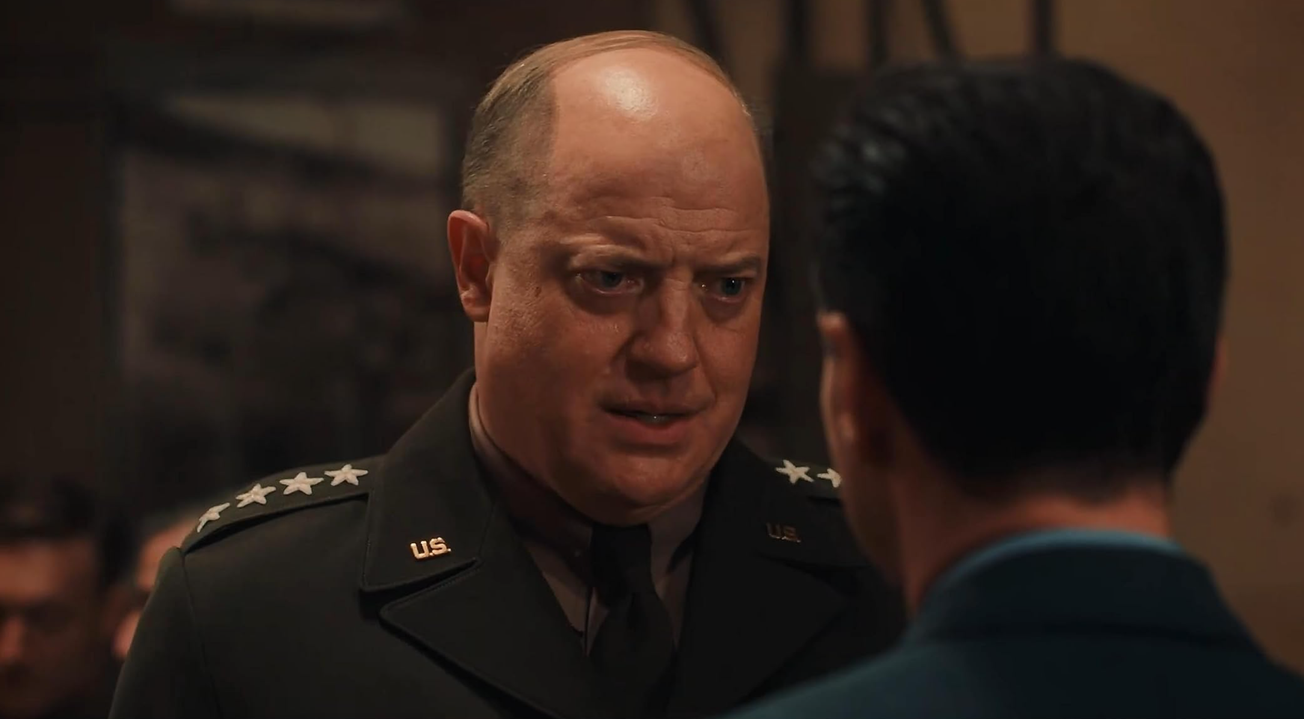
Fraser’s performance as Eisenhower is excellent. There are moments where he is yelling and you can feel his frustration and worry bursting at you through the screen. However, he is also allowed to have scenes with Summersby where it dawns on you that, despite his experience and expertise, he is still just one man tasked with an impossible decision. Fraser himself was not sure if he was up to the task of portraying him when initially offered the role, but I honestly could not picture anyone else.
The end of the film hits you with euphoria but also an inexplicable sadness. Maybe it's the way Maras makes you watch the invasion in near silence. Maybe it’s the accumulation of watching Scott present the unlikely circumstance of a break in the storm - a decision of importance most of us cannot fathom - while experiencing complete and utter mental despair at being unable to contact his wife. I won’t be the first or the last to say this but Scott is magnetic. There is something about his performance that makes you unable to look away from him whenever he is on screen.
 Ella Saxton
Pressure is so much more than a film about the weather. There is an emotional depth to these portrayals and, despite some weaker moments of writing, the cinematography and acting manage to carry the film to a fervent end.
Featured image: IMDb / Pressure
What's your favourite WWII film?