By Leanor Allon, Second Year, English
Throughout his oeuvre, Roy Andersson has maintained a consistent dedication to presenting a hauntingly bleak image of the human condition - a theme that holds a central importance within his feature films. Focusing on the mundane, his despairing presentations of the human experience are characteristic of his filmography.
In 2015, the New York Museum of Arts and Design presented a retrospective of Andersson’s work entitled ‘It’s Hard to Be Human’, examining the prevalence of this motif. He applies an aesthetic of trivialism in his examination of small actions and moments, allowing for an emotive response from the audience. According to Andersson's website, in his film About Endlessness (2019), which won the Silver Lion at the Venice Film Festival, ‘inconsequential moments take on the same significance as historical events’.
In a 2015 interview with IndieWire, Andersson said the following:
‘A linear story is a trap. You’re trapped in that construction. If you leave that ambition and think in fragments, it’s richer – it allows you to see all sides of existence. I want to tell stories about existence, and I think I make it more interesting with fragmentary storytelling.’
His enigmatic narratives express traits that draw comparisons to the postmodern tradition in their fragmentation and pastiche, while also expressing modernist traits of high aesthetics. In Songs from the Second Floor (2000), King Charles XII enters a bistro with his army, returning as broken men after their defeat at the Battle of Poltava. Quotidian subjects and storylines played out by ordinary-looking actors emphasise his desired effect of normalised torment. Travelling salesmen, bankrupt businessmen and anonymous everymen are the main characters of his films. Their grotesque unravelling on-screen in depicted through episodic despairing vignettes - the actors made up with ghastly white face paint and the palette restricted to muted colours like a desecrated Wes Anderson.
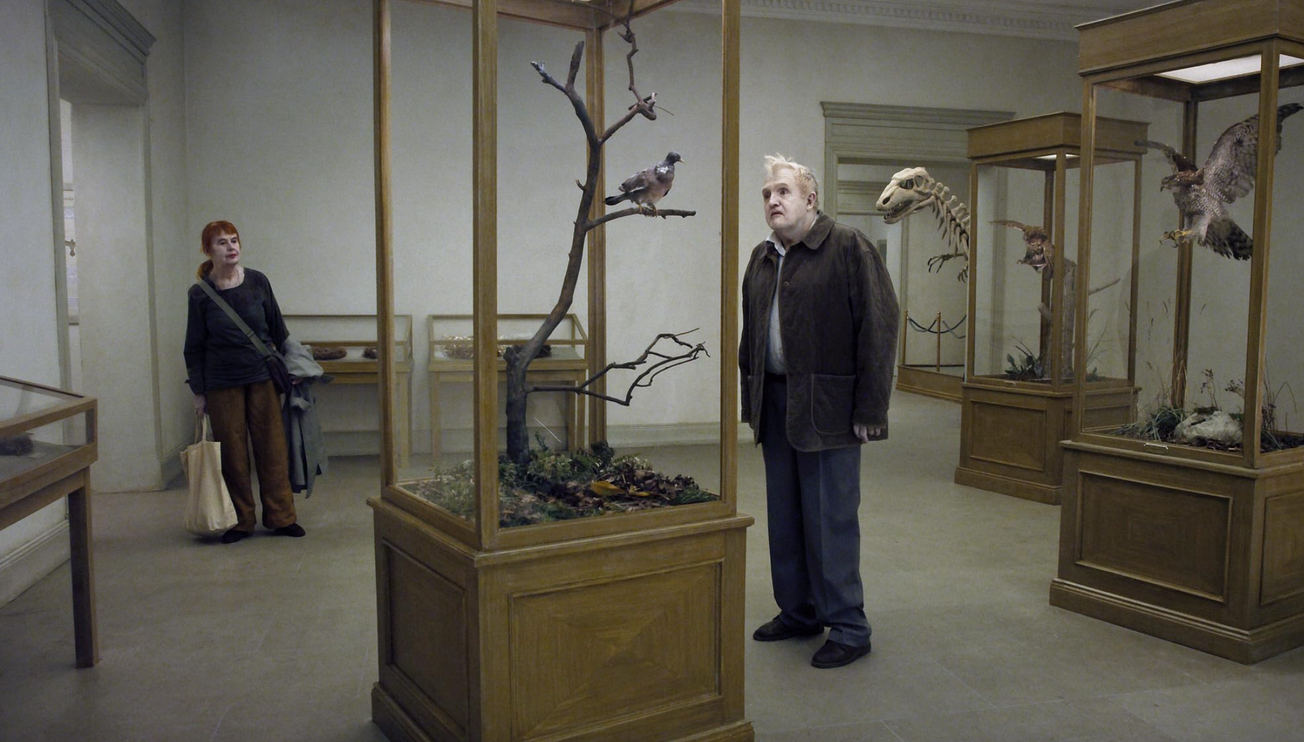
Andersson’s distinct personal cinematographic style sees long, unbroken takes filmed from a singular deliberate angle in carefully staged wide-angle tableau shots. In this way, meticulously composed scenes become cinematic paintings. His compilation of works titled ‘The Living Trilogy’ best depict this effect. The trilogy consists of the aforementioned Songs from the Second Floor (which won the Jury Prize at the Cannes Film Festival), You, The Living (2007) and A Pigeon Sat on a Branch Reflecting on Existence (2019), which won The Golden Lion for Best Film at Venice.
He constructs a highly stylised world within every scene, hand-making miniature interior dioramas and detailed cityscapes inside his Stockholm studio: Studio 24. He founded Studio 24 as an independent production company of feature films, short films and many more artistic outputs following a 25 year break from the film industry after the poor reception of his 1975 film Giliap. He called Studio 24 ‘a quest for independence’.
It was during this time that Andersson dedicated himself to his labour-intensive cinematic productions with it taking him four years or longer to produce a film. He he has only produced six features over the last 50 years. However, his work in advertising has led him to direct over 400 adverts and a number of short films.
Andersson's view of the inherently comedic nature of suffering takes inspiration from Irish playwright Samuel Beckett (best known for his 1952 play Waiting for Godot). Andersson examines universal anxieties of love, death, ageing and spiritual desertion in his films in a caricatural yet affronting approach. The way in which he implements dark and absurdist humour as a method of commentary makes him something of a social satirist and he approaches existential issues facing society with a dismally deadpan tone.
Criticising consumer capitalism and addressing the weight of historical colonial violence upon the collective psyche, Andersson is concerned with suffering, chastising what he views as a modern indifference to the suffering of others while drawing attention to the universal suffering of everyday life. His avant-garde scene construction viscerally addresses historical amnesia and questions the morality of bystanders, implicating the viewers into the narrative as inactive witnesses. Fostering what Sight & sound journalist Nadin Mai referred to as a ‘fascination with the absurdity of human life and our collective ignorance in the face of history’, he references atrocities such as the Holocaust in World of Glory (1991) and slavery and human torture in Pigeon.
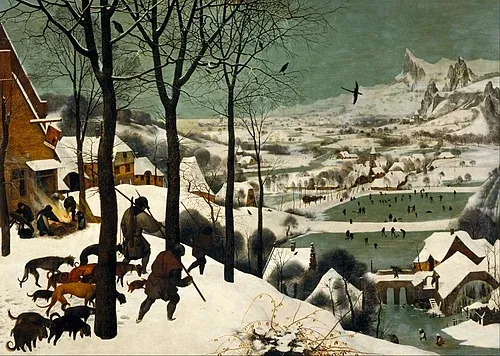
In terms of Andersson’s artistic influences, he cites movements that place an emphasis on humanism, such as German New Objectivity artists George Grosz, Otto Griebel, and Otto Dix. Dutch Renaissance artist Pieter Bruegel’s The Hunters in the Snow (1565) is said to be directly referenced in Pigeon through its foregrounding of everyday labours of man, while Songs features similarities to The Procession to Calvary (1564) through the motif of the crucifixion: a recurring theme in Andersson’s filmography.
 Bethan Parry-Jones
In particular, his satirical response to the alleged loss of religion in the modern world sees About Endlessness’s narrative focus upon a nihilistic pastor struggling with his loss of faith. Furthermore, Edward Hopper’s illustrations of lonely American alienation, especially Nighthawks (1942), provides a sense of artificiality seen in Andersson’s mise-en-scène. Both artists employ the sense of emptiness to invoke meaning. These artistic influences aid in the visual manifestation of Andersson’s meticulous curated film art.
After About Endlessness, Andersson concluded his extensive cinematic career aged 76, announcing his retirement with the documentary Being a Human Person (2020), which recorded his creative process.
Featured image: IMDb / A Pigeon Sat on a Branch Reflecting on Existence
Who's your favourite European arthouse filmmaker?