By Rebecka Melvin, Third Year, Philosophy
Released in 1986, Manhunter was a primary influence on the police procedural and forensic style thrillers that took off in the early 2000s. Rewatching the film now brings with it a sense of nostalgia for the patient and methodological way of filmmaking in the late 80s. With its meticulous detail, specific procedure and distinctive visuals, Manhunter encapsulates what feels like a lost art compared to a lot of modern filmmaking.
Mann’s stylistic choices are recognisable in many films that have followed since its release, from his eerie blues, antiseptic environments and disturbingly cultured antagonists. David Fincher’s films Se7en (1995) and Zodiac (2007) spring to mind. With comparable pacing, Fincher understands the value in depicting forensic procedures to build tension while leaving space to develop characters, allowing the audience to consider and analyse the killer’s motives rather than rushing to solve the murder. What is especially impressive is Mann’s ability to manipulate his audience into a cognitive dissonance of empathy for the villains.
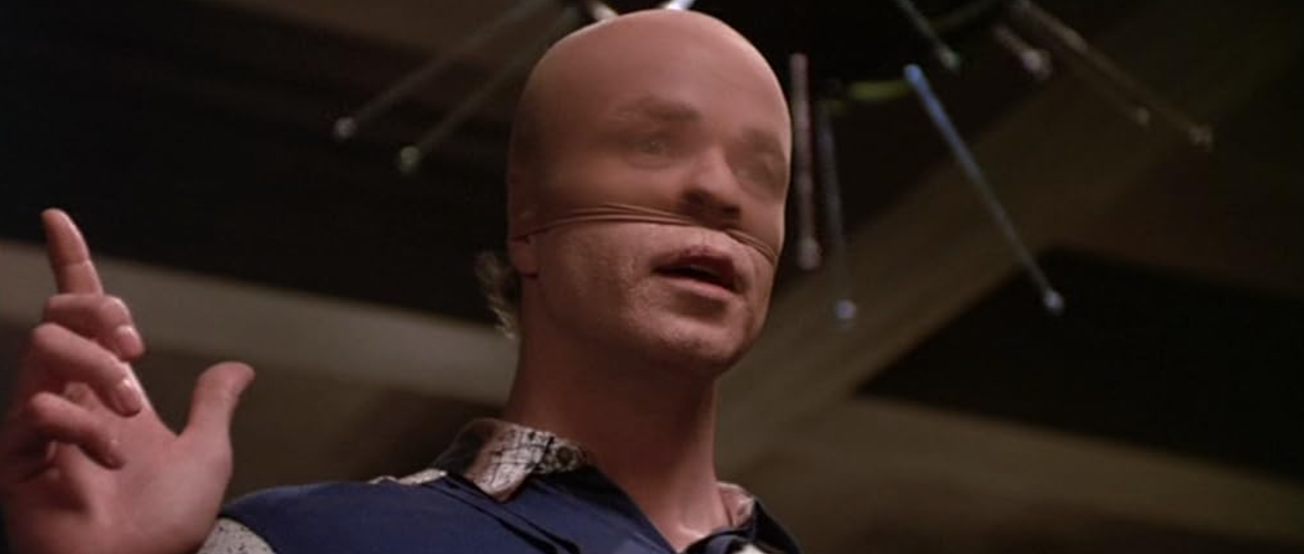
Rather than dismissing his villains immediately, Mann wants the audience to understand them. Through the course of the film, Mann does psychological work to encourage the audience to comprehend the motives behind the actions of the killer. He develops the tragic childhood of his antagonist Francis Dolarhyde (played by Tom Noonan), who experienced significant childhood trauma and social rejection. Mann builds on an intimate relationship between the killer Dolarhyde and Reba (Joan Allen): a kind yet vulnerable blind woman.
Interestingly, he devotes less time and detail to developing the relationship between the protagonist Will Graham (William Petersen) and his family. By doing this, Mann seems to want us to have the same deep understanding of killers as Graham: a criminal profiler with immense empathy allowing him to retrace the intentions and actions behind the murders he investigates. Mann blurs the line between the audience taking the perspective of the investigator and the murderer, often placing the camera in the subjective framing of the killer’s POV, which, at the same time, could be Graham’s retracing of the actions before the murder.
Further, the background is frequently blurred enough for the audience to make out a vague background, but not enough to identify specific places that the film takes place. A reason for Mann’s choice in doing this is revealed in a scene with the egotistical reporter Freddy Lounds (Stephen Lang) and Graham taking newspaper pictures to attempt to bait Dolarhyde. Graham guides the photographer to ensure the sign in the background is identifiable by Dolarhyde, but ‘not too obvious’. Mann wants the audience to experience the blurring of the line between detective investigation and the killer’s investigative work, building on the symbiotic relationship between Graham and the murders he empathises with.
The psychiatric environment Mann crafts and masterfully maintains throughout the film is another elaborate way he develops his characters and ropes in his audience. Brutalist buildings and hypermodern rooms composed of bare white walls and violent white or blue lights compromise the haunting style of the film. Mann plays with the psychological dimensions of his settings, establishing uncomfortable backgrounds that help create tension and existential dread.
A similarity with the TV show Severance (2022-) can be noticed from the corporate absurdism Mann captures through male dominated office spaces, decorated with impersonal postmodern architecture. These environments connect us to the isolating, consumer-driven and disconnected world Will Graham experiences. The deep-rooted empathy Graham has detaches him from the present neo-capitalist world and from his mechanical colleagues who are disinterested in motives and human understanding.
There is also a blatant focus on technology, particularly as an ideal source for malevolence. Home-videos are used by the killer for stalking and phones are lines of communication between Hannibal Lecter (Brian Cox), an imprisoned cannibal, and Dolarhyde seem to elicit an anxiety Mann has with modernising technology. Yet his struggle with it also manifests in a form of awe with heavy detail paid to forensic lab scenes. This is particularly striking to reflect on - in a current age of continuously upgrading technology, Mann forces us to recognise the significance of technology to the criminal world.
 Luca Woodruff

The last thing to mention is the sparse use of music in the film. One cannot help but notice how most scenes are silent, giving attention to any and all actions of the characters. However, when music is used, it is often in relation to the killer. Believing Reba is romantically seeing her colleague, Dolarhyde kills him with ‘Strong as I Am’ ironically playing in the background as a hype-up song for the murderous act. Again, a rock song is used in one of the last scenes of the movie when Dolarhyde is about to kill Reba.
Though meant to touch again on the delusional state Dolarhyde enters as he murders his victims, the only killing that happens is done by Graham, who forces himself into the crime scene and kills Dolarhyde. Throughout the film, Graham walks a thin line of thinking like a murder with inclinations to kill, while maintaining his ethical and humane self. The final scene where Graham stalks Dolarhyde from the woods - a reference to earlier shots of Dolarhyde's POV during one of his stalking and killings - is a collapse of his character. Though the movie ends with Graham reunited with his family on a peaceful, brightly lit beach, it is a haunting scene where a Hollywood hero ending masks the reality that Graham has taken an unnecessary part in a murder.
Featured image: IMDb / Manhunter
Did you catch the 40th anniversary screenings of Manhunter?