The international booker longlist comprises 13 books, selected from 128. The conditions for consideration: the book can be originally written in any language but must have been translated into English and published in the UK or Ireland between May 2025 and April 2026. Following the longlist, a shortlist of six books will be selected, and finally a winning author-translator pair will split the prize money of £50,000.
Looking back over past years, we can see how the international Booker nominations tend to be a microcosm of society's concerns. The longlist in particular can be a good overview of the preoccupations of literature in the past year. For the 2026 round of nominees, the themes that reoccurred across the list included war, transformation, rebellion, and generally, each book seems to linger in some way on a capacity to endure and remain hopeful in challenging times. As head judge, Natasha Brown, mentions: ‘many submissions examined the devastating consequences of war, which is reflected in our longlist’. With the ongoing conflicts in Ukraine, Palestine, and the seemingly constant possibility of the US triggering a new one, the preoccupation with war is unsurprising.
Six authors and seven translators are previous nominees while five pairs have worked on a previous nomination. Three are debuts and two were originally published around thirty years ago, only recently translated.
The international Booker is a brilliant spotlight of the best translated fiction, frequently highlighting authors who are otherwise unknown to an English audience. Having followed this prize for a few years, I’ve been introduced to some incredible books, but also developed a sense for what is shortlist (and sometimes winner!) material. In this spirit, the below list is both an introductory menu to help you select your next read, as well as my attempt at predicting which books are most, or least, likely to make it to the shortlist, to save you reading all thirteen!
 Kashvi Cox
(1) The Nights Are Quiet in Tehran by Shida Bazyar, trans. from German by Ruth Martin
Set across four decades, this polyphonic novel follows one family’s flight from Tehran. Shifting the perspective from the husband and his clandestine political actions to the wife during their time in hiding in East Germany, to each child, one who returns to Iran and one who doesn’t. Through each era, this novel is at its core a story of revolution, oppression, resistance, and freedom.
[Potential to shortlist – a sweeping, multigenerational story of resistance has strong shortlist potential, but I think it clashes with another Iran set nominee]
(2) We Are Green and Trembling by Gabriela Cabazón Cámara, trans. from Spanish by Robin Myers
From previous nominee Cámara, this novel is at once tender and surreal. A queer narrative set in the wilds of the New World, based on a real figure of the Spanish conquest whose gender is malleable in the transformative rainforest setting. The book is a critique of religious tyranny, the mistreatment of women and indigenous people.
[Likely to shortlist – I think this is perfect shortlist fodder; experimental, political, with beautiful prose and a wide range of ideas presented]
(3) The Remembered Soldier by Anjet Daanje, trans. from Dutch by David McKay
In the aftermath of WWI, we connect with the psyche of a traumatised man, losing contact with his identity. After losing all memory, his wife eventually finds him, but the reunion is not the miracle they want to believe. Gradually the two grow close again, but questions of trust and truth swirl for our protagonist.
[Unlikely to shortlist – I think the Deserters is a novel too similar, which does what this book does in a less straightforward way, making it unlikely that both will shortlist!]
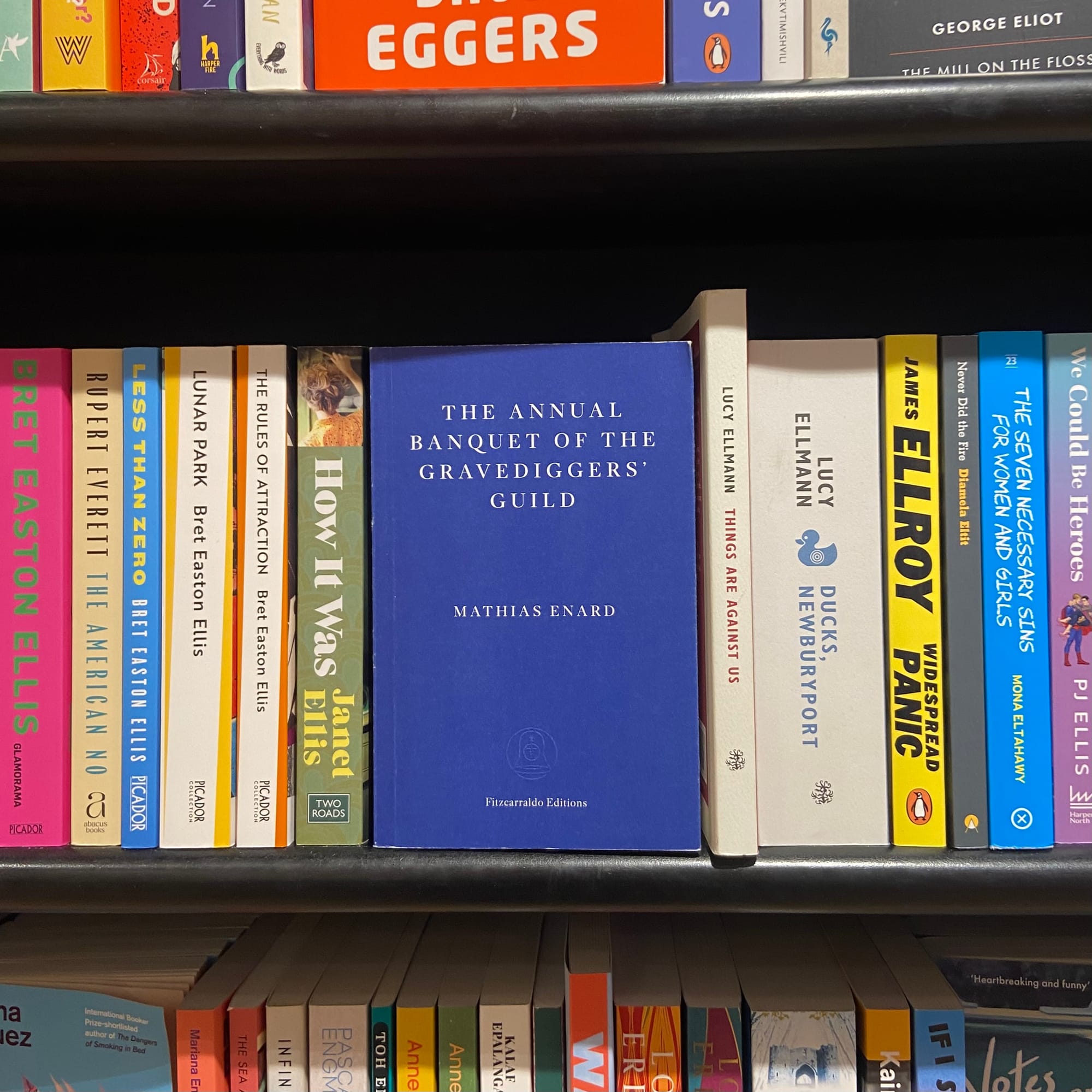
(4) The Deserters by Mathias Énard, trans. from French by Charlotte Mandell
From the previously shortlisted pair, comes a novel that centres around the pull between two narratives that reveal the intimate repercussions of conflict. Fleeing a nameless war, a soldier emerges from the Mediterranean wasteland and has a chance meeting; on 11 September 2001, a scientific conference pays tribute to an East German mathematician, communist and anti-fascist.
[Likely to shortlist – a repeat nomination, combined with the similarity of this conflict to several other modern ones makes this a solid choice for the next stage]
(5) Small Comfort by Ia Genberg, trans. from Swedish by Kira Josefsson
This collection of short stories is intricately built around one central concern: cold hard cash. From an interview with a child star turned thief, to the couple faking marital satisfaction in order to keep their inheritance, Grenberg examines the value we place on both money and people while slyly implicating the reader along the way.
[Unlikely to shortlist – the reasoning behind this is purely that an excellent short story collection won last year, and it's unlikely another would follow!]
(6) She Who Remains by Rene Karabash, trans. from Bulgarian by Izidora Angel
Set in Albania, our protagonist Bekja escapes arranged marriage by swearing herself a virgin and renouncing her womanhood to live as a man. This decision catalyses a destructive chain of events, separating her from her family and lover. An intense and poetic novel, it unspools a narrative of identity, gender, love, freedom and societal norms.
[Despite sharing thematic similarities with ‘We Are Green and Trembling’, I think both have shortlist potential – the drastically different settings and styles make them both equal contenders.]
(7) The Director by Daniel Kehlmann, trans. from German by Ross Benjamin
In the wake of the Nazi’s rise to power in the 1930’s, a talented film director flees Austria – only to find himself compelled to return and care for his ailing mother. He and his family are confronted with the regime's brutal nature, and the propaganda minister won’t take no for an answer as he tries to source the filmmaker’s genius. This novel explores the relationship between art and power, of cog and conspirator.
[Likely to shortlist – for me this is unquestionable; this book hits exactly the shortlist marks. It’s deeply topical, thematically unique, and allows the IBP to reflect on its own role as well.]
(8) On Earth As It Is Beneath by Ana Paula Maia, trans. from Portuguese by Padma Viswanathan
This unsettling novel takes us to a state-built prison in the wilderness, where inmates are exclusively male. Having only succeeded in trapping, not changing them for the better, its operations are winding down, so a new horror is unleashed: every full moon night, the inmates are released, the warden is armed, and the hunt begins. Maia offers a bracing vision of our potential for violence, and our collective failure to account for the consequences of our social and political action, or inaction.
[Potential to shortlist – in the wake of recent political developments]
(9) The Duke by Matteo Melchiorre, trans. from Italian by Antonella Letteieri
A character study of a mountain village governed by nature, this novel presents the Duke, living in content isolation, tolerated, if gently mocked by his neighbours. When he discovers that a man has been stealing timber from his land, he must choose between remaining isolated or honouring his ancestry. With the pace and plot twists of a 19th-century classic, the ensuing story asks 21st-century questions about our relationships with privilege, the past and the natural world.
[Unlikely to shortlist – this book’s chance on the shortlist relies on its style and prose. If it is engaging enough then it stands a chance, but I think there are more likely contenders.]
(10) The Witch by Marie NDiaye, trans. from French by Jordan Stump
Originally published in 1996, NDiaye’s witty, dream-like novel follows a mediocre witch whose own powers were stunted by shame, trying to pass on her magic to her twins. As becomes quickly evidenced by their curious tears of blood, her daughters’ skills far surpass her own; learning this they quickly fly (literally) the nest. Unsettling and enchanting, this book poses unanswerable questions about the mysteries of womanhood and motherhood.
[Likely to shortlist – if not as topical as some of the other ones that I’ve suggested, this novel stands on its own as a genuinely excellent, skilful novel that has a fighting chance despite it’s age]
(11) Women Without Men by Shahrnush Parsipur, trans. from Persian by Faridoun Farrokh
A powerful and essential tale of female freedom; originally published in 1989 and banned in Iran since, this novel traces the interwoven destinies of five women from all walks of life. By different paths, they arrive to live together in an abundant garden on the outskirts of Tehran. Drawing on Iranian history and mysticism, Parsipur illustrates the narrow confines of family and society, and imagines their future living in a world without men.
[Extremely likely to shortlist – the book’s fraught history, Parsipurs several incarcerations for writing it as well as extremely recent political developments concerning Iran make this a very strong contender]
(12) The Wax Child by Olga Ravn, trans. from Danish by Martin Aitken
Previously shortlisted, this time Ravn offers a chilling story about female power, brutality, nature and magic. Based on an infamous 17th century Danish witch trial, we land in 1620, with a small child who has set her wax in the image of a small human. Carrying it around, her warmth shapes it further, gives it life, and the wax child observes all – from the pine forest to the cruelty of men.
[Likely to shortlist – despite not being the most natural topical pick, I think in this case a compelling and well-constructed narrative could trump obvious relevance]
(13) Taiwan Travelogue by Yáng Shuāng-zǐ, trans. from Mandarin Chinese by Lin King
A romantic and incisive post-colonial novel, Shuāng-zǐ’s first novel to be translated into English tells a bittersweet love story between two women. As interpreter Chizuru aids Chizuko’s travels around Taiwan, Chizuko becomes infatuated. But something keeps her travelling companion at a distance, and it is only after a heartbreaking separation that Chizuko begins to grasp what it is. An artful exploration of language and power, this book unearths lost colonial histories and deftly reveals how power dynamics inflect our relationships.
[Could shortlist – it's focus on language itself makes it a good pick, and it presents an interesting post colonial narrative, but there are similar narrative's (see Camara's entry) that I think have a stronger chance]
Which books do you think will shortlist?
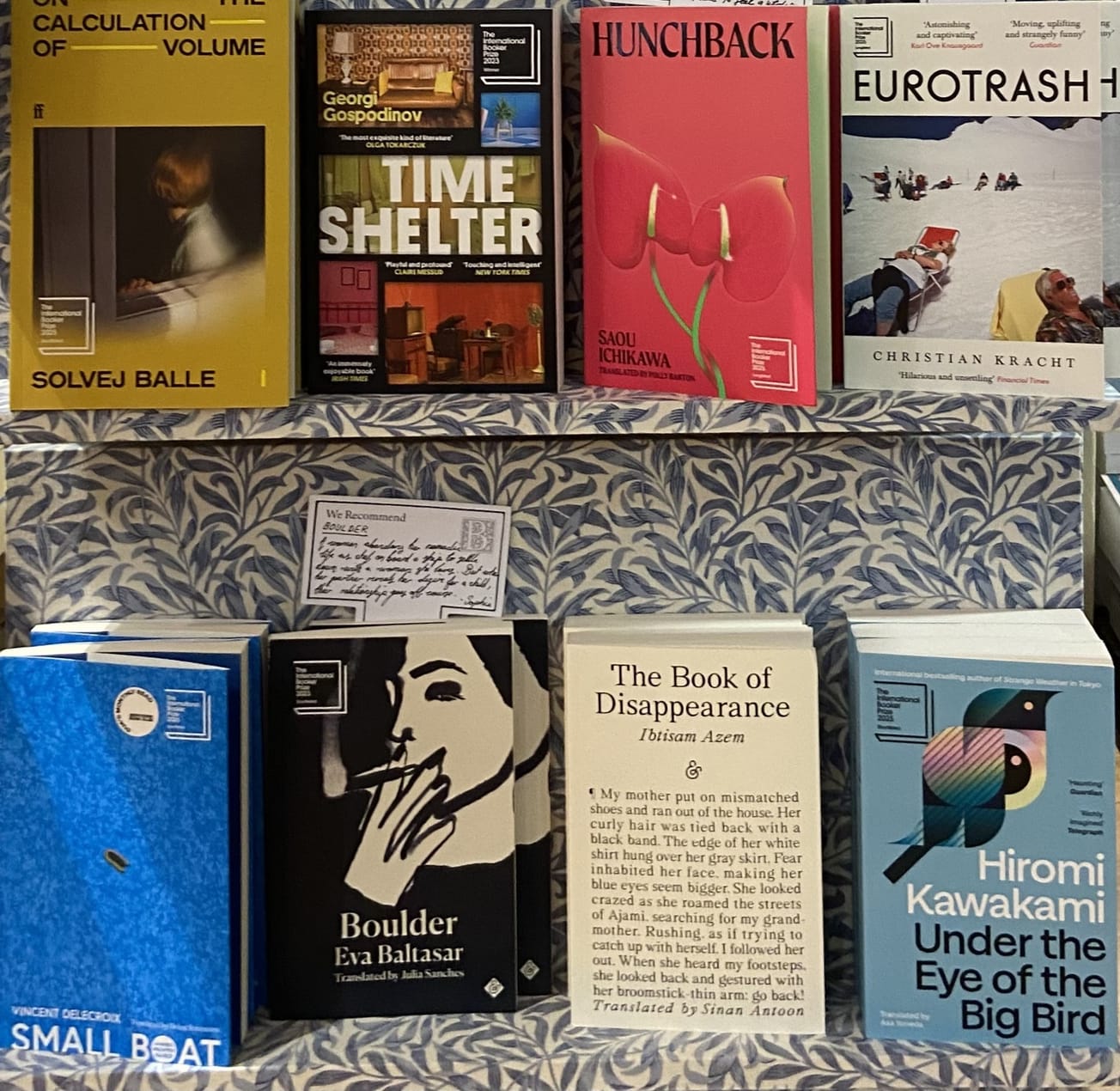
Featured Image: Epigram / Ruby Wright