By Alfie Coan, Third Year, Physics
The dinosaur subgenre has been through a lot since evolving from its early 20th century silent era roots. Stop-motion legends like Willis O'Brien and Ray Harryhausen refined the combination of dinosaurs and live-action actors in the ‘50s and ‘60s. Spielberg’s use of CGI revolutionised the look of on-screen dinosaurs in his masterpiece Jurassic Park (1993).
But what comes next? The subsequent entries in the Jurassic Park franchise have been disappointing at best and most modern attempts only wish they could be described as such. Peter Jackson’s King Kong (2005) is a notably admirable effort - and don’t forget Ice Age: Dawn of the Dinosaurs (2009)! But it’s safe to say it has been tough for fans of dinosaur films in the last three decades. How hard can it be to make a decent, fun dinosaur film?
The latest attempt, David Robert Mitchell’s The End of Oak Street (2026), is a step in the right direction. We are thrust immediately into a quiet suburban American neighbourhood in 1982. It’s a sunny day, families are milling around and the kids are playing together in the street. In a matter of minutes, we meet the Platt family. Daughter Audrey (Maisy Stella) is introduced as scientifically minded, quoting the work of astronomer Carl Sagan. Her younger brother Brian (Christian Convery) is anxious about their parents’ relationship and finds comfort in his dog, Starbuck.
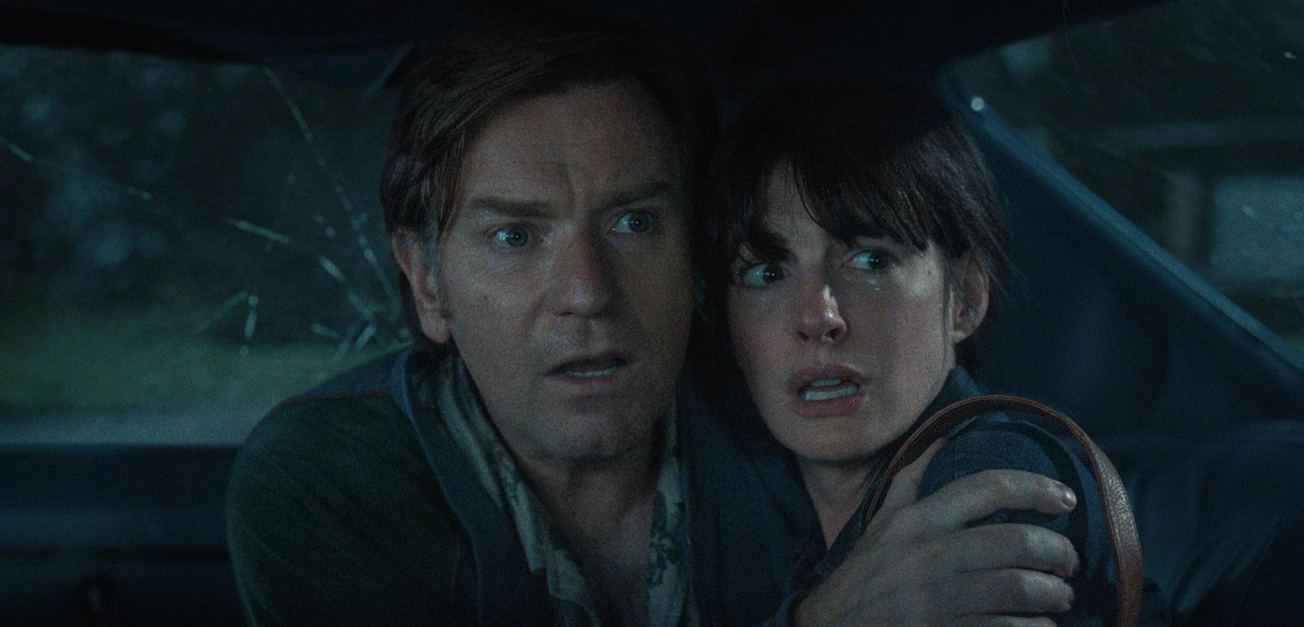
The parents, Denise and Greg (Anne Hathaway and Ewan McGregor respectively), are trying to hide their fragile marriage from their kids and personal struggles from each other. As we follow the family through their normal lives, a strange plant appears in a neighbour’s garden and Brian begins noticing strange, bright lights from his bedroom window. The first act feels akin to E.T. the Extra-Terrestrial (1982) and is certainly more Spielberg-esque than the man’s very own Disclosure Day (2026).
Denise stands out initially as the most developed character, and we learn that she writes as a form of escapism - about a woman running away from home and moving to New York to start a new life. Greg delivers pizzas to make ends meet after losing his job, a fact he keeps from Denise out of embarrassment, and seems to struggle, or have struggled, with a drinking problem. Denise’s wishes for change are granted when, by cosmic coincidence, the entire neighbourhood is transported 200 million years back in time. Dinosaurs begin to pour into the streets, the basement in which Denise escaped her life floods, the Platts are trapped together in their boarded-up house and we wonder whether the greater problems lie outside or inside the house.
Not a single performance falls flat and Hathaway and P.J. Byrne (as the complaining neighbour) are particularly great throughout. The score, composed by the prolific Michael Giacchino, draws us in to the humdrum suburban life of the Platts and gradually builds an atmosphere of mystery and wonder when our characters encounter something otherworldly. It proves most successful when the family comes face to face with their new prehistoric neighbours and we become immersed, standing beneath an ancient behemoth of a creature, holding our breaths and hoping it doesn’t notice us. Cinematographer Mike Gioulakis, who has worked with Mitchell previously on the horror film It Follows (2014), commands excellent use of split-diopter shots to elevate the family conversation scenes.
The motivations behind the choice to set the film in the ‘80s are unclear and it serves only as a surface-level addition to the film’s aesthetic. This echoes the treatment of many of the film’s characters: traits seem to only exist as decoration rather than meaningful additions. Denise’s writing, Greg’s job struggles and alcoholism and Audrey’s sexuality could all be avenues into exploring the family relationships further but they are all left by the wayside in favour of the dinosaur movie route. Denise is sidelined as her own personal struggles and feelings of escapism are seemingly left in 1982 and the issues between Denise and Greg are concluded through distraction rather than actual resolution.
 Alfie Coan
The exhilarating dinosaur thriller ultimately undermines a promising subtext about marriage and family relationships before allowing it to resurface for one last breath at the end of the film. It seems that The End of Oak Street tries to be two things at once and loses its balance before eventually stumbling over the finish line with a nice final message. Can a dinosaur film also be a compelling family drama? I’m not sure, but at least Mitchell has been willing to give it a shot. Despite struggling to succeed as the latter, the action sequences are a lot of fun, the dinosaurs look and sound great and the premise is exciting. As a dinosaur film, End of Oak Street is one of the best, if not the best, since Spielberg blew everybody’s minds back in 1993.
Featured image: IMDb / The End of Oak Street
Do you think that David Robert Mitchell is the new Steven Spielberg?