By Alfie Coan, Third Year, Physics
Both Backrooms (2026) and Obsession (2025) bring forth the next generation of horror filmmakers and the future looks terrifyingly bright. How does A24’s psychological horror film, from the studio’s youngest ever director, hold up under the buzzing, fluorescent yellow lights?
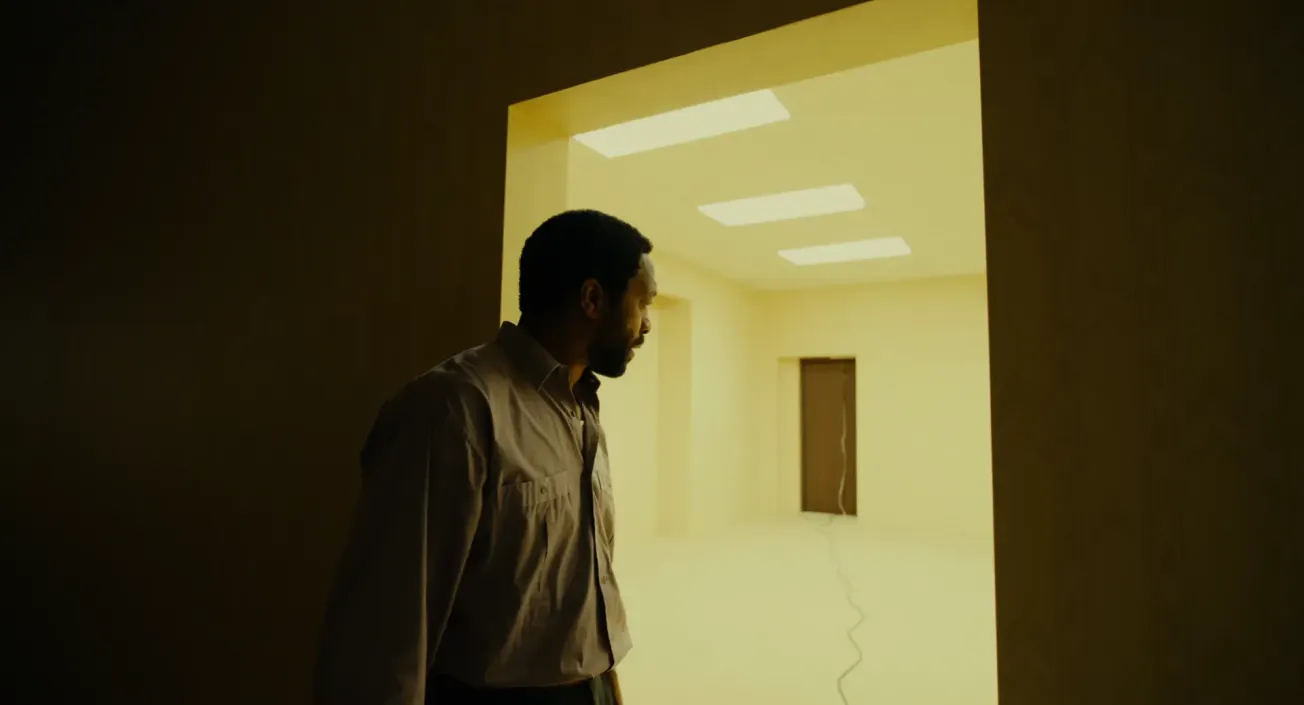
Starring Chiwetel Ejiofor and Renate Reinsve in the leading roles, Backrooms explores an unsettling world covered in musty, old wallpaper and lit in sickly yellow by headache-inducing lights from the perspectives of Mary (Reinsve), a therapist haunted by her childhood, and her struggling patient, Clark (Ejiofor). Watching this on opening night after the premiere screening of Looking for Laurie was a contrasting experience to say the least.
Originating from an anonymous post on the online forum 4chan in 2019, the open-source internet urban legend of the Backrooms piqued the interest of Kane Parsons, who began making found footage videos for his YouTube channel in 2022 at the age of 16. Four years later, his original video has been viewed over ninety million times and Parsons, at 20, has become the youngest A24 director in the studio’s history. Backrooms has also become the studio’s most financially successful film to date, pulling $393 million (£290 million) at the global box office on a modest $10 million (£7.4 million) production budget.
The film explores the minds of the two protagonists, Clark and Mary, as their pasts, presents, and futures fall out of balance. Clark, a lonely furniture salesman, recruits his two young employees to help him explore a claustrophobic expanse of unusual corridors and rooms he has discovered in the basement of his furniture shop. After growing concerned following their recent sessions, Mary, Clark’s therapist, enters the Backrooms in search of him. Mary’s tumultuous memories of her childhood and Clark’s growing mental instability are explored and, in many cases, fled from through nonsensical spaces and dark corridors that feel almost like distant memories of the real world.
There is a lot more going on that meets the eye. Backrooms offers a subtext exploring the psychological effects of anxiety, grief, and the monster within ourselves that resists positive change and growth in favour of moral stagnation. In many ways, the Backrooms themselves are a product of the characters’ own minds. The plot, as with many aspects of the film, is minimal and leaves much up to interpretation (or possibly a sequel?), and so the film serves as an effective introduction to the world of the Backrooms for those unfamiliar with the concept.
As we have come to expect from them, Ejiofor and Reinsve deliver excellent performances and make the most of a script that doesn’t fully enable them to showcase their best. Finn Bennett and Lukita Maxwell are effective as Bobby and Kat, the cautious pair who follow Clark into the Backrooms and serve as a straightforward way to incorporate the found footage elements via Bobby’s camcorder, which make for the strongest sequences in the film. This is where Parsons shines in showcasing what he has effectively perfected over the past four years: shaky camera-work, dramatic angles, low-quality fuzz and a feeling of impending doom and electric tension that only lets up when the camera cuts off. These (unfortunately infrequent) sequences are immersive, nail-biting and addictive.
The cinematography throughout the rest of the film is still effective: playing with symmetry, shadows, and tricks of perspective to mimic the characters’ disorientation, as well as drawing inspiration from countless images posted online that present empty, unnerving spaces. Wide-angle lenses promote the isolation of characters within the frame, presenting overwhelming loneliness as well as up-close desperation and panic. Parsons has spent years meticulously crafting his sets in the 3D graphics software Blender, and his work alongside cinematographer Jeremy Cox to translate his signature visual take on the Backrooms to real physical spaces (the crew constructed 30,000 square feet of Backrooms sets) and real cameras, without an over-reliance on CGI, is commendable.
Complete creative control over the set design leads to each room and corridor looking perfectly out-of-place, that is to say perfectly fitting the Backrooms. The sound design and score is yet another highlight: the buzzing lights and distant, alien echoes are accompanied by fantastically dissonant, disturbing tones which keep us on edge throughout.
 Leah Pollard
Backrooms reflects a lot of the most successful aspects of Parsons’ YouTube series in its found footage sequences, cinematography and sound design. Somewhat unsurprisingly, the aspects of the film which are least present in his original series, namely character writing and development, are the weakest of the feature. It is a narratively conservative but well-executed piece of work that sets Parsons up for a bright future in horror directing. While not as strong a statement as fellow Gen Z horror director Curry Barker’s Obsession, Backrooms excels in atmosphere and immersion, and hides a lot under the damp, beige carpet in the way of a deeper exploration into the human psyche.
Featured image: StillsLab / Backrooms
Do you agree that Backrooms and Obsession signal a new wave of horror?