
By Charles Hubbard, Film & TV Deputy Editor
Tim Curry had always been one of those actors who everyone knew, even if they wouldn’t necessarily recognise him if they saw him. Whether he was dressed up as the killer clown Pennywise in the 1990 miniseries It, wearing heavy facial prosthetics in Ridley Scott’s Legend (1985) or clad in a get-up that would inspire thousands of drag queens for decades in The Rocky Horror Picture Show (1975), Curry always preferred to physically disappear into his roles in a way that made leading man fame somewhat elusive.
A character actor who exerted an outsize impact on every single one of the films he graced with his devilish Cheshire cat grin and notoriously idiosyncratic speaking patterns, Curry gave voice to the oddball and weirdo in all of us - a contribution to film and theatre history that will undoubtedly outlast any top billing.
Like Diane Keaton, who also passed away recently, Curry started his career in the original production of the musical Hair (1968-1969), which redefined the countercultural musical for the 1960s in a way that Rocky Horror would do for the 70s. Curry continued to be a major name on the London stage, garnering Olivier nominations for playing The Pirate King in The Pirates of Penzance (1982) and King Arthur in Spamelot (2006-2007). However, his biggest stagebound achievement came from the other side of the pond in 1981 when he originated the role of Mozart in the Broadway production of Peter Shaffer’s Amadeus, starring alongside Ian McKellen, who played Antonio Salieri, Mozart’s wannabe ‘rival’. It’s no wonder that, after playing Shaffer’s overtly sexualised, semi-revisionist iteration of Mozart, Curry quickly became Hollywood’s top choice to play weirdos and oddballs with a generous dollop of British charm and cheeky camp.
Curry’s next most prominent role came in 1985 when he played Wadsworth, a mischievous, conniving butler, in Jonathan Lynn’s cult classic adaptation of the board game Cluedo (that’s Clue for the Americans in the back), which features perhaps the single most astonishing sequence Curry ever committed to screen - after the “Sweet Transvestite” number in Rocky Horror, of course. In that film’s climax, which was originally released with three separate endings, Curry gleefully races around the film’s doll’s house set, explaining the various different ways in which the central murder could have been committed with exquisite physical and verbal dexterity - I’d thoroughly recommend looking it up on YouTube if you’re in the mood for a good belly laugh. We all have our favourite line from Clue (popular choices include Madeline Kahn’s “Flames on the side of my face” and Michael McKean’s superlative mic-drop “I’m gonna go home and sleep with my wife”) but my favourite will always be Curry’s hysterical delivery of “She had friends who were socialists. Well, we all make mistakes.”
Curry’s chameleonic virtuosity continued onto the small screen, when he perfectly physicalised Pennywise the clown decades before Bill Skarsgard would offer up his much more menacing take on the character. As much as I love Skarsgard’s malevolent eyes, I’ll always prefer Curry’s veneer of lightness and friendliness that makes his hidden violence and monstrousness all the more terrifying. Curry continued to pop up in smaller roles, perhaps most notably as Long John Silver in Muppets Treasure Island (1996) and a similar version of his character from Clue in Home Alone 2: Lost in New York (1992). I wonder if he and Donald Trump, who cameos in the latter film, ever interacted on set. No role was too small or seemingly gauche for Curry to try his hand at. He continued to be a prolific voice actor well into his sixties, lending his clout to Ferngully: The Last Rainforest (1992), Star Wars: The Clone Wars (2012-2014) and the audiobook release of A Series of Unfortunate Events: The Bad Beginning (2002), for which he was nominated for a Grammy.
 Alfie Coan
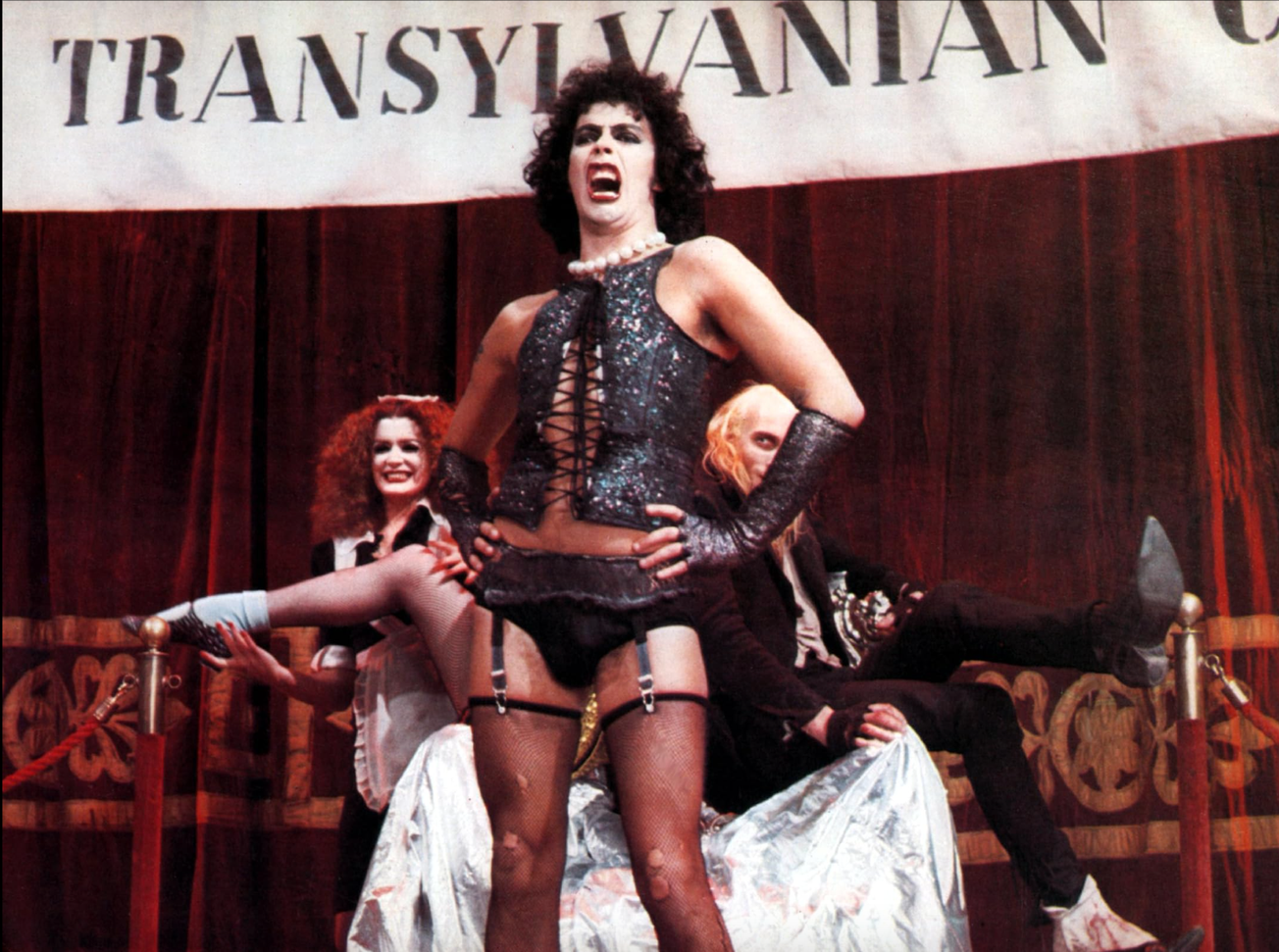
But of course the role for which he will always be remembered is as the bisexual, gender-fluid mad scientist Dr Frank-N-Furter in The Rocky Horror Picture Show - both the original London and Broadway productions and the 1975 film directed by Jim Sharman. In terms of sheer impact on pop culture, especially when it comes to fashion and cabaret performances, I would argue that Curry’s turn as Frank-N-Furter is easily one of the ten most important screen performances in the history of cinema. For decades after the film’s release (during which it continued to be played regularly at revival screenings across the world) and even now, Curry’s leathery black corset, heavy white pearl necklace and purring delivery is still what many people think of when they hear the words ‘drag queen’. While Curry always kept his romantic life strictly private, he has widely been claimed by the LGBTQ+ community as a queer icon, predominantly for his turn as Frank-N-Furter.
Curry was always a master at every domain he put his hand to. Theatre, film, TV, music (he has also released three rock-focused studio albums) - he could do it all. Curry was a true legend and will continue to be for as long as people still have the drive to fire up Rocky Horror for the umpteenth time and feel the antici………pation of waiting to see him blaze onto the screen once again.
Written by Charles Hubbard
Featured image: IMDb / Tim Curry
What's your favourite Tim Curry performance?


)