By Freddy Buck, Second Year, Neuroscience
If you've ever wondered why you or someone you know loves a good spooky horror film, rollercoaster, or even why people actively pursue dangerous hobbies like skydiving, this article will attempt to answer those questions.
Fear is something hardwired into humans; it is something that has been learnt through our ancestors to keep us safe. But it seems rather irrational for us to experience such high levels of euphoria from something designed to keep us from harm.
However, since we are coming up to my favourite season, Halloween, so many of us will be settling down to watch a few scary films with our flatmates, attending scare mazes and fright nights or even telling ghost stories into the night. These are things I did in my first year, and you cannot help but find such fear- and anxiety-inducing experiences somewhat fun. Almost as if you are drawn in and addicted to the way they make you feel. But why is this?

Fear stimulants such as horror movies or scary mazes activate the prefrontal cortex of the brain, the hippocampus, and the amygdala, which make up the limbic system. This system acts as the emotional regulation centre, where the spooky stimulus is processed, and a fear response is activated. This in turn activates our sympathetic nervous system, triggering a release of adrenaline from our adrenal glands.
We commonly know this as the fight-or-flight response, causing reactions such as pupil dilation, sweating, and increased heart rate. This is all designed to give us the best physiological state to flee the stimulus or face it head-on. Scary movies, however, pose no real threat to us, and we consciously know this. Research has found that when we watch horror films, we have a protective frame allowing us to understand that the film is not real, and so we can enjoy the thrill of it. Scientists suggest that by taking the wider context into account, we shift from a high-arousal state of fear to a state of excitement as we know we are safe.
The hippocampus and prefrontal cortex also play a major role in the interpretation of situational context and risk levels. Higher-level processing from these two brain structures allows us to perceive that the movie's psychopathic villain is not a true threat. The hippocampus acts as a memory library to provide the wider context of the situation, whereas your prefrontal cortex interprets this memory to tell your nervous system that you are actually sitting on your sofa watching the scary movie. This shift from feeling real danger to understanding we are safe triggers the release of endorphins and dopamine.
Dopamine is part of our reward system and is associated with excitement. For instance, the anticipation of a monster attacking your favourite character in a film poses no real danger; because we can take this into account, we shift from fear to safety and thrill, reducing the sympathetic nervous system response since the threat is not real. Whereas being home alone and hearing noises in your flat/house could be a real danger, and so you stay in a state of fear.
Dopamine, as part of our reward system, targets other brain regions like the basal ganglia, a group of nuclei found within the brainstem. The basal ganglia is often associated with habitual and addictive behaviour. Hence, the surge in dopamine from scary movies activates the basal ganglia and ultimately feeds this thrill behaviour and explains why people can't help but watch horror films, go to scare mazes and get involved in thrilling activities, often referred to as “adrenaline junkies”.
Such thrill-seeking behaviours can lead to social bonding.
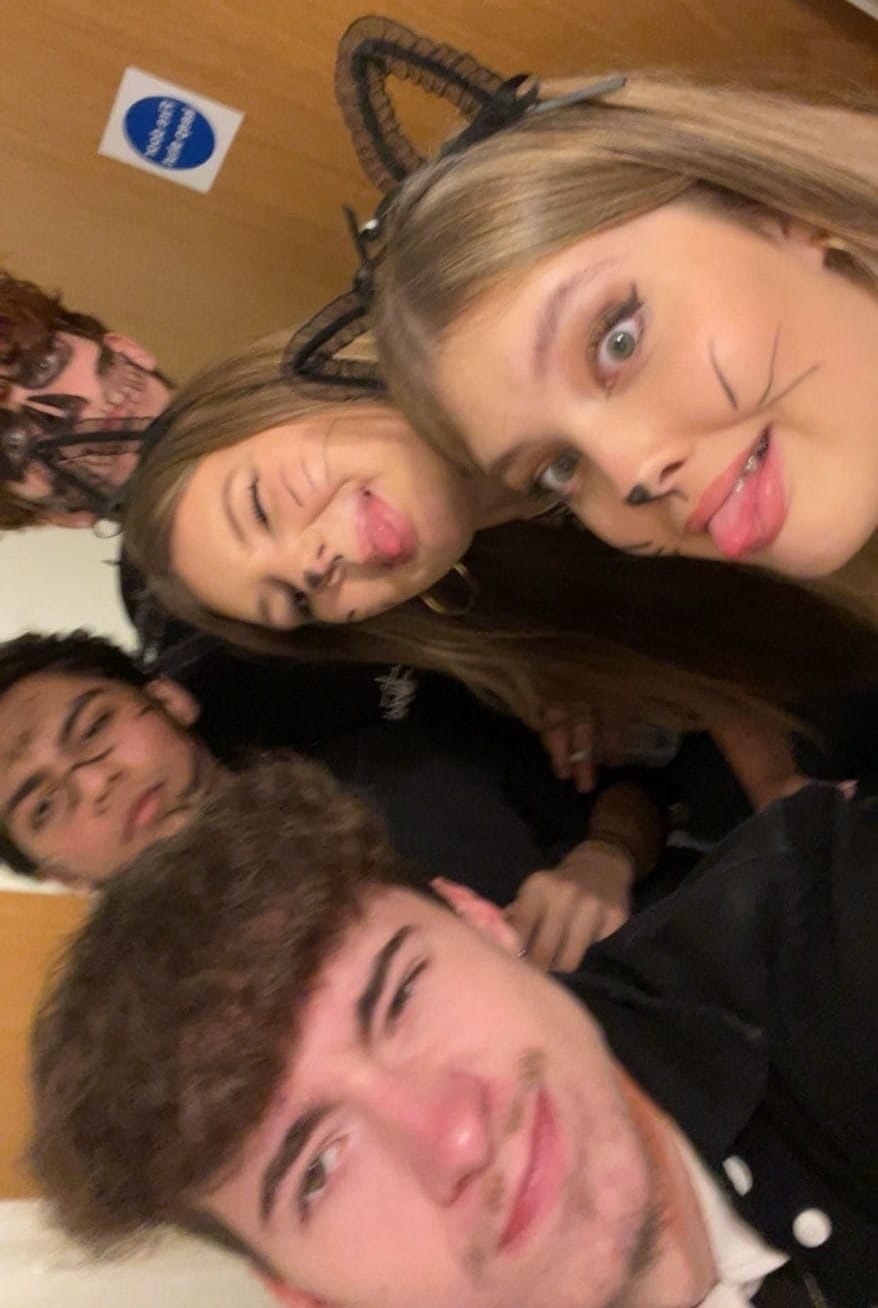
As I can imagine, this autumn, many of you will be watching horror films with flatmates or your friends, rather than watching alone. This is because frightful activities not only release adrenaline and dopamine but also oxytocin. This is a social bonding hormone which can create a sense of closeness between you and others. But also, in the past we thrived due to safety in numbers. Being with more people meant a higher chance of survival and reduced danger. Whilst no real threat exists when watching a horror film, the same idea applies; the same way anxiety nowadays has generalised to your essay deadline.
 Barney Johnson
 Meadow Wattret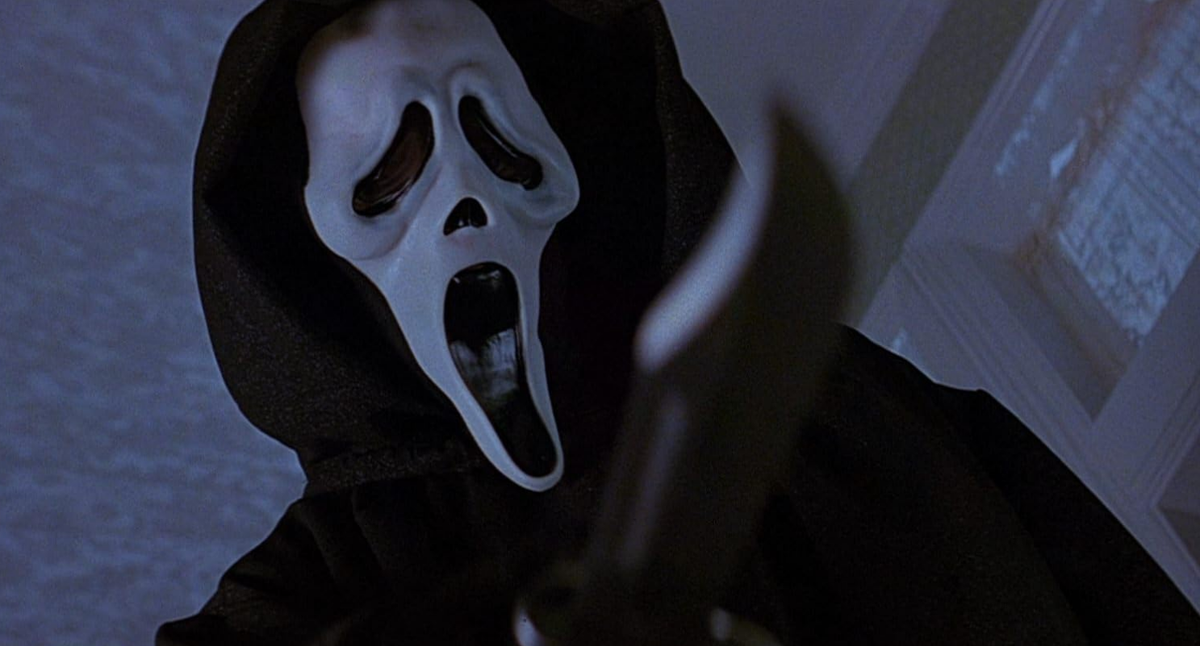
So next time you think about watching a horror film, going to a fright night or going on a rollercoaster, bring a few friends, as you now know the benefits neurologically behind doing so, and it may help bring your flat even closer and make new friends whilst doing so.
Feature Illustration: Epigram / Romina Treviño
Are you a horror film dopamine junkie, or do you steer away from this genre?