

By Katy Bright, Second Year, English
As one of the most celebrated authors globally, William Shakespeare has become a household name. Whether you study English Literature at university level or you haven’t picked up a book in years, most of us have interacted with his works at some point in our education. April 23rd has been coined ‘Shakespeare Day’, marking the anniversary of his birth and death. Celebrations take place annually to recognise his contribution to playwriting and poetry, through parades, performances and dedication days in schools.
Sometimes it feels almost unbelievable that one man could have had this much success. Writing a presumed 38 plays (that we know of) and a subsequent 154
sonnets alone, his literary achievements seem immense for the mere 25 years he dedicated to writing. As a result, much scholarship is convinced that Shakespeare did not actually write these alone. Some argue that the name ‘Shakespeare’ was a
pseudonym for more than one writer who worked alongside him. On top of this, evidence for Shakespeare’s life is scarce, particularly in the years where his work began to gain critical attention; this has been termed ‘The Lost Years’ (1585-1592), referring to the period between the baptism of his twins and his recognised contribution to the London theatrical scene. There is also little evidence as to why he left Stratford-Upon-Avon and decided instead to move towards London, but there are many theories. Some believe it was due to a private homosexual relationship, others assume there was family business to attend to, but much criticism theorises that he was receiving quiet help before he started publishing his works.
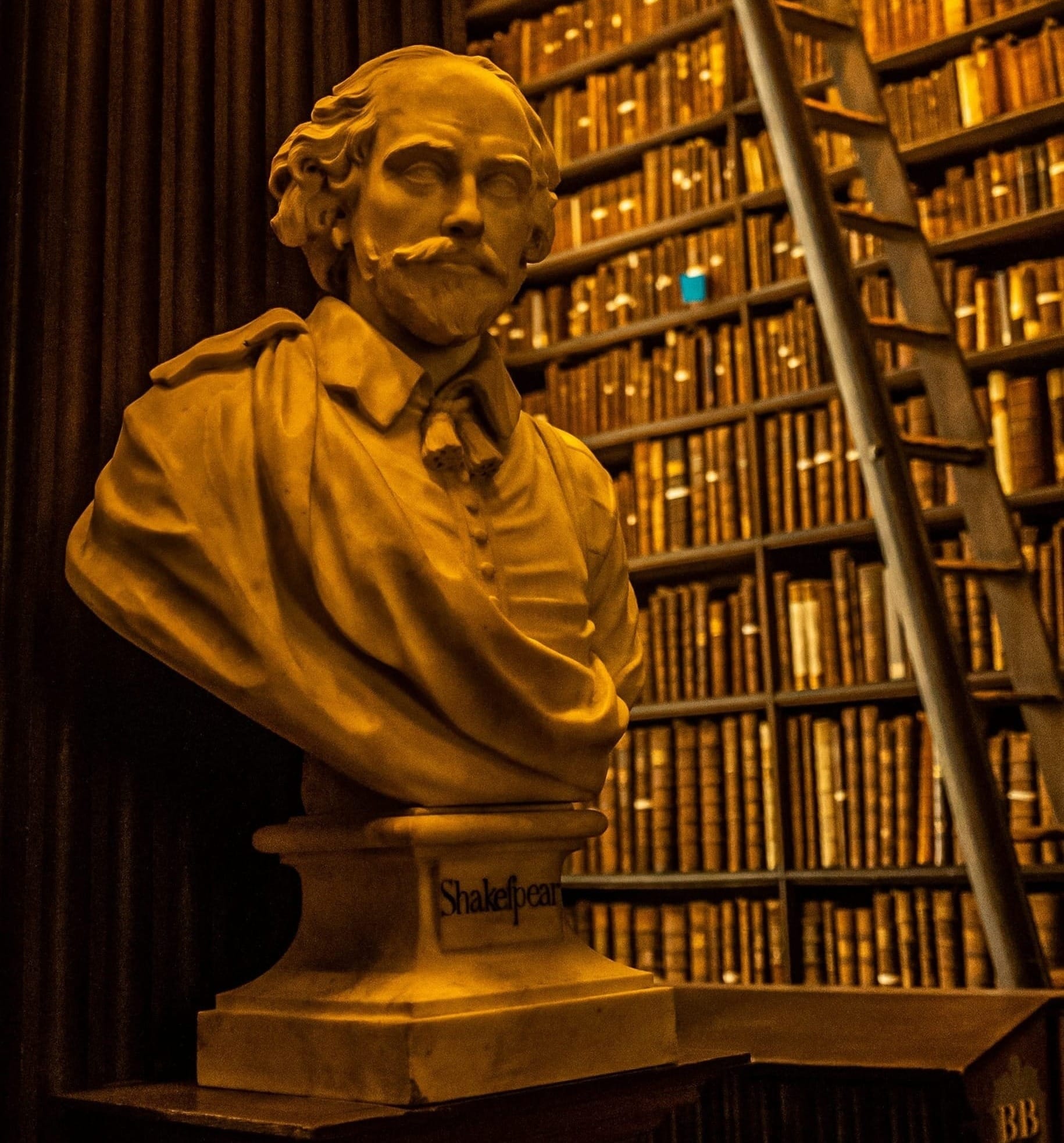
It has been suggested that Shakespeare was more than one writer, that he represents a body of knowledge which cannot be attributed to one man. One of the most notable reasons for this belief is the strange dissonance between his works. While some texts advocate for political liberty and freedom of expression like King Lear, others have more conservative leaning such as The Taming of the Shrew. The wavering political views across his works suggests for many that Shakespeare did not work alone.
There is also a multi-vocal aspect to his work. His plays and poems do not
maintain a single narrative voice, instead, they adopt a polyphonic array of perspectives which often fail to complement each other in the ways we would expect. He creates worlds which have room for different political and discursive meanings to speak at the same time, and to all be given the same merit and validation. This multi-vocal method, in which all characters are given a voice, posed a risk during the time he was writing. His range often leads to the assumption that someone must have been working alongside him, someone who had intimate knowledge that could inform the development of his multitudinous characters. Is this not a reductive assumption though? Does this not just imply that Shakespeare is incapable of empathy in his fiction?
 Katie Asha
Much of Shakespeare's plurality could be attributed to the profoundly collaborative nature of early modern literary culture (approximately 16th-18th century). Particularly in theatre, literary pursuits became a hub of blended ideas. The promotion of authorial collaboration meant that the role of the individual author was different to today. Often this collaboration between authors was silenced - especially if it was from a woman or someone of a lower socioeconomic background.
This is a debate which has been heavily contested, but there is still no answer.
Perhaps someone helped him come up with ideas, like when you ask a housemate for help with essay ideas, and if that is the case it seems far too cruel to
condemn his entire body of work for it. The beautiful thing is that we will never know. Instead, we must enjoy the variety and depth of Shakespeare's work and celebrate his contribution to literature on the 23rd April.
Featured image: Unsplash / Julian Nortoft
How will you be celebrating Shakespeare Day?