By Laura Cooper, Third Year, Film and English
The 2020s has seen huge developments in bringing queer cinema to the general masses, and there are few examples of this more exciting than the success story of Jane Schoenbrun.
For fans of queer film they have become a household name, offering a unique take on horror that focuses on human relationships with media, whether they be formative, obsessive, or darkly erotic. Schoenbrun’s most recent outing, Teenage Sex and Death at Camp Miasma (2026), is easily the most fun of their three films, but for me didn’t quite reach the levels of emotional tension present in I Saw the TV Glow (2024) or We’re All Going to the World’s Fair (2021). The question is, does that missing piece matter when I had such a good time watching it?
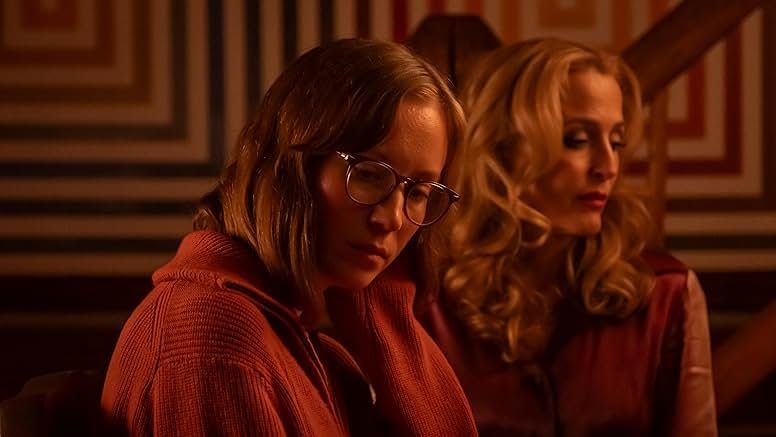
The film is based around Kris (Hannah Einbender), a socially awkward filmmaker who takes a trip to meet reclusive retired actor Billy Presley (Gillian Anderson), the original ‘final girl’ from fictional slasher franchise, Camp Miasma. What begins as a work meeting quickly becomes something more intimate and strange, and before we know it the film takes a turn towards the surreal, becoming part blood-soaked horror story, part sexual fantasy.
As the film's title gives away, Schoenbrun here is exploring the intersection between sex and death, and especially where this fits into the canon of classic horror cinema. It reimagines the problematic slasher trope of using murder as punishment for sexual experimentation by fully leaning into the campy eroticism of these films. The killer goes by the name Little Death (a clever reference to the French euphemism for orgasm), and his cathartic stabbings become a symbol of sexual discovery amongst women and queer people. Whilst I loved the willingness to openly explore sexual taboo as a middle finger to purity culture’s current unsettling resurgence, I found the movie’s allegory to be somewhat messy in its construction.
The third act relies heavily on Lynchian dream logic, and while this sounds enticing in theory, it ends up diminishing some of the stakes the movie had built up to that point, and as we drifted further into half-formed fantasies I became steadily less invested in Kris’s personal development. The script even acknowledges this disconnect, one of its most returned to lines being, ‘if it gets too real, you can always turn it off’. The line is an interesting metacommentary on the film itself, but also highlights its key flaw in that it never felt ‘real’ enough for me to be emotionally moved or affected by the horror of it, in contrast to Schoenbrun’s other films that felt a lot more visceral in their messaging.
My gripes are by no means to imply that I disliked the film - watching its madness unfold and laughing along with a packed cinema was a joyful experience, and I was even encouraged by Gillian Anderson herself not to overly intellectualise it (a tough ask for a film student). As she says in her wonderfully sultry southern accent, ‘it was about two things: flesh and fluids’.
This brings me to the fantastic design choices at play here: the gore is camped up to eleven, Schoenbrun citing the gleefully cartoonish use of blood canons in Evil Dead II (1987) as a key inspiration. They also mention Evil Dead's use of matte-painted backdrops, and the implementation of these backdrops in Camp Miasma was a highlight of the viewing experience. Hand painted to perfection by Brandon Tonner-Connolly and Matt Hyland, they gave the film a surreal and nostalgic look that brought to life Schoenbrun's love for old-school horror filmmaking. It is a joy to read about the work put in to create these breathtaking practical sets, especially amongst increasing reports of AI use in mainstream releases.
The stellar design was complimented by brilliant performances across the board. Hannah Einbender’s endearing nerdiness melts under Gillian Anderson’s esoteric charm, and the two are electric on screen together. Special shoutout goes to the truly impressive levels of sexual tension in a sequence entirely dedicated to dipping sauces. The supporting cast also brings a lot to the film; Jack Haven as the gender-defying Little Death was an inspired choice, and the team of film executives Kris has to report to via zoom bring pure comedic perfection.
 Ella Saxton
When thinking about how moved I was by Jane Schoenbrun’s previous films, I can’t say I didn’t leave Teenage Sex and Death at Camp Miasma with a tinge of disappointment. That being said, the film is undeniably audacious, consistently engaging and full of love for the classic genre it is commenting on. I highly recommend checking it out on a big screen with a group of friends for a brilliant time at the cinema, and to witness what could easily be the most entertaining opening credits sequence of the year (Little Death says no to drugs!).
Featured image: IMDb / Teenage Sex and Death at Camp Miasma
What did you think of Teenage Sex and Death at Camp Miasma?