By Holly Nicholson, Third Year, English
This week, Bristol Beacon welcomed acclaimed historian and presenter David Olusoga for the debut of his new show, A Gun Through Time. Known also for A House Through Time and his recent appearance on Celebrity Traitors, Olusoga brings his recognisable combination of wit and intellect to an ambitious exploration of one of the most controversial symbols in human history: the firearm.
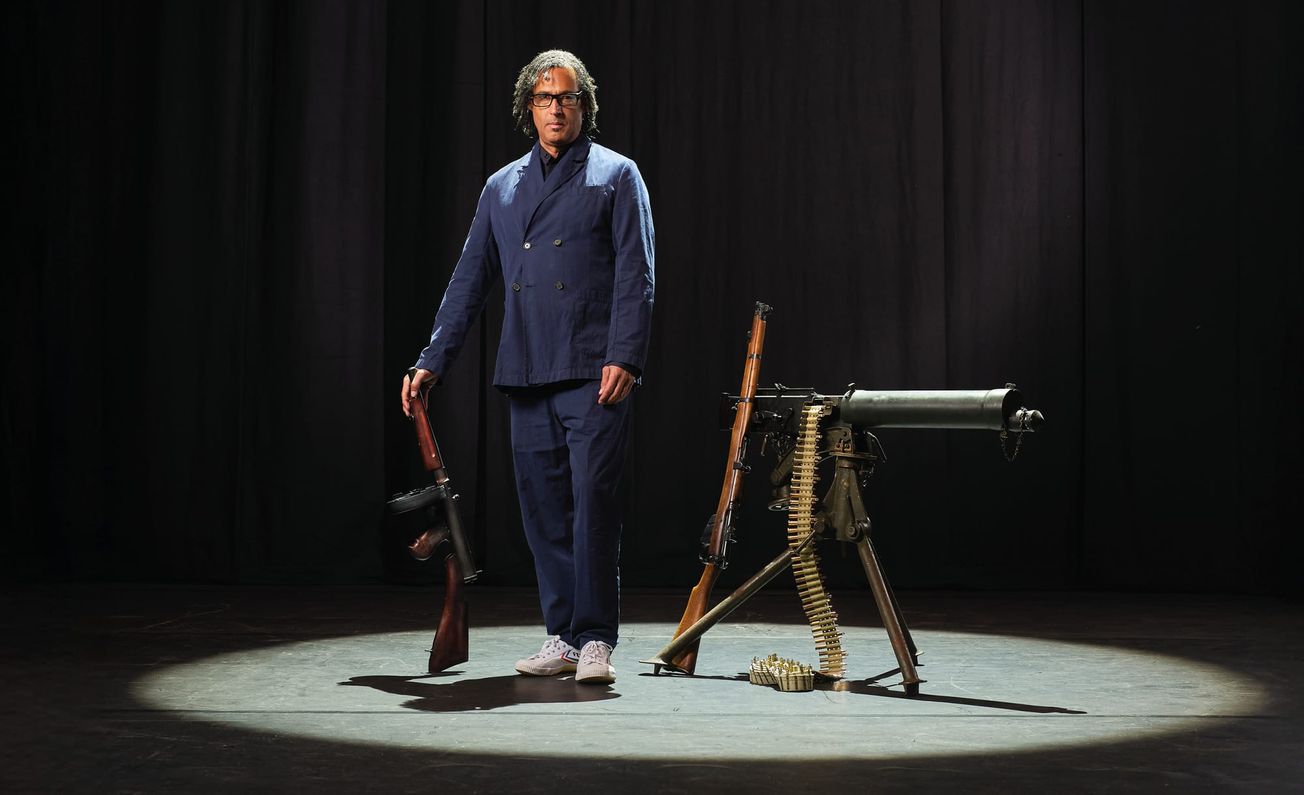
A Gun Through Time stands out not just in its consideration of such a taboo topic, but also in its dynamic structure and style. The stage design itself is a fundamental detail in communicating the coexistence of traditional warfare in the modern age, with four deactivated weapons (the Brown Bess musket, the Lee–Enfield rifle, the Maxim gun, and the Thompson submachine gun) contrasting sharply with the modern aesthetic of the show itself. The four guns sit statically against a background of constantly moving visuals, including interactive polls with which the audience can engage, videography, and relevant statistical charts. In this setting, the guns appear both familiar and foreign, once destructive, now rendered obsolete. Yet, Olusoga stresses that these 'terrible objects' are 'fundamental to understanding our history.' The stark contrast between the historical relics that are the subject and the digital innovation of the show itself represents the central thesis: that the past is inseparable from the modern day.
'42 per cent of American households own a gun, whilst in India 71.1 million firearms are in the hands of civilians ... highlighting our privilege and disconnect as UK citizens'
The show begins by inviting the audience to consider their own relationship with guns, highlighting our privilege as UK citizens to be so disconnected from them. The use of visuals and projected charts immediately present the audience with some striking statistics: 42 per cent of American of households own a gun, whilst in India 71.1 million firearms are in the hands of civilians. The interactive element of the show gives it a strong start, as an interactive poll revealed that only 34% of British audience members had ever held a gun.
Olusoga then turned his attention to the guns themselves, handling each in chronological order of use and manufacture. The Brown Bess musket was Britain's standard-issue firearm for over a century, indicative of a time of mass imperial conquest by the British Empire. As Olusoga speaks, an expansive list of wars, revolutions and conflicts that this gun was involved in is projected to the back of the stage – a stark reminder of the extent and severity of British involvement in cross-continent conflict.
The focus then shifts to the Lee-Enfield rifle, a weapon that defined both World Wars and symbolised the modernisation of warfare in the twentieth century. As the demand for artillery surged, both the Lee-Enfield and the newly manufactured Thompson submachine gun were used to arm the soldiers at the Somme. Olusoga examines both the political and economic consequences that arose from such mass manufacturing. He notes that pioneers of these machines began to advertise guns as 'saviours of life rather than takers of it,' reframing the use and marketability of guns. Amid this shift in the purpose of the firearm, Olusoga highlights the unexpected social transformation that arose with increased manufacture: the conscription of women into munitions work is what Olusoga deems to have made their political and social mobilisation ‘inevitable’ after the war.
'The Tommy Gun became the face of the evolution of firearms from a necessity to a romanticised, marketable aesthetic used for economic gain and the allure of violence as spectacle'
With the arrival of the Thompson submachine gun or 'Tommy Gun’, came a new post-war battlefield: the gangster underworld of the Prohibition era. Olusoga charts this shift with charisma, wit, and many pop-culture references – marking a new era of the gun as a cultural icon of lawlessness, propaganda and seductive marketing. The Tommy Gun became the face of the evolution of firearms from a necessity to a romanticised, marketable aesthetic used for economic gain and the allure of violence as spectacle.
After a brief interval, Olusoga returns to consider the effect of one of the most influential firearms of all time. Its invention revolutionised warfare and remains relevant today: the Maxim Gun, also known as the ‘Devil’s Paintbrush.' The introduction of the first fully automatic machine gun had devastating impacts, marking the end of the age of the cavalry and the beginning of new, mechanised warfare.
The show then begins to explore the modern-day impacts and longstanding influence of the Maxim Gun, drawing the audience's attention to pictures of the weapon being used in Ukraine just this year. The paradox of Ukrainian citizens using weaponry invented almost two centuries ago to shoot down Russian drones – one of the most technologically advanced pieces of equipment of our time – is striking in its exhibition of the simultaneous enduring and disintegrative nature of traditional warfare.
'Olusoga transforms instruments of death into instigators of reflection, prompting us to consider our privilege in having such a detached relationship to firearms'
As the performance draws to a close, the tone becomes increasingly introspective, encouraging the audience to consider Britain’s post-war complacency and the wrongful assumption that mechanised warfare belongs to the past. Olusoga transforms instruments of death into instigators of reflection, prompting us to consider our privilege in having such a detached relationship to firearms. He leaves his audience with no choice but to confront his closing question: 'Is our luck about to run out?' This question lingers long after the curtains have closed and echoes throughout Britain, a country that was once so involved with war, now sitting in the precarious privilege of being able to watch it from afar. Olusoga urges his audience to consider not simply the historical narrative of guns, but their revelation of the cyclical nature of human violence and behaviour.
A contemporary sensibility dominates this increasingly relevant and poignant show. Olusoga's engagement with multimedia and the audience, combined with his unflinching awareness of current geopolitics – makes this debut performance a resounding, undeniable success. A Gun Through Time is an ambitious, humane and necessary meditation on power, the past, progress, destruction – and, fundamentally, our place within it all.
 Tylah Hendrickson
Do you think our luck is running out?