By Melis Akdogan, First Year, Law
While the so-called ‘love triangle’ in Severance (2022-) is a great way to solidify the message the show tries to convey, it also opens the floodgates of media illiteracy. Many people would obviously argue it’s sick and twisted to desert your actual wife to watch as you leave her for your so-called 'work wife'. Here is the real twist: this is not a good argument if you’ve seen Severance up until the ending of season two and are trying to list your reasons for not liking the ending.
Severance, created by Dan Erickson and directed by Ben Stiller, is a science-fiction thriller that uses a variety of psychological themes to captivate its viewers. The show’s first season aired in February of 2022, the second season following (not so shortly after) in 2025 after a three year wait which set the fans’ expectations higher the more it went on.
The show follows Mark Scout (Adam Scott), wallowing in his own misery after the supposed death of his wife Gemma (Dichen Lachman). In order to cope with the grief of her loss, he undergoes a procedure in Lumon Industries to surgically place a chip in his brain to separate his work life from his personal life. The procedure is simple enough. His work-self ( his 'innie' referred to as Mark S.) will not know of
anything but a life confined to a single floor in a corporate building. His real-world self (his 'outie') will be able to escape the pain his personal life brings him for eight hours every day. To his outie’s surprise, Mark S. has a life, and even a love of his own, Helly (Britt Lower).
This distinction is important to remember as we look at the infamous ending of season two that left many fans disappointed.
From the beginning of the show, one of the ideas Severance tried to lead the viewers to challenging is the idea that these innies are either less real than the outies or just the same people with the same lives.
However throughout the show it becomes obvious that these innies are persons of their own. They develop emotions, relationships and experiences. It’s quite Lockean. Their personal identities are tied to their consciousness and memories, entirely separate from their outies’ lives. Mark S. has no knowledge of
Mark Scout or his wife Gemma. What he has is Helly.
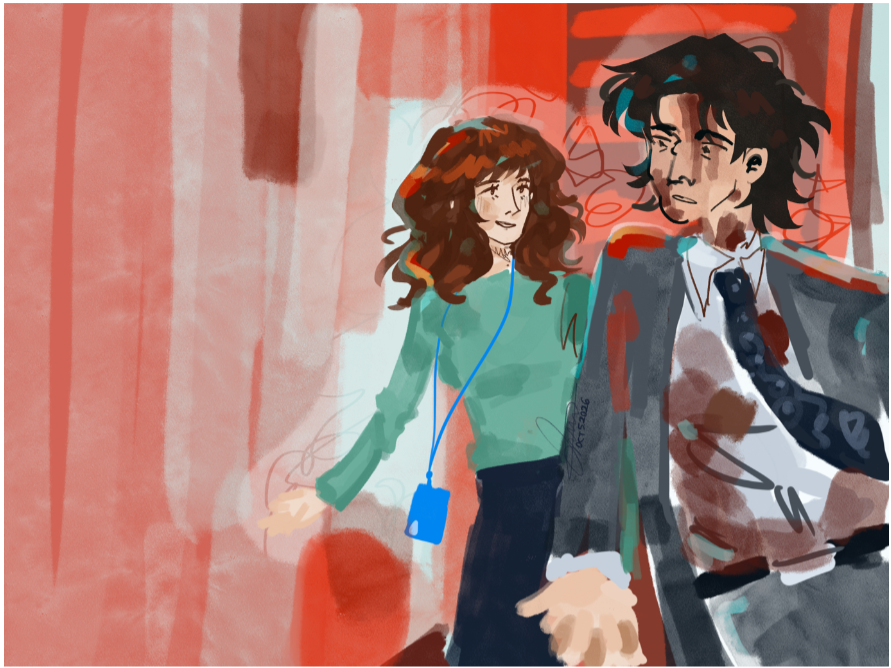
The season one finale makes this distinction impossible to ignore. Mark discovers that his wife is actually alive, while Helly discovers that her outie is Helena Eagan, heir to Lumon. Season 2 then turns the conflict inward. Mark Scout, who previously did not care about his innie, wants him to find Gemma and then ultimately disappear so that he can reclaim the life he has lost. From Mark S.’s perspective, it just means giving up his own life for a stranger, which is a sacrifice he is not prepared to fully make. The ending scene of season 2 involves a shot of Mark S. running away hand in hand with Helly, with Gemma (safely escorted to safety) bangs on the door, crying for him to return. What she and some viewers don’t appear to have understood is that it’s not Mark Scout that makes this decision, it’s Mark S.
If we establish Mark S. and Mark Scout are ultimately different people, the question was never 'Gemma or Helly?'. Reducing the show to an ordinary romantic rivalry or a cheap workplace romance misses its entire premise. Both versions of Mark are fighting for one more second with the people they love. Mark
Scout waited years to reunite with Gemma and Mark S. is more than willing to finally put himself first for what will most likely be his last moments with Helly.
The decision he makes at the end of season two isn’t some selfish betrayal, it’s the key moment in the series that finally draws the line between the innies and the outies. By choosing to leave Gemma behind, Mark S. makes a perfectly autonomous decision against the person that gave him this confined life in the first place. He does help Gemma escape, he simply refuses to die afterwards.
Blaming Mark S. for his decision would place the viewer on the same side as Lumon, who simply believes that lives of innies can be discarded if convenient. The beautifully written tragedy of Severance is that you just cannot have it all. It was always going to be one or the other, autonomy or obedience. The season two finale answers that question perfectly. If Mark S.’s decision feels so wrong to the fans, perhaps the shock it leaves is exactly what the show intends.
Featured Illustration: Epigram / Melis Akdogan
What did you think of Severance's second season?