
By James Lewis, co Editor-in-Chief
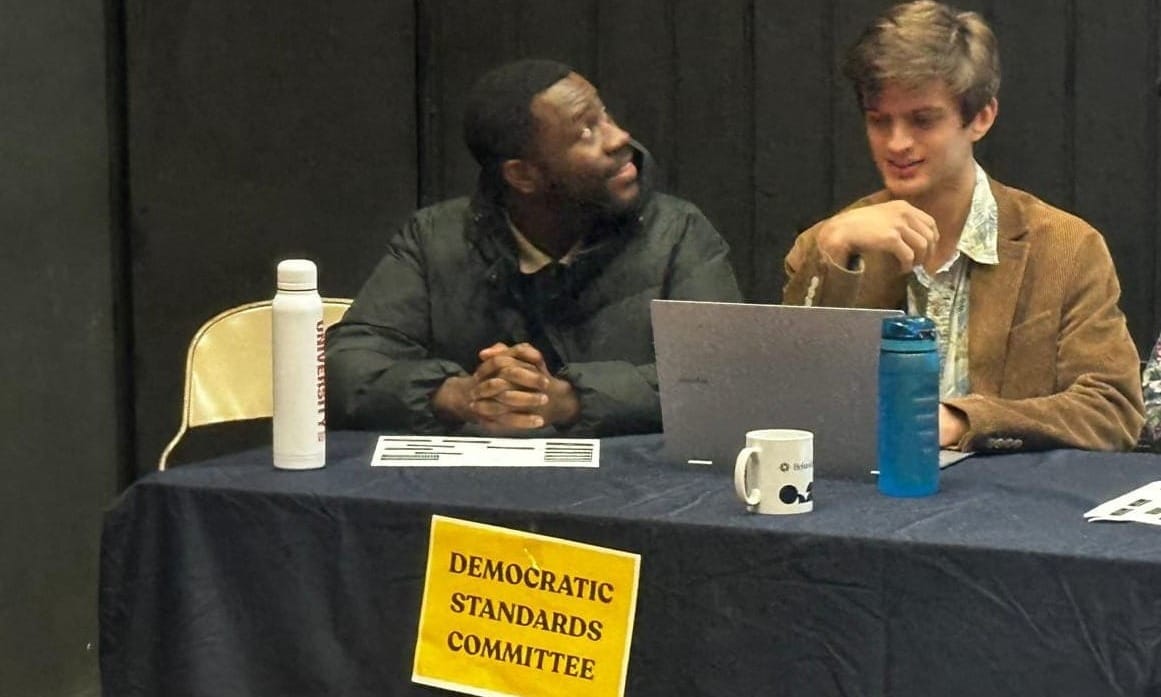
The complaint alleges that the SU were in breach of their Articles of Association when the Democratic Standards Committee (DSC) – a group of elected students who run democratic events at the SU – rejected a Motion of Censure being brought to Student Council on 11 December 2025.
The proposed Motion of Censure related to the Board of Trustees’ unprecedented move at November’s Student Council to overrule students, who had voted against updating the SU’s byelaws to remove reference to the Associate Membership Scheme (AMS).
How did we get here?
In April 2024, Bristol SU announced it would commission an external review of the SU’s Code of Conduct following an open letter – published in March 2024 – by the University of Bristol Ladies Hockey Club. The open letter pointed out that sexual assault did not technically violate the SU’s Code of Conduct policies. The review made 42 recommendations.
 Julia Mullins
 Eden Reyhanian
 Amelia Jacob
The Code of Conduct was updated in August 2024 to implement recommendations made in the review. In July 2025, the SU announced that the AMS would be scrapped on August 1 to implement further recommendations – this decision prompted significant backlash from the student body at the time.
However, the SU’s byelaws were not updated to reflect the removal of the AMS as this usually requires approval at Student Council.
What happened at November’s Student Council?
Students voted against a motion to formally remove AMS from the SU’s byelaws. But, because of the SU’s recent Code of Conduct review, the SU’s Board of Trustees voted to overrule the Student Council vote in an unprecedented move.
A SU spokesperson told Epigram that the review recommended the AMS be removed from the byelaws because it represented ‘safeguarding, health and safety and insurance’ risks.
The SU byelaws govern how the SU functions. Normally, any byelaw change requires a supermajority of 66 per cent in favour at Student Council. However, the Board of Trustees voted to overturn the decision expressed at Student Council to uphold the recommendations made in the Code of Conduct review.
The Board of Trustees is a group of 11 elected students (including seven Full Time Officers) and five appointed trustees, who are chosen based on specialist knowledge. They have ultimate legal responsibility for the SU. They act in the interest of the charity and its members by following the six essential duties described by the Charity Commission. Their decision to overrule Student Council was legal though unprecedented.
 James Lewis
Ned Gardner-Thorpe – second year Chemist and course representative – said, however, that the Board of Trustees’ decision to override Student Council’s vote ‘disregarded the views of students who participated in good faith.’
So, what’s being complained about if the Board acted legally?
Mr Gardner-Thorpe proposed a Motion of Censure to be debated and voted on at Student Council on 11 December 2025 concerning the Trustees’ overruling of Student Council’s vote. He said that the removal of the AMS has had an ‘unacceptable impact on societies and lack of support among students is becoming increasingly clear.’
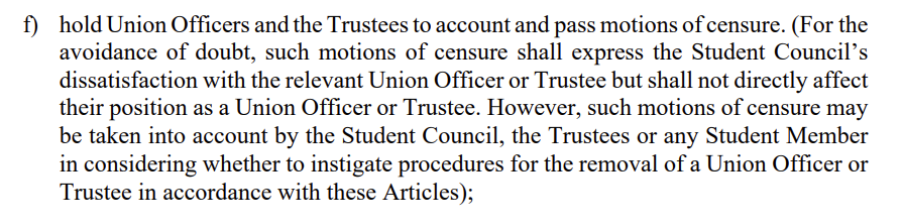
A Motion of Censure is a strong, formal criticism that can be brought against an individual or group in positions of power. According to article 41.1.f of the SU’s Articles of Association – the highest document the SU governs from – Motions of Censure are possible.
However, the Motion was rejected by the Democratic Standards Committee (DSC) (an elected group of students who are responsible for the SU’s democratic processes, decide Council agendas, interpret the byelaws and Articles for SU democracy, and other responsibilities to ensure fair and transparent democracy at the SU) after five hours of deliberation.
In an email seen by Epigram to Mr Gardner-Thorpe, the decision is defended. ‘[T]he intended purpose of [this motion] doesn’t match the appropriate use of the Censure mechanism’, the email read, ‘and goes against the spirit of what a Censure should be used for.’ Instead, an alternative Expression of Dissatisfaction was added to the agenda of December’s Student Council, which was voted in favour of.
Motions of Censure in the context of Student Union’s have generally been used to show dissatisfaction with an individual’s actions, rather than a group’s. This has been the case at Trinity College, Dublin, Durham University, and at the National Unions of Students in recent years where individuals – not groups – have been censured or nearly censured.
This is not to say, however, that a Motion of Censure against a group is not possible. Mr Gardner-Thorpe says that the article in which Motions of Censure are mentioned are broad (the article says, ‘such motions of censure shall express the Student Council’s dissatisfaction’) because, he says, ‘the writers intended a broad interpretation of censure powers.’
 Aimee Anderson
Mr Gardner-Thorpe told Epigram that his Motion of Censure was intended to ‘demonstrate that the conversation on Associate Membership is not over and that the situation must be resolved in a way acceptable to students.’
He also was disappointed with the alternative dissent, because it ‘removed or altered much of the criticism [he] intended.’ He said that this ‘wasn’t acceptable’, which has prompted him to refer the situation to the Charity Commission for a resolution.
Since Bristol SU is a charity, the Charity Commission serves as its sector’s regulator.
 Lenny Osler
An SU spokesperson reiterated how the Expression of Dissatisfaction enabled ‘a formal expression of dissatisfaction with the Bristol SU Trustee Board from student representatives.’
They also acknowledged that the ‘DSC is aware of the need of a mechanism to express dissatisfaction, and this will be a future topic of discussion.’
While the complaint has been lodged, the charity commission have not yet completed their investigation into the allegations.
Featured image: Epigram / Ellen Reynolds
What do you think of the way the SU have handled all this? Let us know! Send us a DM on Instagram (@epigrampaper_) or drop us an email on editor.epigram@gmail.com