By Charles Hubbard, Film & TV Deputy Editor
Black comedies are one of the hardest, if not the hardest, film genre to pull off. And that’s perhaps why the genre’s historic winners shine so bright, be it The King of Comedy (1982), Fargo (1996) or a little movie you might’ve heard of called Pulp Fiction (1994).
And yet Bad Apples (2026), Jonatan Etzler’s blistering new addition to genre, aims its crosshairs on an institution that not even Quentin Tarantino’s most transgressive features dare to target - the school system. It’s no secret that primary schools are dramatically underfunded with overworked teachers and limited amenities - a fact that many film and TV shows over the past few years, the most obvious example being Abbott Elementary (2021-), have laid bare.
However, Etzler’s film goes one further, offering a thorny and deeply disquieting ‘solution’ to the problem that feels straight out of The Twilight Zone (1959-1964) - one that will have you cackling and then checking in with the other members of the audience to see if it’s ok to be cackling at such onscreen behaviour. I’ll answer that one for you now - it is ok to be laughing at Bad Apples, even if the film itself is occasionally a little clumsy with who it seems to be laughing at.
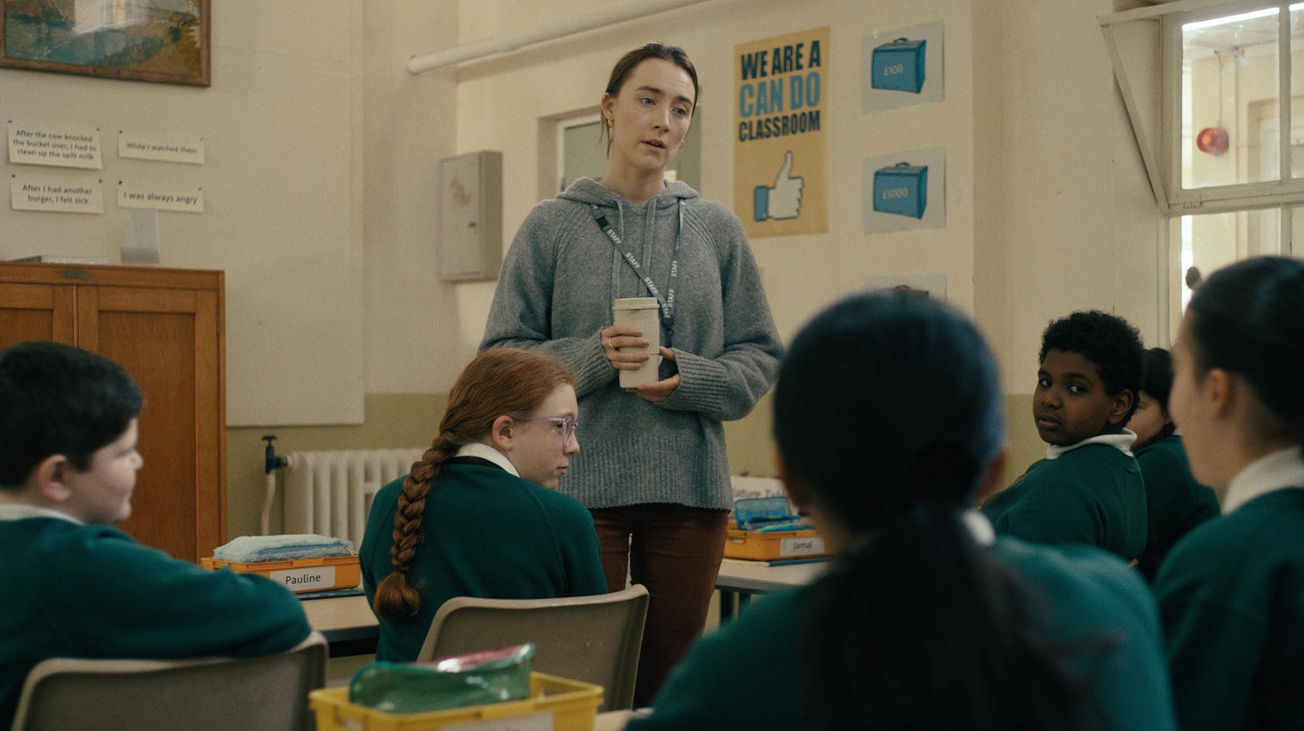
Maria Spencer (a perfectly cast Saoirse Ronan) is a long-suffering teacher at a West Country primary school with a bizarrely large house (on a teacher’s salary?) and a class of perfectly angelic kids. That is, except for Danny (an intensely unnerving Eddie Waller) - an aggressive, disruptive student who answers the question “What if the violent tendencies of Jamie from Adolescence (2025) were a little less buried under the surface?” After Danny assaults a fellow student, Maria claims she has no choice but to take extreme measures to remove him from the classroom and take a more one-on-one approach to teaching him. I really can’t go any further without getting into spoilers, even if, like The Drama (2026) earlier this year, the big twist I’m dancing around happens about 30 minutes into the film.
I’ll have to admit, I was very worried at first. After an intensely smug and ham-handed opening sequence that looks to hit the audience over the head with the metaphor of the title before the film itself has had a chance to show its hand (this goes for Chris Roe’s overbearing score as well, which gives the game away far too early here), the brief moments of comedy feel wildly misjudged and provoked little more than confused mutters from my audience. However, once the key idea of the film becomes clear, Etzler and screenwriter Jess O’Kane are finally able to grab control of the tonal dial and wrestle the film to where it needs to be - an action that seems rather fitting if you know the narrative string of events.
The film’s attitude to class is also extremely complicated and thorny. The audience is invited to empathise with Danny (who is very clearly of a lower socio-economic background than his classmates, especially the more sycophantic ones) and the ‘nurture-not-nature’ essence of his temperament is made clear, though fortunately without any shoe-horned exposition - O’Kane has that much faith in the audience, at least.
And yet Danny’s father Josh, while played sensitively and with appropriate pathos by Robert Emms, is regularly lined up for a series of slightly cheap jokes that feel gross and unseemly. While it’s maybe bad practice to ding transgressive black comedies for a lack of insensitivity, it sometimes feels like a bridge too far for a film to invite the audience to laugh at a working class father who has no choice but to do a 9 to 5 even when his son is missing, especially since Etzler doesn’t care enough to give the character a proper resolution.
That said, the film’s portrait of morally bankrupt privileged collectivism that so clearly looks to prioritise middle class children over their less fortunate counterparts is eminently brutal and timely - and incredibly well judged when it comes to the script, direction and performances. The final denouement here will make you chuckle in disbelief, right before you consider the fact that it isn’t entirely unfeasible that this is a scandal you could hear about on the front pages of The Sun. I say denouement; the film’s real denouement is a stupid narrative spanner thrown in at the 59th minute of the 11th hour that undercuts the grisly resolution here and serves no actual function. Unless the creative team here wants to set up a sequel?
Ronan has had a difficult time following the kind of rapturous hype that is generated by getting three well-deserved Best Actress nominations before the age of 25 and this film represents the first time since Little Women (2019) that it feels like something with her in the lead role is really cooking on gas. The genius of her casting is that it is completely conceivable that she could be cast in the sincere, “one kind-hearted teacher against the system” version of this film - think Detachment (2011) or Steve (2025), making it all the more alarming when her character’s secret sociopathy is revealed. While watching her character, I strangely kept thinking of Hannibal Lecter. Like Lecter and therapy, Maria is a legitimately excellent teacher and the fact that she is driven to do it even in the most unsettling (not to mention illegal) of circumstances is at once very funny and perversely heart-warming.
 Alfie Coan
If this film actually gets a wide theatrical release (it already struggled to get distribution when it played at TIFF last year), I suspect it’s going to cause just as much online ruckus as the aforementioned The Drama and Obsession (2025). No doubt there will be many hot takes on the extent to which the film actually supports or condemns the actions of its lead character, bolstered by the kind of tin-eared media illiteracy that only a post-pandemic internet hellscape can foster. While I’m not sure yet which side I come down on regarding whether the film’s heart is really in the right place, it’s still a genius narrative idea and one that only could have come from a cult Swedish novel.
Featured image: IMDb / Bad Apples
Did you see Bad Apples?