
By Rebecca Le Jeune, Third year, Politics and International Relations
POV: You’re staring at the PERi-ometer at Nando’s. Can you handle more than mild? You’ve long graduated from lemon and herb, but choosing HOT still feels like you might be putting on an act. Meanwhile, your mate loves the burn. Why can’t you?
We don’t know exactly when or why humans started eating hot peppers. Archaeologists have found evidence of mustard seeds dating back as far as 6000 years ago, although it remains unclear whether they were used for consumption or for other purposes.
One theory suggests that spices were added to food to kill bacteria. Other research shows that spicy cuisines developed more prominently in warmer climates, where food-borne microbes are more prevalent.
So what actually determines whether something is ‘spicy’? The heat of chilli peppers is determined by the levels of a chemical compound called capsaicin, with intensity measured using the Scoville scale. This indicates how much capsaicin a food contains based on how much it can be diluted before the heat becomes undetectable, essentially measuring chemical intensity rather than subjective pain.

Not all spicy foods are spicy in the same way. The difference lies in the type of compound involved. Capsaicin and piperine, found in chilli and black peppers, are heavier molecules known as alkylamides, which tend to stay in the mouth and produce a lingering burn. By contrast, mustard, horseradish, and wasabi contain smaller, more volatile molecules called isothiocyanates, which can travel up into the sinuses, creating a sharp, nasal heat rather than a long-lasting mouth burn.
Spiciness also differs fundamentally from taste. While sweet or salty flavours are detected by taste buds that respond to sugar molecules or sodium ions, spiciness is not a taste at all. Instead, it signals a pain-like sensation. Certain compounds in spicy foods activate sensory neurons known as polymodal nociceptors, pain sensing neurons whose role is explicitly to detect potentially harmful stimuli. These are found throughout the body.
Many polymodal nociceptors express TRPV1 receptors, and Chilli peppers contain capsaicin, a compound that activates TRPV1 receptors in the mouth. TRPV1 is a protein that normally responds to physical heat or tissue damage, but it can also be triggered when capsaicin binds to it. When this happens, the receptor opens and allows ions to flow into the nerve cell, sending a signal to the brain that mimics burning pain.
It turns out there is plenty of research on why certain individuals like their food spicy. Let's debunk three theories.
- Genetic and biological
People differ biologically in how they experience this process. Some individuals are born with more TRPV1 receptors, or with receptor variants that are more reactive, while others have fewer or less sensitive receptors. These differences influence baseline spice tolerance. Once TRPV1 is activated, the resulting ion flow signals the brain, making it believe the mouth is on fire.
Then, does the sensitivity to spiciness simply improve over time? In reality, the effect of repeated exposure is less important than commonly believed. In a study, researchers examined whether repeated exposure to capsaicin could damage or significantly reduce the chemical irritant receptor system. The human results were modest. Repeated exposure to chilli peppers led to only a slight decrease in sensitivity, indicating minor desensitisation rather than destruction or serious impairment of receptors.
Physical differences in the mouth also matter. The distribution and sensitivity of receptors vary from person to person, and conditions such as geographic tongue (an inflammatory condition of the tongue) can increase sensitivity, causing the burning sensation to feel stronger or last longer.
A study performed on identical twins found that 18–58 per cent of the variation in how pleasant people find spicy food can be attributed to genetic factors, suggesting that enjoyment of spice is partly inherited.
- Cultural

People may assume that populations based in warmer climates, who tend to eat spicy food more, may be more genetically tolerant to spiciness. There is no strong evidence that people in Ethiopia (the spiciest country) and the UK for instance differ biologically in TRPV1 in a population-level, genetic way.
Spicy food is more prevalent in hotter countries, and several theories suggest that it promotes sweating, which helps cool the body, and that many spices have antibacterial properties. Although frequent chilli eaters meet higher detection thresholds, the difference between them and non-eaters is small: they require only slightly more capsaicin to notice the burn. In other words, eating chilli regularly does not eliminate the sensation of heat. A ‘chilli a day’ does not keep the spice away.
What changes more than sensitivity is how the sensation is interpreted. With repeated exposure, people learn how to respond to TRPV1 activation. The burn may feel more predictable, more controllable, or even desirable. It is not that experienced chilli eaters cannot feel the heat; rather, they are more likely to want it.
Over time, culture reinforces this process. In cuisines where spicy food is common, the sensation is framed as normal food rather than a challenge. The burn becomes associated with flavour, familiarity, and social belonging, rather than danger or distress.
- Psychology

People who enjoy spicy chilli may also enjoy the sharp, nasal sensation produced by wasabi. However, these sensations are mediated by different sensory pathways: chilli activates TRPV1 receptors associated with heat and burning pain, whereas wasabi stimulates TRPA1 receptors in the nasal passages, producing a rather nasally pungent, irritant sensation.
Although both are nociceptors (pain and irritation sensors), they adapt differently with exposure and are located on overlapping but not identical nerve fibres. As a result, tolerance to one pathway does not guarantee tolerance to the other. Someone who comfortably eats very spicy chilli may still find wasabi overwhelming, and vice versa.
The connection between the two is therefore less biological and more psychological. Studies show that individuals who report enjoying spicy food tend to score higher on sensation-seeking and adrenaline-seeking personality traits. For these individuals, the discomfort associated with spice is experienced not as a deterrent, but as a controlled and enjoyable form of stimulation.
When capsaicin activates pain pathways, the body responds by releasing endorphins, which dampen pain signals while simultaneously producing feelings of pleasure or reward. For some individuals, this creates a positive feedback loop: the burn triggers discomfort, followed by relief and enjoyment.
In this sense, liking spicy food reflects not just sensory tolerance, but a broader willingness to seek out intense experiences. The appeal lies in the challenge itself, rather than in the specific chemical pathway being activated.
It’s a mindset: growth begins where mild ends. To be comfortable, or to be spicy? I don’t know about you, but I'm eating spicy food tonight.
Disclaimer: the author takes no responsibility for self-inflicted pain post-jalapeño.
 Timothy Quiney
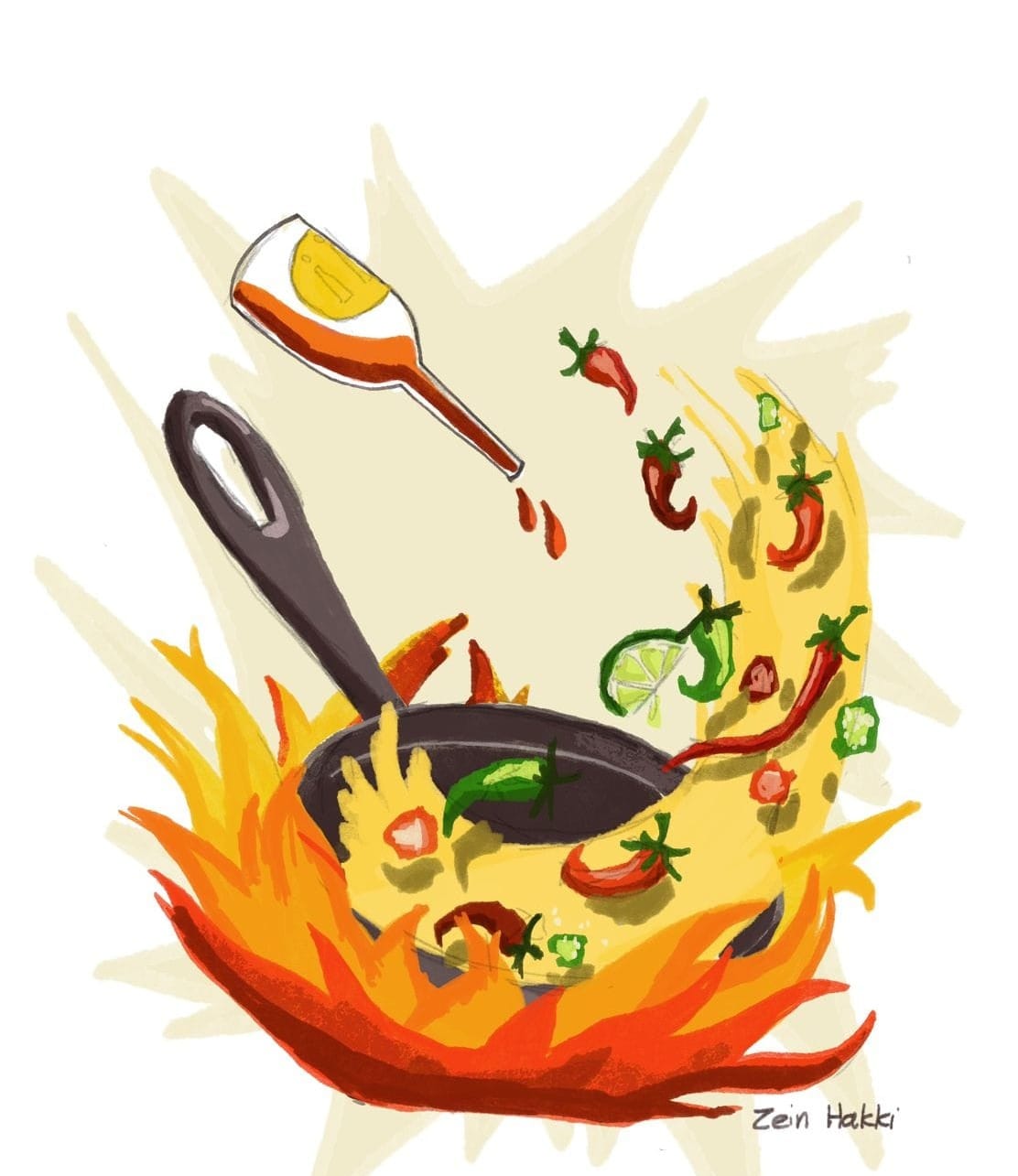
Featured Image: Epigram / Zein Hakki
Can you handle spicy food?