By James Lewis, Co Editor-in-Chief
One issue will dominate this year’s SU elections: money. 41.3 per cent of students named rent prices, cost-of-living, or personal finances as their most pressing issue. The data comes from a survey conducted by Epigram of 144 students to understand what voters will have on their minds.
Students will be asked to vote for Faculty and Course Reps, Student Community Organisers, and Student Trustees to sit on the SU’s board, and more, from 9 March. But what will be anticipated most are the elections of the seven Full-time Officer (FTO) positions.
In Epigram’s survey, students were asked to rank their three biggest concerns or issues. This means we can represent this data in two ways: by first choice and a weighted score. By giving three points to people’s first choice, two to second, and one to third, we can see what issues are on people’s minds but not right at the front.
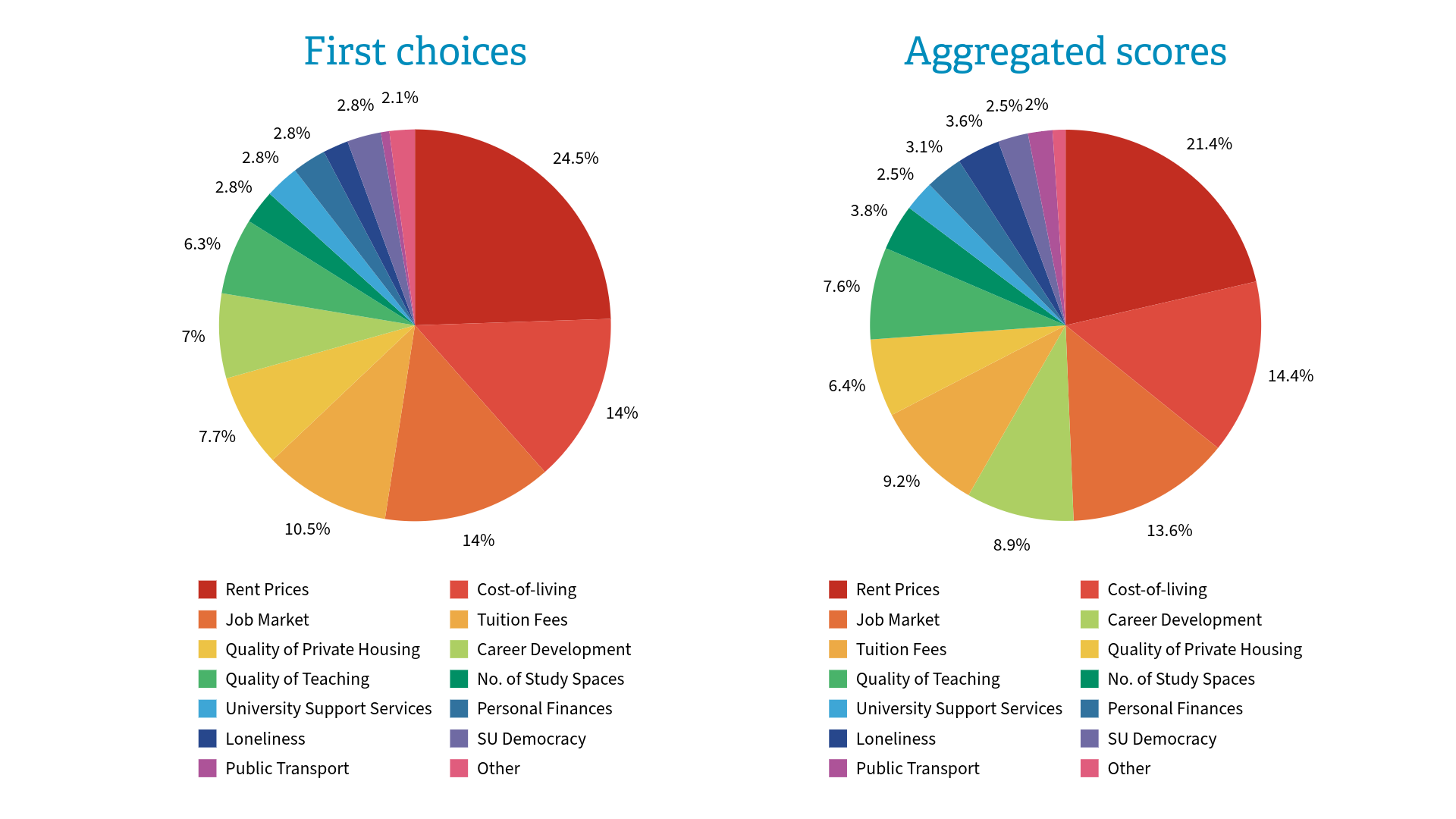
When looking at the ungrouped data, rent prices lead. Nearly a quarter of students ranked this as their number one, with the aggregated data weighting it at 21.4 per cent. According to SU data, the most common price that students pay per month is between £601 and £700. More than a decade ago, the average was £396.
The data suggests people are paying more than what their rent is worth. In fact, 7.7 per cent of students cited the quality of private housing as their biggest issue. A 2025 Epigram survey found that 93 per cent of students had experienced mould or damp. Meanwhile, landlords haven’t been making it any easier, with Bristol SU’s housing report 2024 stating that 53 per cent of students had a ‘negative’ or ‘very negative’ experience with their landlords. The picture is clear: being a student renter in Bristol is difficult.
Beyond housing not matching what students pay for, cost-of-living ranked second in the weighted data. The university’s website states, on average, a student spends £1,221 per month on total living expenses, rent included. If a Bristol student lives on the maximum maintenance loan of £10,554 for eight months of the year (taking holidays into account) then they have £1,319.25 per month to live, leaving little margin for unexpected costs.
‘Concerns about the cost-of-living and job market rank joint second at 14 per cent for outright biggest issue. This illustrates the double tension students face, as an expensive education isn’t neatly translating into a well-paid career.’
To compensate, more students than ever are working part time jobs. The university recommends that undergraduates should limit their part-time work to 15 hours per week, and postgraduates to 20 hours. Bristol SU’s Student Work-Life Report 2025 found, however, that 29 per cent of students exceed 15 hours work per week with 14 per cent exceeding 20 hours of work. 77 per cent of working students said work has impacted their studies.
Beyond financial pressure, our data shows evidence of students’ fears for the future. 10.5 per cent of respondents ranked fees as their biggest concern. Raised to £9,535 this year, fees are only set to increase, rising with inflation from next year. Recent coverage of the loans system has called it a regressive tax. Those who can afford it now are usually financially comfortable, but those who take loans – most home students – can’t afford it in a lump sum and end up paying more than their wealthier peers when interest kicks in. The Bristol SU FTO team lobbied against this policy change at the time, saying the proposed increases ‘doubles down on a broken tuition fee model that has driven the sector into a crisis.’
Concerns about the cost-of-living and job market rank joint second at 14 per cent for outright biggest issue. This illustrates the double tension students face, as an expensive education isn’t neatly translating into a well-paid career.
In the last two years, the number of advertised graduate positions has fallen by 70 per cent, according to the recruiter Reed. With fewer roles, and AI making it easier than ever to hammer out a cover letter, the number of applicants per vacancy is 140. 20 years ago there were just 38.
Teo Guez, third year Economics and Politics student, and this year's Arts, Social Sciences and Law Faculty Rep, told Epigram that career development and guidance had been a focus this year. He said, ‘[t]he main thing we hear from students are that they feel overly funnelled to specific branches of their field [...] and aren’t empowered to explore the variety of careers their course has to offer. Combined with a bleak job market and little guidance on how [and] with who to network, many students understandably feel underequipped’.
Beyond practical support, some students said that the SU could offer more reassurance to a student body facing a bleak graduate job market. Julia Banaczkowska, a second year Law student, said that by ‘simply acknowledging that a fear of the future for many students exists’ would be helpful, and help students ‘feel like they aren’t alone in these concerns.’
‘Loneliness is something nearly everyone feels at university but is conspicuously missing in conversation. With everyone looking like they’re having the time of their lives, it’s difficult to be that person.’
The SU doesn't have a careers service, but instead lobbies and advocates for students to make the university’s service work best. However, Teo said that while there are ‘innovative ideas floating around at the SU,’ for careers guidance, it was difficult to get ‘scattered’ Faculty Reps and FTOs coordinated when they have such a short mandate. Add to that having to deal with ‘painfully slow university bureaucracy’ it is difficult to effect meaningful change in this area. Teo suggests that ‘the SU should look into how Reps’ efforts can be combined into a longer, sustained campaign for careers support.’
While concerns over money and the future are concrete, something less definite recurred in people’s answers: loneliness. Though few named it their biggest issue, it rose when second and third choices were considered. Loneliness is something nearly everyone feels at university but is conspicuously missing in conversation. With everyone looking like they’re having the time of their lives, it’s difficult to be that person. A 2023 government study found that 93 per cent of students experience loneliness at least once while at university, but it also discovered that 43 per cent of students felt they would be judged if they admitted to feeling lonely.
Second year law student, Julia Banaczkowska, told Epigram that while she appreciates the SU do a lot of work in this area, she feels ‘there is [...] room to reconsider how loneliness itself is framed. [...] university messaging often suggests that the solution to loneliness is simply to socialise more’, and she wonders if there was scope to see this in a different way.
 Lenny Osler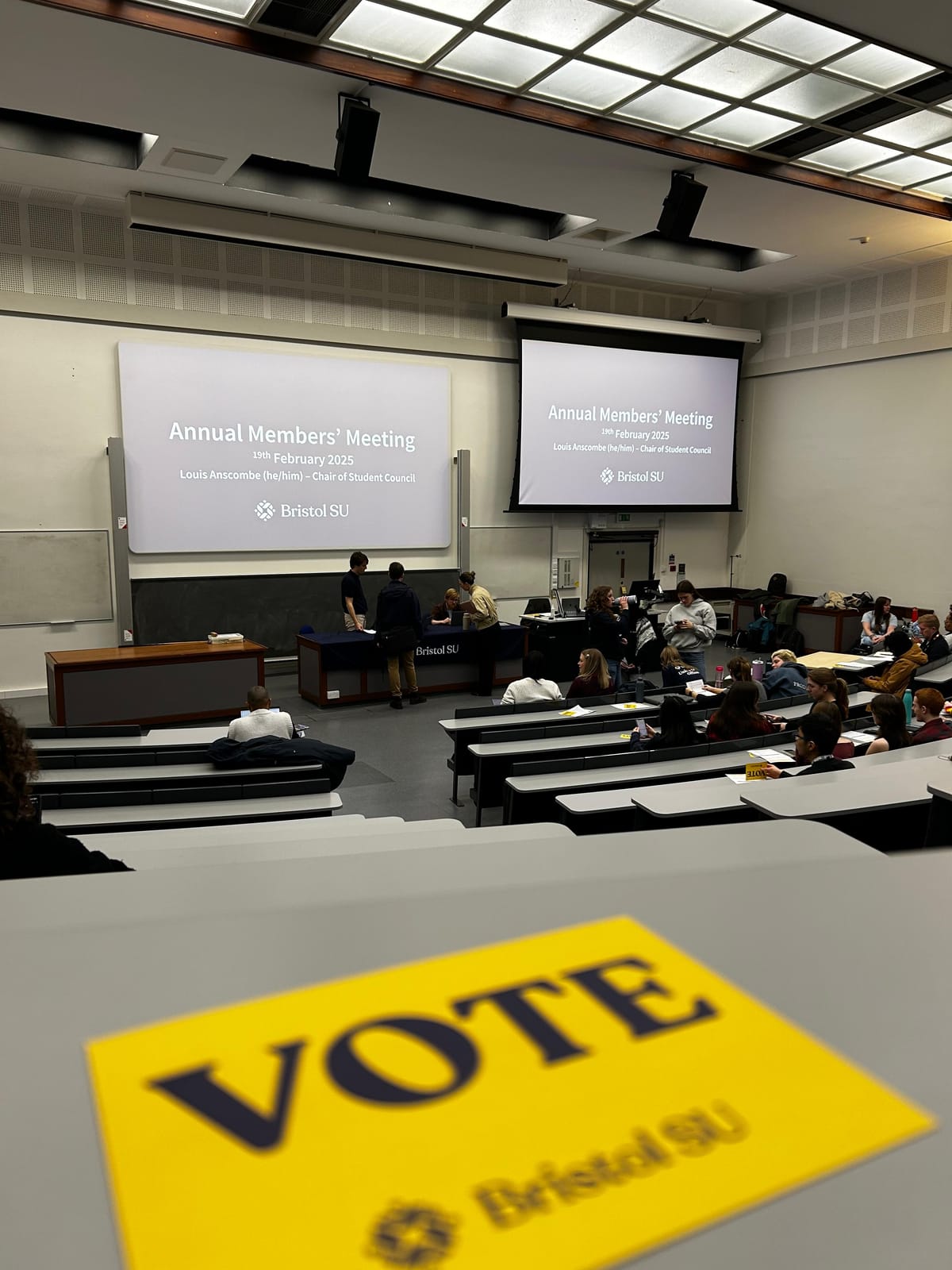
 James Lewis
Many of the issues students face are the results of policies far beyond the SU’s influence. But when it comes time to vote, it’s more than just what people promise. Credibility, empathy, and passion are as important, because it’s ultimately down to whether or not students trust them to keep on going, even when change is slow.
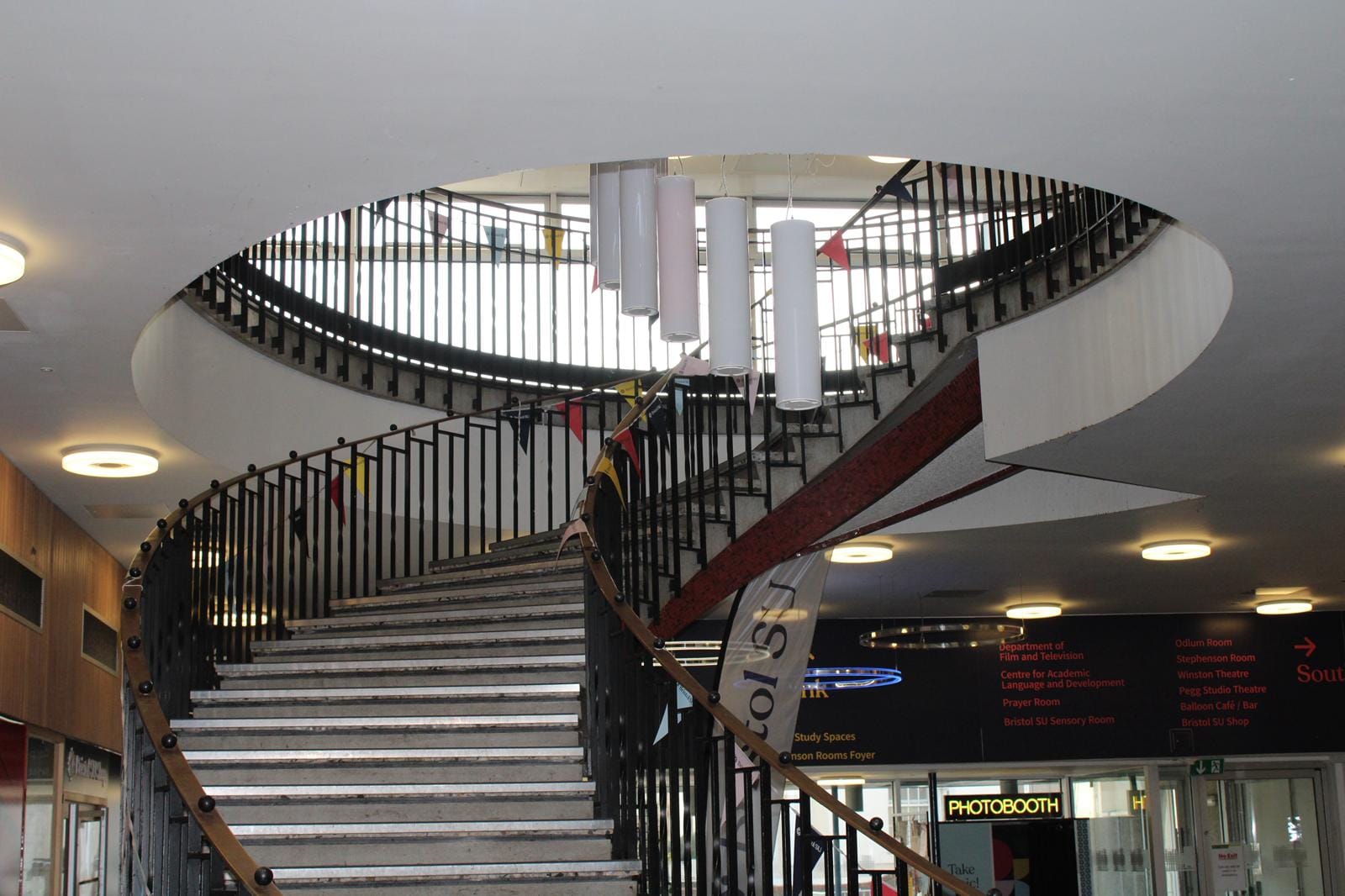
Featured image: Epigram / Frankie Curtis
Voting opens from 9am, 9 March until 9pm, 12 March. Will you be voting? Let us know! Drop us a line, editor.epigram@gmail.com, or dm us on Instagram, @epigrampaper_