By Sofia Lambis, Deputy Editor and Cara Hene, Digital News Editor
The University and College Union’s (UCU) Bristol branch says the move marks a further step in the targeting of specific Schools at the University of Bristol.
If they choose to take up the Voluntary Severance Scheme, open to all academic staff in the School of Humanities and the School of Modern Languages, staff essentially make themselves redundant in return for a good pay-out. This particular severance scheme offers 9 months’ pay, and staff members have three weeks to express their interest.
The scheme was presented to all staff in the two Schools on February 6. The day before, University HR had met with Faculty leadership, the two Heads of School and unions to explain the content of the scheme and how it was to work, Epigram understands.
‘The calculation they themselves have come up with is what makes this necessary’
In response, the Bristol branch of the UCU, which represents over 120,000 members nationally, said:
‘Since this time last year, we have warned that the University of Bristol’s approach to the crisis in Higher Education funding will have an uneven effect across the institution. Such cuts started in 2025 and are accelerating in 2026. Shit is getting real.’
The scheme was flagged as upcoming in two separate January 28 meetings, at which all academic staff for the School of Modern Languages and School of Humanities were invited to attend separately.
A senior Modern Languages staff member who Epigram spoke to described department morale as 'quite low' in the wake of these meetings. Staff felt ‘unsupported’ by the University and feared that the next step could be compulsory redundancies.
The newest Voluntary Severance Scheme has not come out of the blue.
In March 2025, Bristol UCU leadership wrote that the University of Bristol had embarked on a ‘death spiral’ following the ‘50 per cent surplus’ scheme, which says Schools must make a 50 per cent operating surplus.
Epigram spoke to Oscar Berglund, Bristol UCU co-President and Senior Lecturer in International Public and Social Policy, and co-author of the March 2025 piece.
He told Epigram the Voluntary Severance Scheme marks a continuation of the ‘50 per cent surplus’ policy, which he said unfairly impacts certain Schools at the University of Bristol.
While the ‘50 per cent surplus’ equation does include employees as a factor, it does not take into account factors such as buildings and equipment, Berglund says.
This means that non-STEM Schools, which as a percentage spend comparatively much more on staffing (as opposed to expensive laboratory equipment, for instance) than their science-y neighbours, will face more pressure from the University.
And this pressure has now come in the form of Voluntary Severance.

Both Berglund and the senior Modern Languages staff member Epigram spoke to argue that those Schools with the lowest intake of overseas students, which are, again, the Humanities and Modern Languages Schools, are further impacted by the ‘50 per cent surplus’ policy because they bring in less fees.
All of this amounts to a ‘managed decline’ of certain parts of the University, according to Berglund.
‘This is a choice that the University are making. They are choosing to shrink these schools. They don’t have to do that. The calculation they themselves have come up with is what makes this necessary.’
However, Berglund does say voluntary severance is preferable to compulsory redundancies - they give staff who are already thinking about leaving the chance to do so, rather than firing indiscriminately.
‘Some students will suddenly see units disappear from their curriculum because staff aren’t here to run them’
At the January 28 Modern Languages School meeting it was also announced the School had a new goal of achieving £1 million savings by August 2026 and £3 million by 2028. The senior Modern Languages staff member told Epigram that colleagues doubted whether either the August savings or the ‘50 per cent surplus’ were possible for the School to achieve.
They were also ‘unsurprised’ by the Voluntary Severance Scheme itself, as they felt it was coming, but were ‘stunned’ by its speed and timing. They felt staff were given a very short window to decide, and that the severance package itself was ‘not particularly generous.’
 Beth Robinson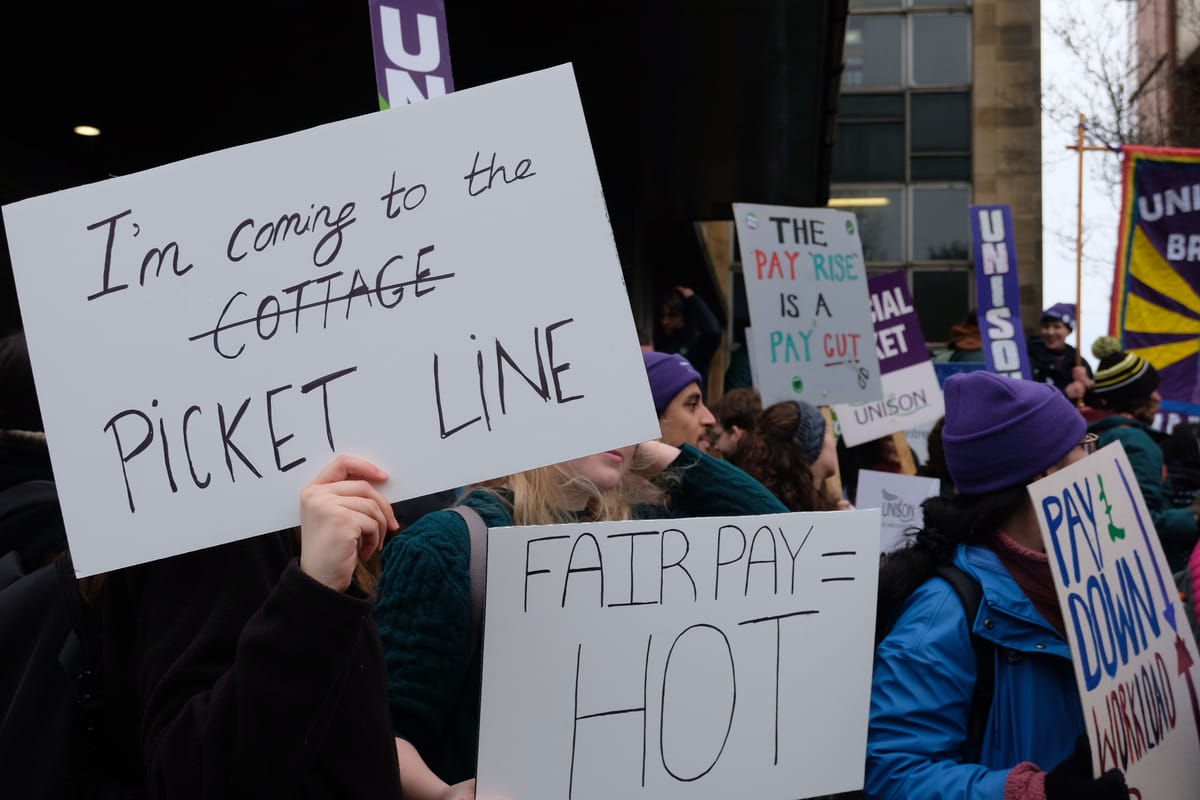
The scheme’s introduction during TB2, when many students are choosing next term’s units, is also significant: ‘We don’t know what units are going to run next [academic] year… some students will suddenly see units disappear from their curriculum, because staff aren’t here to run them.’
However, Bristol is not alone in its cost saving efforts; universities across the UK are finding it increasingly difficult to operate amidst financial pressures.
In April 2025, the Russell Group issued a joint call for more government support, warning that ‘the scale of the deficits we’re facing are so large that efficiency measures alone are not going to be able to address them.’
If compulsory redundancies were to be put in place, Bristol UCU says it will do ‘what we successfully did last year in CALD’: call for strike action.
The branch claims that ‘these voluntary means are brought in to avoid the strike action that compulsory redundancies would lead to.’
 James Lewis
A University of Bristol spokesperson said:
‘We value having a broad range of modern foreign languages at Bristol and are equally committed to supporting disciplines within the School of Humanities. These are key contributors to our University’s comprehensive, disciplinary portfolio and our overall strategy and ambitions.
‘As part of a prudent, measured approach to managing our finances, we routinely take planned and focussed actions where necessary due to changing student demand and reducing research income streams, while routinely seeking opportunities to deliver our services more effectively and efficiently. This includes identifying ways to reduce our non-pay spending.
‘The School of Humanities and the School of Modern Languages have launched a voluntary severance process where eligible staff can apply for the opportunity to leave the organisation. The aim is to ensure that we continue to deliver high-calibre education, conduct high-quality high-impact research and maintain the health of our academic disciplines in these Schools.
‘The University is in constant dialogue with our Trade Unions about any proposal that may affect staff. We are committed to working with them to find ways of delivering any necessary staffing changes through voluntary means where possible, and to supporting our staff.’
Featured image: Epigram / Sophie Maclaren