By Hana Sakurai Wernham, Second Year English
Curated by fine art photographer Judith Jones, ‘Twilight: The Blue Hour’ exhibits artworks that capture that mysterious hour of transition between day and night.
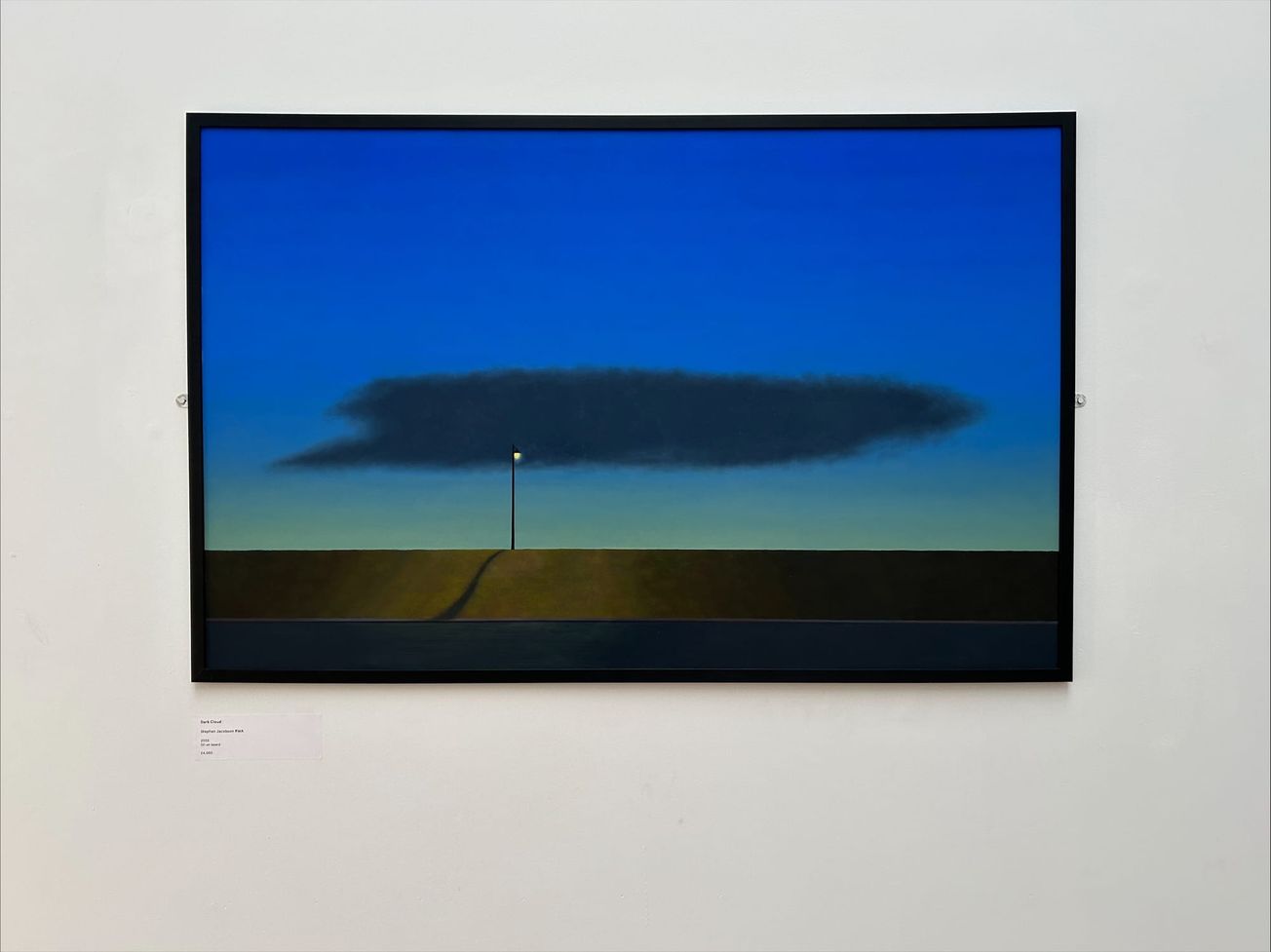
In the RWA’s Kenny Gallery, I am immediately confronted by the potency of that blue. The exhibition is confined to one room in which royal twilight blue stares from every wall. This is especially manifest in Stephen Jacobson’s ‘Dark Cloud’, where a grey cloud hovers over an expanse of vibrant dawn sky. The blue in Jacobson’s painting, as well as in the exhibition’s other works, is dark, formidable. Whether we are moving away from daylight at dusk or towards it at dawn is unclear. In the great ambiguous blue, we can only be sure that it is night-time (just turned or nearly over); that it is dark. But rippling underneath the darkness is an arresting vibrancy whose origin lies somehow outside the canvas.
This vibrancy threatens hope – you know that an incredible light must be coming or going, cracking open somewhere on the reverse of the image. Artificial lights in the form of streetlamps and lit-up windows litter Ros Cuthbert’s watercolour paintings: warm orange and cool white provide beautiful counterpoints to darker skies. But those atomistic lights pale in comparison to the promise of daylight that otherwise threatens the images.
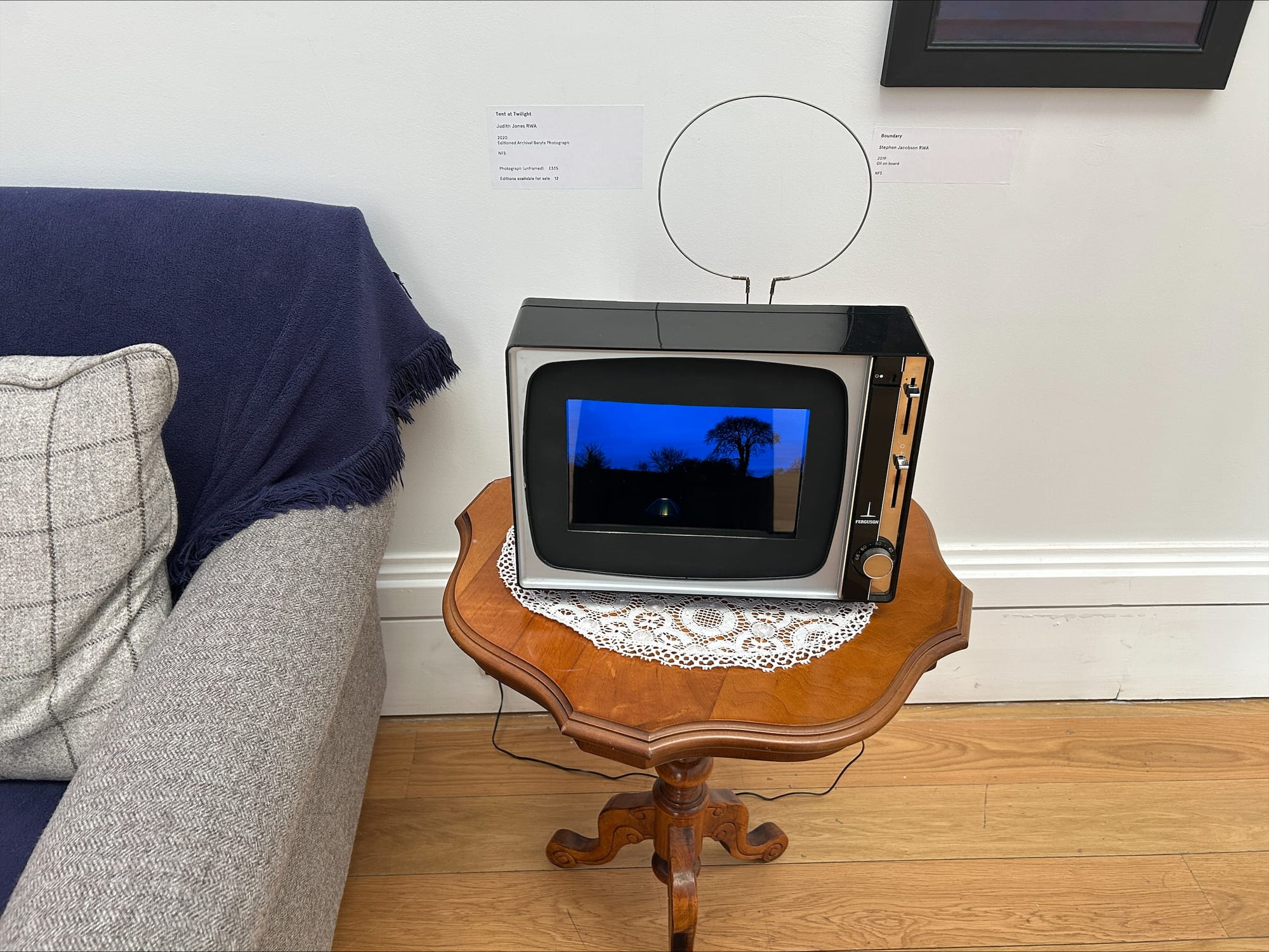
Judith Jones’ photographs are inexplicably nostalgic, often featuring garden sheds and other outdoor structures that look like portals to other worlds. One such photograph, featuring a solitary lit tent in a garden swathed in blue, is installed in a small vintage TV. On a wooden table cushioned by a lace doily, the piece makes me feel like I’ve woken up at night, a child in my English grandparents’ house (despite having not grown up with English grandparents). I imagine that, disturbed by own waking, I’ve sought respite in their living room only to be met with the strange energies of a place made unfamiliar by twilight. I am at once comforted and uneased.
Cast with ambiguity, viewers project their own feelings onto the blank blue, a void which is at once fascinating and fearful. In the light of this, Jones invites exhibition attendees to wonder what lies beyond the artworks and ‘draw a sketch of what you think happens next’ with the sketchbook and colourings pencils provided. The wealth of interpretations that follow her instruction are probably my favourite part of the exhibition:
First, a relevant geopolitical remark: ‘The Americans bomb it!’ It makes me wonder what the colour of nuclear annihilation would be. Probably a blinding whiteness. Or perhaps the absence of colour – like the twilight blue, a void. What would that look like?
Or maybe, as Arthur Crawford suggests, a ‘deer comes along’. The deer’s placid smile and the man’s incredulous expression is a dialectic worthy of serious academic analysis.
A welcome surprise: George (age 9) suggests ‘a black cat will jump ontop of the tent’.
 Katerina Ralli
Maybe we will see beautiful abstract forms that look like eye floaters. When lighter blue begins to break on the horizon and meets the eye, we can see the shadows cast by proteinous clumps that float on the retina. Alternatively – scribbles.
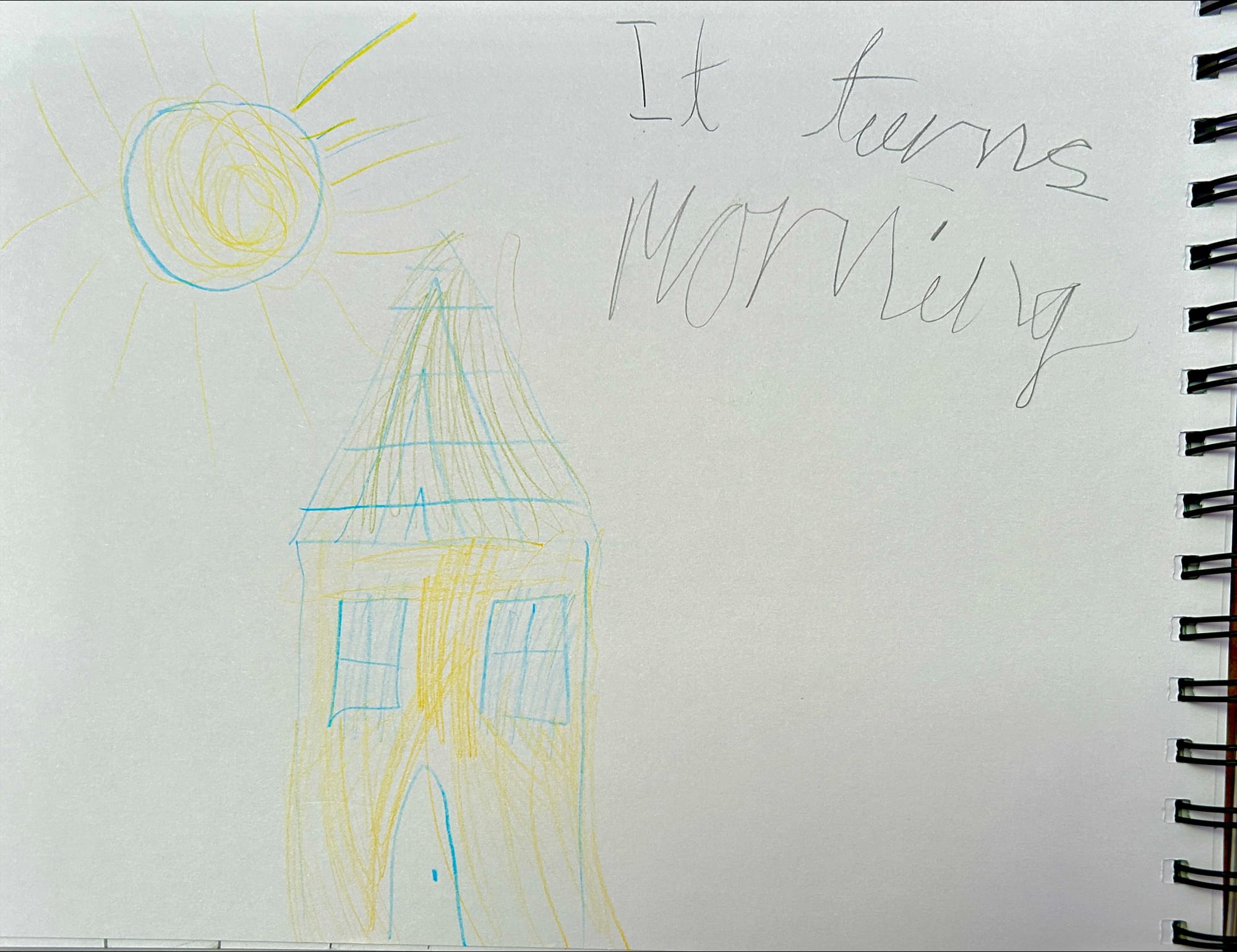
I will end with my favourite: the promise that after the blue, ‘it turns morning’, the eternal truth.
‘Twilight: The Blue Hour’ is running 10 March – 26 April 2026 at the RWA and is free to attend.
Featured image: Stephen Jacobson, ‘Dark Cloud’ / Hana Sakurai Wernham
Will you attend this show at RWA?