By Freya Randall, MA English Literature
If you’ve been on a walk around Bristol’s university campus in the last month, chances are you’ve encountered a poster promoting Shaxsoc’s ‘Twelfth Night’, featuring a disco ball held between Malvolio’s iconic yellow cross-gartered stockings.
Despite being an English Masters student, I am still, somehow, a big fan of Shakespeare. Leaving aside my personal bias, Shaxsoc managed to bring its own upbeat 70s twist on one of Shakespeare's most famous comedies. It has been a long time since I have laughed this hard at a piece of student theatre. I spoke with directors Alexandra Finnan and Ellie Parfitt about their intentions going into directing this iconic play.
I’m a big fan of Twelfth Night - when you were cutting down the script, was there a conscious decision there to focus on the more slapstick elements of the play?
Alex: I feel that when people think of Shaxsoc, especially recently, a lot of the more serious plays come to mind. Julius Caesar is a tragedy. Winter’s Tale is a tragicomedy mainly known for its tragic moments. We wanted a show that focused on funniness. These characters are written to be outrageous and stupid and silly and we just wanted to really bring that out.
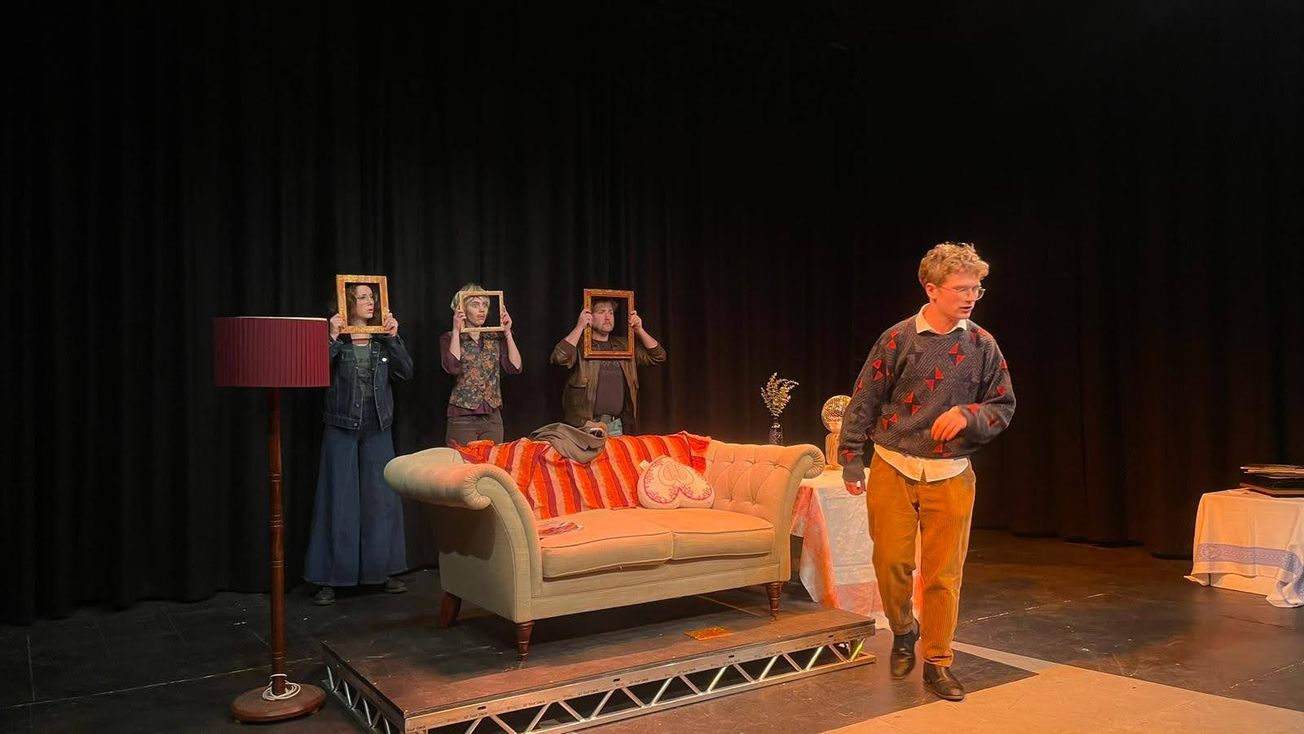
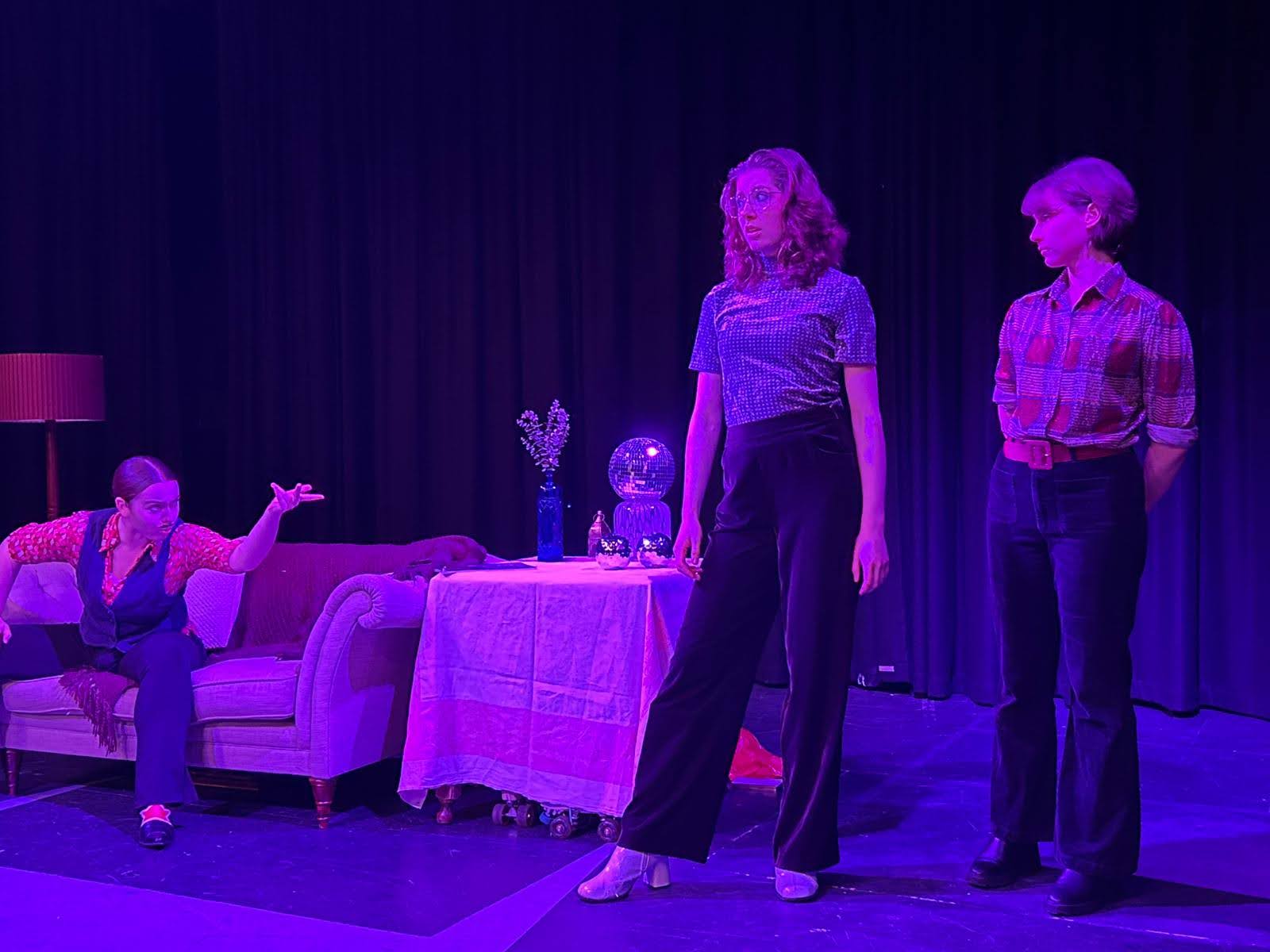
The simplicity of the Kelvin Player’s House set design (a couch and accompanying side table that would be re-decorated between scenes by crouching actors) worked to the play’s advantage without distracting from the performances. It was the actors’ outfits that really set the scene: from purple leather pants to sequined shirts and swirly flower makeup.
Was there a specific reason why you went with the 70s era?
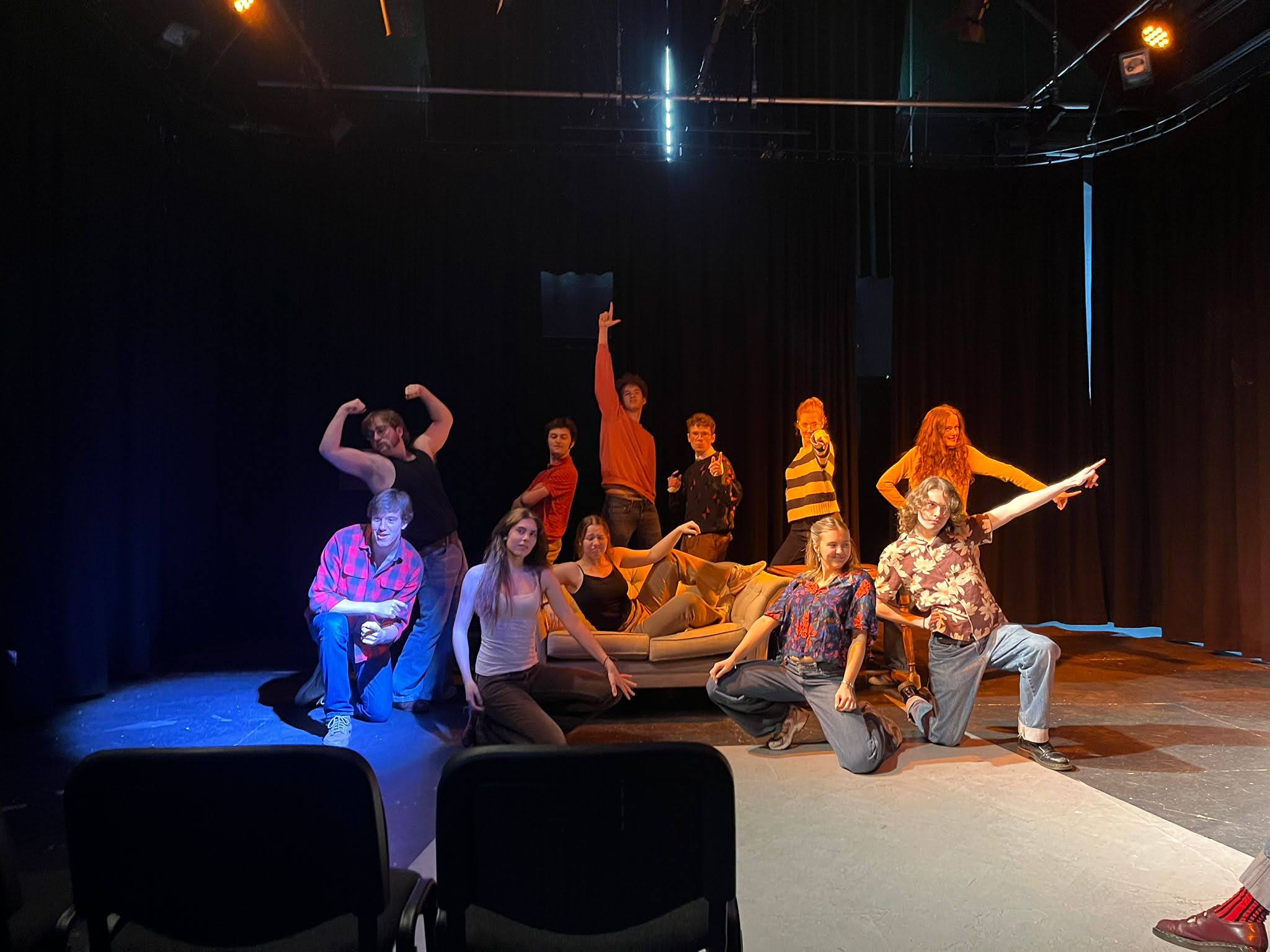
Alex: I think that, by anchoring [the play] in a specific decade we could really expand on the characters, and show a lot more subtext than you might originally think is there. With characters like Feste, he’s complicated because he’s so wise - but he does speak in riddles. We felt that, for him, it really made sense to place him in that Hippie movement of the 70s so that people can detect that organised chaos without really having to dig for it in the language.
Played by Oisin Voghlan, Feste the fool’s easy-going swagger around stage, sprouting winding riddles mid-guitar strum added a Woodstock flair that perfectly complimented the wild 70s vision of the production. The charisma (and excellent singing) Voghlan brought to the role made it clear why the fool was able to jump between the courts of Olivia and Orsino with ease: in his words “foolery does walk about the orb like the sun; it shines everywhere.”
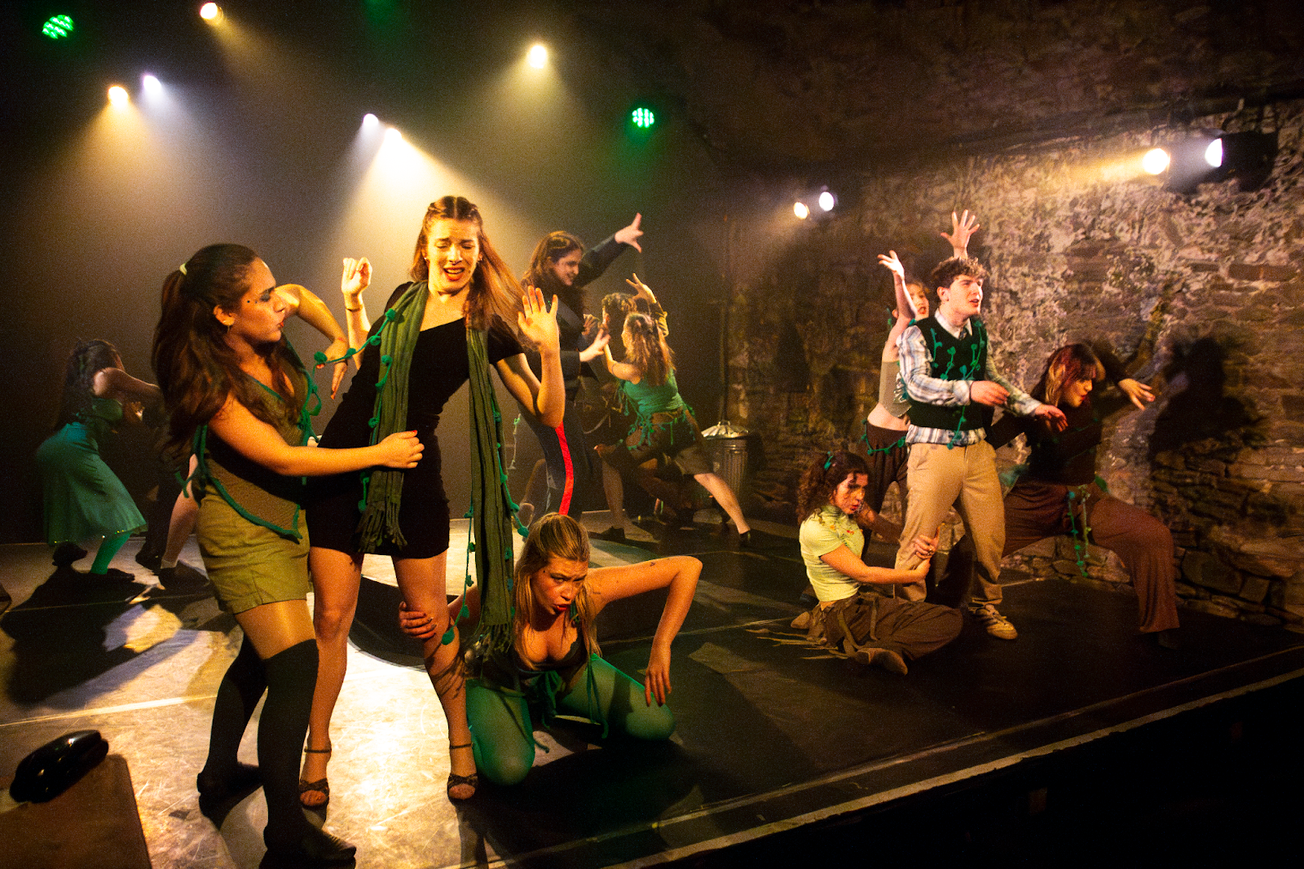
Duke Orsino’s court - (signalled through a set design change that featured a phallic vase) showed us exactly what we were heading into, with dance interludes to Donna Summer’s ‘Hot Stuff’ and Chic’s ‘Le Freak’ driving home the sequined, almost psychedelic theme. Decked out in drag king get up, complete with eyeliner moustache and a strategically placed sock bulge, Orsino, played by Holly Ford-Langstaff, showed a peacock-swagger and stage presence that added far more flavour to the script. The dynamic between Orsino and Viola (Ciara Lurshay) is ridiculous in the best way, Viola’s pure panic sitting with Orsino as they are romantically serenaded, having the audience muffling laughter through their hands.
Twelfth Night, in my opinion, is one of the best Shakespeare plays to have a queer angle on. Already a conversation about gender norms - originally all characters would have been played by men - it's essentially been a drag show from the start, and that 70s sparkly Bowie-ness helped buoy up the original gags. Amelia Clarke’s exaggerated femininity as Olivia worked perfectly in her attempts to woo the disguised Viola, hiding as the man-servant Caesario.
What I enjoyed about Shaxsoc’s production was that you chose to bring a lot of focus to the ‘background’ characters.
Ellie: We looked at some pre-cut scripts. And one had cut the character Fabian entirely, and given his lines to other characters. We wanted to make sure everyone had their moment with their lines to bring these characters to life. We multirolled some actors for that reason; the Captain, Officer and Priest (Cillian Britchfield), because we wanted that recurring gag throughout. We combined the characters Valentine and Fabian (Charlotte Kelleller) because we thought their motivations lined up in different ways, and knew multirolling could add to the humour of the characters.”
Shaxsoc’s production endeared me to the sub-plot just as much as the main love triangle. In previous productions of Twelfth Night I have watched, Sir Andrew Aguecheek, a gormless romantic suitor vying hopelessly for Olivia’s hand, faded into the background. The same cannot be said for the frankly stellar performance given by Olivia Fay. Sporting a platinum blonde Justin Bieber style wig, armed with the world's tiniest lime green water gun, Aguecheek’s wide eyed naivety constantly kept the audience laughing from the moment he stumbled through the curtain.
The physical comedy was great, beyond the actual script itself. I felt that half the laughs made by the audience came from those decision. Did you plan moments like the wig snatch from the very start?
Alex: Yes. One of the first ideas we had was ‘what if Andrew was bald?’
Were you influenced there by any other productions?
Alex: We just thought that he was spiritually bald, honestly.
Ellie: Especially the moment where they talk about his hair “like flax on a distaff” - if he’s wearing a wig that moment becomes much more comedic.
Olivia’s household was fantastic. From the Drunk Sir Toby Belch (James Davies), the ironic Fabian (Charlotte Kelleher), the brilliantly scheming Maria (Stella Richings) to the lady of the house herself.
Like a clown with a never-ending handkerchief, Belch’s constant stream of liquor bottles from his socks, his pockets and his belt added a pantomime quality to the ‘grieving’ court, contributing indelibly to every scene he stumbled through.
The group's strategic abuse of the snooty servant Malvolio (Sam Garvin-Smith) couldn’t help but make you feel bad for the man. Classic gags worked brilliantly here, characters hiding in plain sight as Malvolio reads a fake love letter (Fabian putting a lampshade on her head was a personal favourite.) I’ve never watched a performance of the yellow-stocking scene that I didn't love, and Garvin-Smith’s commitment was fantastic to see. You couldn't help but feel bad for him come the play's end, decked out in a blindfold and fuzzy-handcuffs. Wronged indeed.
This is not to say the play didn't have its moments of reprieve. Sebastian’s (Sam Holmes) mournful lamentation of the believed death of his sister added a moment of humane pathos that was sorely needed in order to keep the comedy well balanced. We don’t blame Antonio (Tommy Burrows) for risking an arrest by the glittery Officer (Cillian Britchfield) to try to help him out.
It’s a mark of a good actor, I think, to speak Shakespeare like it's regular day-to-day accessible English. Every one of Twelfth Night’s actors spoke as candidly as if they were having a regular conversation. All in all, the amount of love that went into this production is clear.
Alex: A shout out here to our lovely production team. Because so much of it was them working on the costumes and the props, it was really important to us that we had quite a consistent set. We have to thank our design team, the marketing team, and the producers. Shaxsoc is still growing, but it feels like a little family a lot of the time. We had fun.
 Lia Middleton
This production was a testament to the joy and passion that should always be present in student theatre. With its sequined flair and slapstick humour, it was the ideal show for the Spring term. For a society that carries tragedy so well, Shaxsoc has shown with Twelfth Night that they truly understand what makes for good comedy. Anyone involved in this production should be proud.
Featured image: Shaxsoc
Have you seen any Shaxsoc productions?