By Lenny Osler, News Reporter
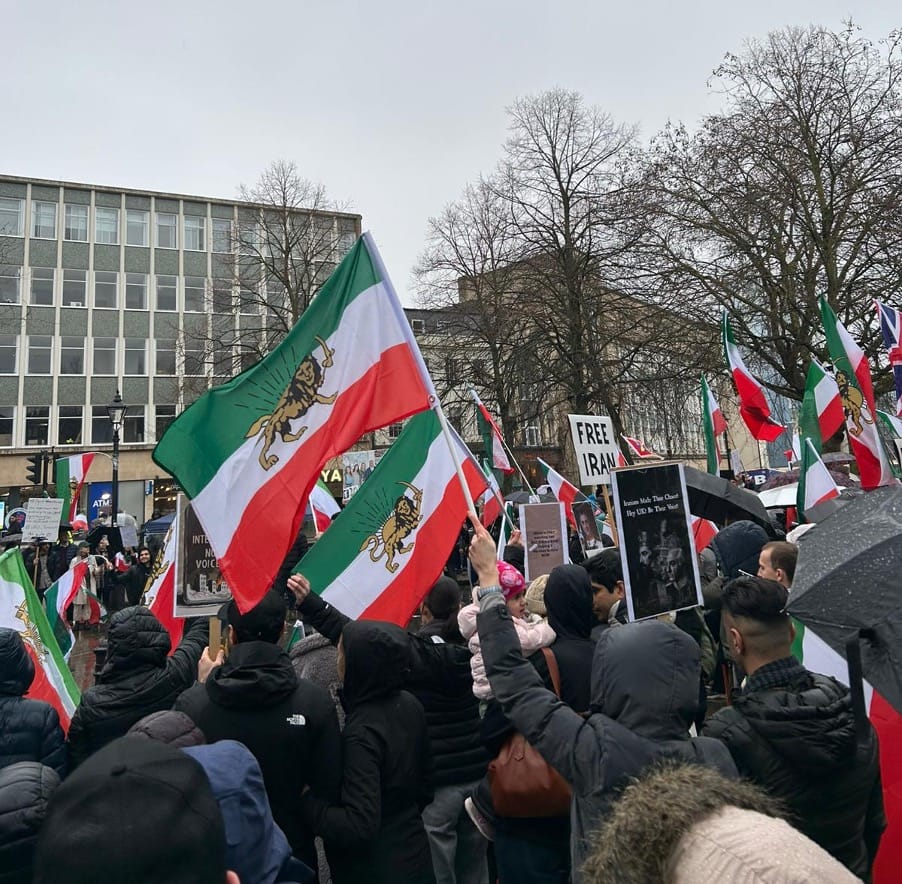
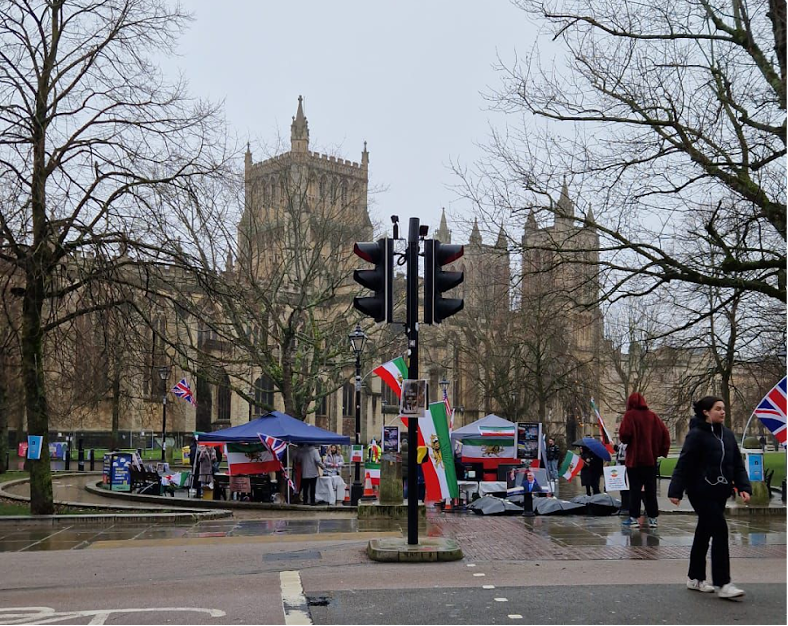
At around 11:35 AM, protesters began to arrive in the centre of the pedestrianised area on College Green, where a semicircle of gazebos had been set up sheltering boxes piled with flags and placards.
Nearly 300 people gathered in the rain to demonstrate, chanting slogans such as ‘Mullah’s regime, fascist regime.’ The demonstrators demanded an end to state violence against protesters in Iran, and called for the removal of the current Iranian leader, Ayatollah Ali Khamenei.
Anti-government protests in Iran began in late December 2025 in response to a sharp fall in the value of the Iranian rial. The protests quickly escalated into calls for regime change, which were met by a harsh crackdown by the Iranian government.
According to the US-based Iranian Human Rights Activists News Agency (HRANA), at least 3,090 people have been killed since the unrest began, with some estimates putting the death toll much higher.
Protesters at College Green held banners depicting Reza Pahlavi, the former Crown Prince of Iran, currently in exile in the US. Pahlavi’s father, the former Shah (king) of Iran, was overthrown during the Islamic Revolution of 1979. Among chants from the crowd were calls for Pahlavi to become the country’s leader.
Epigram spoke to Arash, a Bristol resident originally from Iran. ‘The first thing we want is for the [British] government to blacklist Sepâh.’
The Islamic Revolutionary Guard Corps (IRGC), known as Sepâh in Persian, is a branch of the Iranian military specifically intended to ensure the stability of the current regime. Since anti-government protests flared up in Iran, the IRGC have been implicated in killing and injuring civilians with guns, as well as detaining, torturing and executing protestors.
The USA, Canada, Australia, and Saudi Arabia are among the countries currently designating the IRGC as a terrorist group.
 Rafael Nieto
 Dana Andrea Datu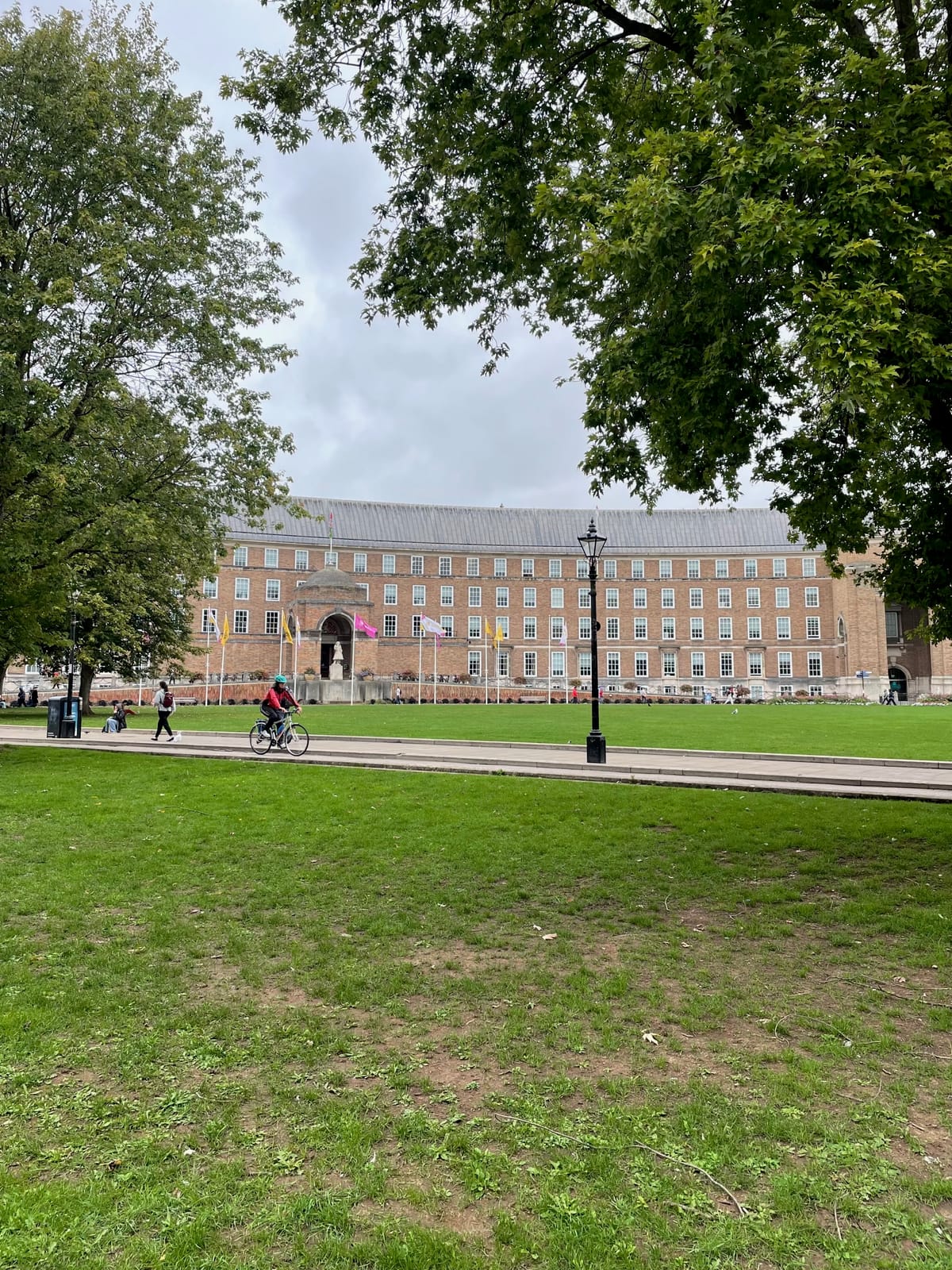
Due to an internet blackout imposed by the Iranian government, Arash, like others at the protest, told Epigram he’s had no contact with his family for two weeks.
Despite this, he remained hopeful. ‘Soon there’s going to be change. Like a tsunami, it’s coming,’ he said.
Epigram interviewed a woman, who did not wish to be named, about what the demonstration demanded of the British government. She said, ‘the UK should close their embassy [in Iran], block all trade, and remove Iranian assets from the country like they did with Russia.’
When asked if she had been personally affected, she said ‘my cousin was executed for joining a protest, and my nephew was arrested last week.’
Others at the protest had mixed feelings about reinstating the Shah in Iran.
A University of Bristol student questioned ‘Is the Shah truly the best option?, adding ‘if you look back at the previous Shah, he was ruthless in his oppression.’
On the other hand, one Iranian protester Epigram interviewed claimed that ‘the last Shah was a really good king.’ Her British partner added that bringing democracy to Iran was ‘secondary to the end of the Islamic regime.’
 Lenny Osler
 Dana Andrea Datu
Protesters varied in their visions for Iran’s future, with one female protester telling Epigram that a ‘constitutional monarchy similar to the UK’ would be ideal.
Meanwhile, Arash was certain that Pahlavi ‘doesn’t want to be king’ and is confident a transition to democracy will occur.
Protestors differed in regard to potential US intervention to instigate regime change, an option President Trump has repeatedly threatened.
One student expressed concern: ‘We can’t trust Trump,’ she said. ‘We need to focus on what the people of Iran need, which is democracy.’
In contrast, another protester argued that ‘the only option is US [intervention]’ She also stressed the importance of local action, saying ‘we need the British people’s support. Send an email to your MPs so we can get the IRGC sanctioned.’
By 2:15 PM, the demonstration was packing up. Epigram spoke to one of the protest’s organisers, who was uncertain if follow up protests would occur.
‘This is the first time in two years we’ve come out to support the Iranian people.’ he said, adding ‘if we do [hold more protests], they will be in the same place, and on a Sunday.’
Featured image: Epigram / Lenny Osler