By Lilianna Car, Second Year, English and Philosophy
On the 24th of August, we saw Nigel Farage posting an AI generated video on Instagram and TikTok, captioned ‘A little bit of fun!’ A harmless video of the Reform UK leader in a fur coat, declaring himself ‘prime minister of the pint,’ surely? Or could this perhaps be a more sinister example of social media being used as a platform for indoctrination?
Despotism does not begin with a police state or censorship; all extreme features of an undemocratic regime are constructed over time. So, we must question even seemingly harmless acts from leaders and scrutinise them carefully. If we do so with Farage’s use of social media, particularly TikTok, his sinister motivations are distinct.
Instances such as Farage’s AI video are an attempt to fashion himself as a charismatic leader, a vital strategy for assuming more social and political power. Dictators have always been charismatic; Hitler’s public speaking ability has been widely recognised, and Mussolini has been addressed affectionately as ‘Duce’ as recently as 2022. Charisma is important for connecting with the people. It provides that comforting notion that a political leader is ‘one of us’ rather than part of the esoteric, out-of-touch political elite. Farage has been using social media to fast-track his own relatability, meanwhile his own elite background and multi-million-pound net worth is skilfully evaded.
For Farage’s campaign, connecting with young people in particular seems to be a priority, plausibly due to their increasing left-wing stance, or perhaps due to their vulnerability to influence. And what better way to reach young people than young and popular TikTok? With 57 per cent of 13 to 17 year-olds in the US using TikTok daily, its use for propaganda purposes is eminently clearer by the day, and Farage too has recognised this potential.
It all began with the 2021 ‘Cameo’ videos which quickly went viral on TikTok. Cameo is a platform where users can purchase ‘personalised videos from their favourite stars’, with most creators being social media influencers or otherwise moderately famous celebrities. For Farage, his use of the platform allowed him to get his face recognised by the younger generation. Unsurprisingly, he was paid to say phrases including, but not limited to: ‘skibidi chungus,’ ‘don’t be a sussy baka,’ ‘you have no rizz,’ and ‘happy pogday.’
These ‘brainrot’ phrases are largely meaningless to older generations, but students and those younger than us know them all too well. Is this a deliberate attempt from Farage to appeal to younger people? Many of the videos he has created have between one and three million views, flaunting his success. Farage is participating in throwaway trends, essentially fashioning himself as a TikTok influencer, which, as a political figure, obscures the line between information and entertainment.
'All cults of personality start somewhere, and it is important to recognise these initial warning signs'
And of course, young people, who are not inclined to question the motivations behind what they are fed on TikTok, are entertained. Farage currently has 1.3m followers on the platform, with the Reform Party having 441,800, Labour having 232,200 and Conservatives 131,300. Popularity on TikTok directly corresponds to party popularity in the recent opinion polls. Clearly there is a political advantage to having Gen Z on your side.
But Farage the Entertainer does not stop there – his appearance on I’m a Celebrity… Get Me Out of Here! in 2023, the AI crafted video, Andrea Jenkyns’ live pop performances at the party conference are all part of Reform’s plan to stockpile charisma. The intention behind such acts is to seem genuine and likeable enough to make voters idolise Farage, at which point they stop questioning him. Reform supporters, especially young people, begin to act like a celebrity fanbase – cheering for whatever Farage says and thereby giving the party an extremely solid backing. Simultaneously, the opposition responds on the same social media platforms, seeing these acts as ludicrous, only leading the TikTok algorithm to promote the content further and extend its reach. A certain win-win for Farage.
 Lucy Canning
Compared to leaders like Starmer, who have little social media presence and even less charisma, Farage seems stronger, and his policies remain unscrutinised. These tactics are reminiscent of Trump’s - think rallies and unhinged tweets. Farage has even started selling Reform UK football shirts, perhaps the UK’s equivalent to ‘MAGA’ caps.
Of course, Farage’s actions may not snowball into radicalism for the UK; however, all cults of personality start somewhere, and it is important to recognise these initial warning signs. We need to consider what this might look like in our modern climate - some TikToks may be far from harmless. Social media has always distorted reality, and it will increasingly distort our politics until we recognise its potential as a real, present threat to democracy.
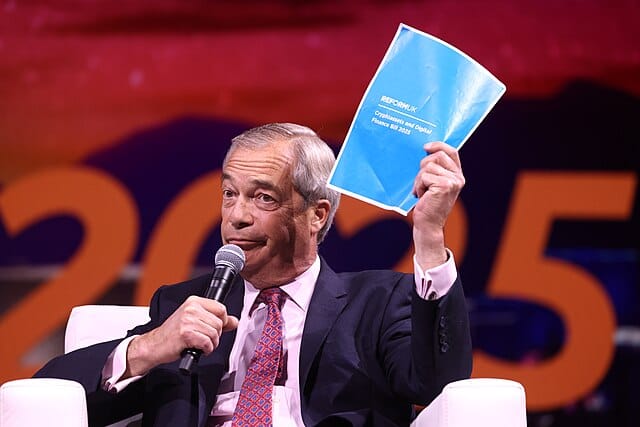
Featured Image: Wikimedia Commons / Gage Skidmore
Is social media starting to influence your politics?



.jpg?ref=epigram.org.uk)