By Alex Boersma, Literature Columnist, 25/26
In honour of World Poetry Day last month alongside people increasingly reaching for screens, poetry has had to compete for our attention in a fast moving world. As a poetry lover myself, I began to wonder if it still has a space in student's lives? It's a tale as old as time that many of us were traumatised by poetry at GCSE and A level and may struggle to read a poem without subconsciously analysing it. However, it's an incredible art form and should still be engaged with outside of our studies.
I interviewed 16 students about their engagement with poetry from a wide range of subjects including English, classics, law, zoology, sociology, philosophy, German, modern languages, film and theatre.
My interviews generally confirmed what I assumed was the case; 75% of those I interviewed reached for other forms of literature before poetry, leaving only 25% reaching for poetry first. Those who did reach for poetry first explained ‘poetry is lightning in a bottle’ and believe ‘poetry can provide deep emotional impact, truth and humour in a faster and more elegant way.’ Those who didn't reach for poetry explained this was because they found long form novels better for escapism and relaxation as they felt they could properly get invested. One student explained ‘poetry is too short and only the most powerful and famous stay with you’ whereas they found they could talk about novels more generally. Another explained that 'poetry takes time' with multiple readings and more thought needed than with a novel. This seems to be the main reason why students don't reach for poetry first with some respondents expressing that they feel guilty reading poetry without taking the time to unpick it and properly understand the poem, with one student describing not doing so as ‘disingenuous.’ Two students explained they found non-fiction books more mentally stimulating than poetry so reach for non-fiction.
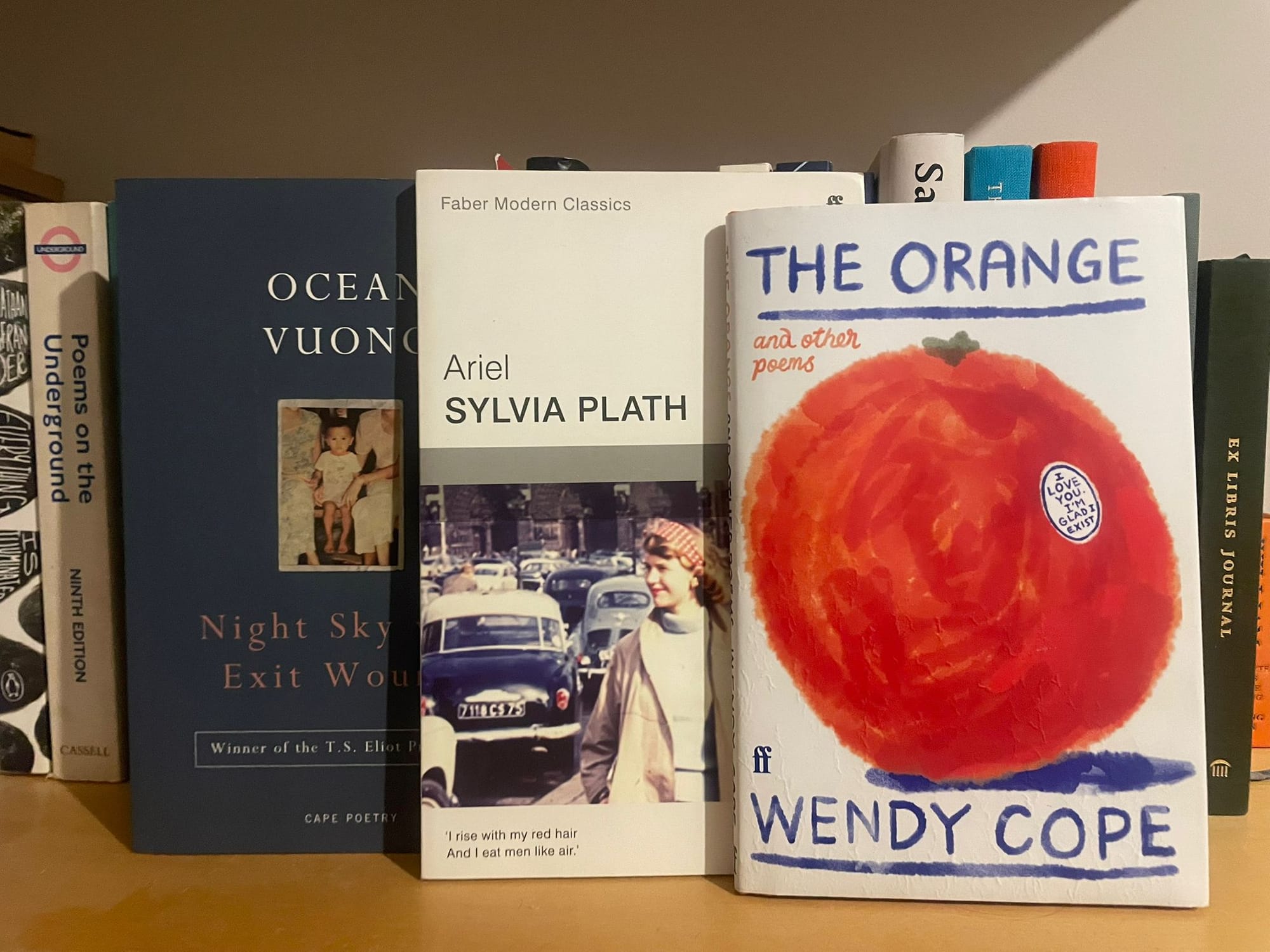
Students had a variety of favourite poems including but not limited to: Sylvia Plath, Wendy Cope, Mary Oliver, Derek Walcott, Patti Smith and Frank O'Hara. It somewhat surprised me that not many classic poets were mentioned with only Tennyson and Milton mentioned. Some favourite poems included So many rooms by Laura Scott, The World's Wife by Carol Ann Duffy, the epic Paradise Lost by John Milton, Les Fleurs Du Mal by Charles Baudelaire and of course, The Orange by Wendy Cope.
‘Poetry is a universal language or way of communicating truths that we can all share’
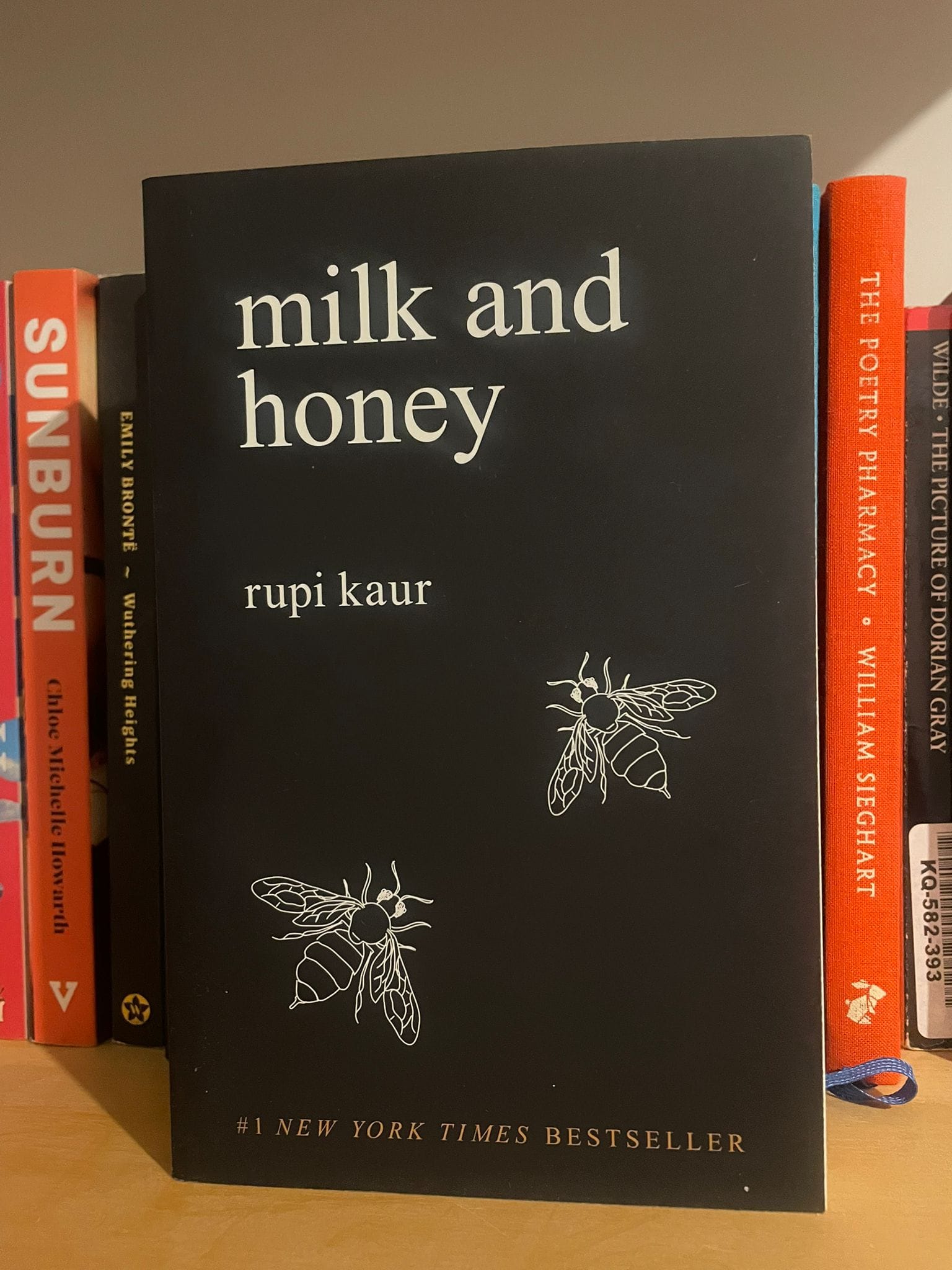
I asked students which poems first got them into poetry and while many said the classic Love through the ages GCSE poetry anthology, others remembered exactly where they were when they first fell in love with poetry. Some of the poems mentioned include the inevitable Milk and Honey by Rupi Kaur, The ning-nang song by Spike Milligan, Because I could not stop for Death by Emily Dickinson there were two mentions of Valentine by Carol Ann Duffy, likely because this was also taught at GCSE and Failing and Flying by Jack Gilbert. Two students had poems that they remember having to recite at school; The Tyger by William Blake and The Village Blacksmith by Henry Wadsworth Longfellow.
I have written poetry in my notes app for as long as I can remember, none of them will ever see the light of day however the act of writing them and being able to turn big feelings into delicate poetry has served me well and acted as a sort of therapeutic practise. Of those interviewed, 90% wrote their own poetry as well as reading it. This again was suspected however it did shock me that it was such a high percentage. Many students noted that they wrote poetry for the same reason as myself, to process emotions and events. One explained writing poetry helped them process their childhood trauma which they found particularly helpful as they are neurodivergent and found this works for them. They explained that their ‘struggle for human connection’ is what ‘fuels’ their poetry most. I couldn't help but resonate with this and others mentioning their feelings of isolation at uni sometimes so I hope this serves as a reminder that you truly are never alone in these feelings. Another student shared that ‘there's something deeply nice about this shared experience and acknowledgment’ when you resonate with a poem. They explained ‘poetry is a universal language or way of communicating truths that we can all share’ which I think sums the magic of poetry up perfectly.
‘Poetry is often the attempt to articulate the inarticulable;’ it captures what we can't quite say, in the same way as music and art.
One student explained writing poetry acts as 'a vehicle to move out of dark emotional places' with the majority of students agreeing that they wrote about negative emotions and overwhelming feelings. Another described their inspiration stems from the 'particularly beautiful and symmetrical' which I found particularly lovely. A couple also mentioned that they have neglected writing poetry due to university and hope to get back into it again once they have graduated, which I can relate to procrastinating my dissertation by writing this article!
A close friend of mine also told me about the poetry collection he is writing at the moment and gave me a sneak peek, though I'll admit I'm an avid reader of his Substack so had enjoyed a couple already! He gathers lots of inspiration from religion and the unconventional which society rejects such as the perverse, mysticism and distortion. He explains he enjoys using poetry to explore ‘pushing the limits of what is and isn't acceptable in everyday life.’
Finally, I asked the respondents if they believe poetry is a dying art form? 57% said maybe, 25% said no and 18% said yes. One expressed ‘It’s always been an art form on the fringes, but with lowering literacy and comprehension rates, the art form as a whole is in jeopardy, at least as far as a young perspective is concerned.’ Some students also noted that social media has lowered attention spans and so many struggle to sit down and read a poem they need to think about in depth as many ‘reach for quicker dopamine fixes.’ Reassuringly, as of 2025, ‘1 in 4 children and young people still enjoy reading poetry’ despite the temptation of social media and streaming. Lots of students noted the two have combined with the emergence of social media poetry, which has made it more accessible. With the rise of TikTok and Instagram poets, the form of poetry is constantly evolving. One student who does believe poetry is a dying form stated this is because ‘there is no definitive start and end to poetry’ in the same way there is with novels. They continued explaining that our generation doesn't enjoy things without distinct starts and ends and stressed that they feel we need to believe we have 'completed' something which they don't believe poetry is able to give.
Others mentioned newer forms of poetry such as music and slam poetry which though untraditional are merely new forms. One student added 'poetry will always hold the human experience, just in different ways to how it once did'. I couldn't agree with this more. Another explained ‘It comes too naturally, and seems to always reinvent itself. It might be changing, vanishing in some parts of life and reappearing elsewhere but it'll never die.’ As well as taking new forms, one student pointed out that it's not the art of poetry itself that is dying but rather ‘the art of enjoying it collectively.’ I do agree with this in part, thinking of how people don't meet up to talk about poetry in the same way the boys in Dead Poet's Society do and how novel book clubs are still thriving. However there are still poetry events in Bristol such as the Lyra poetry festival which Epigram will be covering next month and poetry open mics. Despite this, one student believes we need more ways than events where poetry is read aloud to make it more accessible and ‘get rid of the stigma that poetry is complicated.’
There has been a recent rise in the sale of poetry books due to the wave of performative males clutching onto poetry to impress females, as was shown in the performative male contest earlier this academic year. One student added many of these poetry books were able to conveniently fit in the back pocket of ‘Bershka’s ultra baggy jeans.’ They note poetry was a major trend then and as with any trend, it ebbs and flows- this doesn't mean that it won't become trendy and mainstream again.
 Sofia Lambis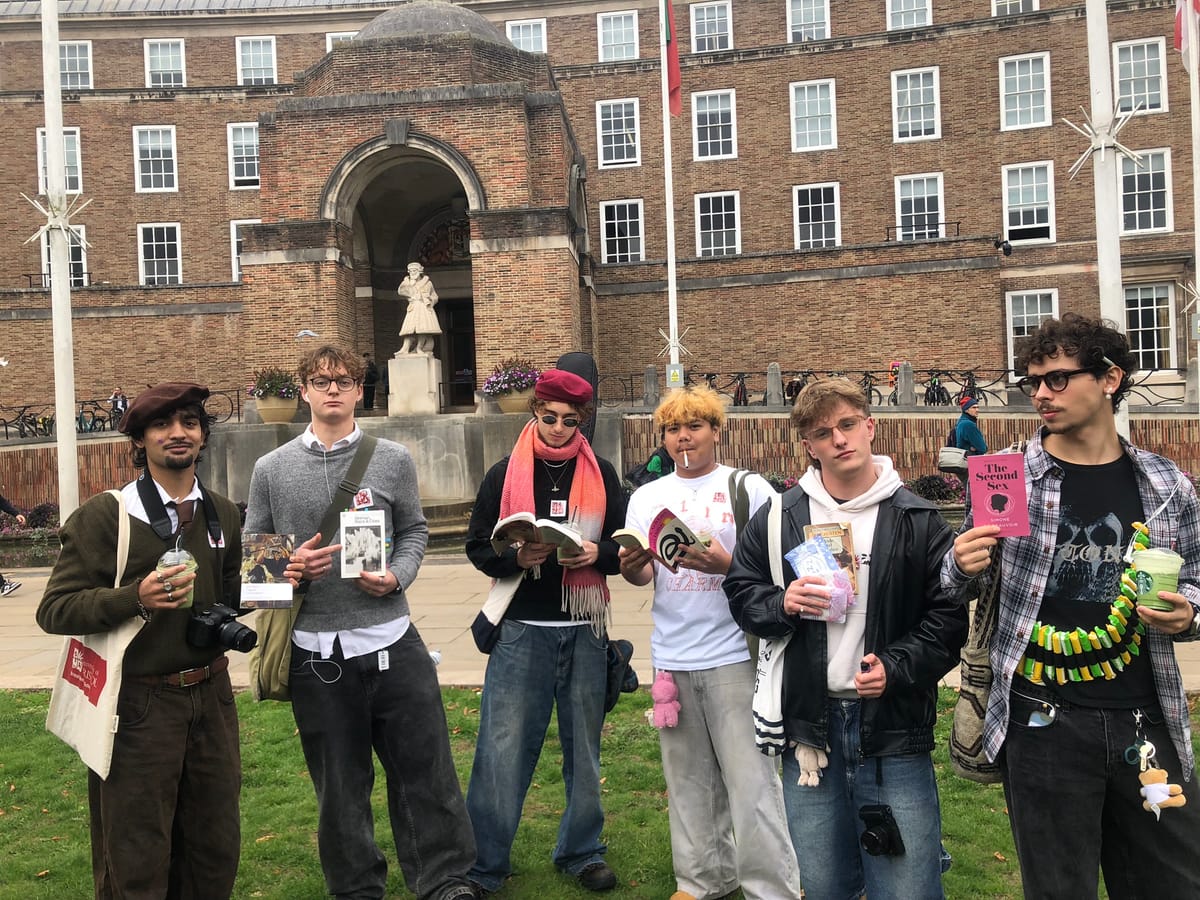
Overall, looking into this topic has been very reassuring, students do still engage with poetry and many find it a beautiful form of expression, particularly to process emotions and capture the beauty of everyday life. One student explained ‘writing poetry is one of the fundamentals of human expression’ and that ‘poetry is often the attempt to articulate the inarticulable;’ it captures what we can't quite say, in the same way music and art do. Another added that poetry is predominantly ‘sought out in times of need and not as a common feature of life.’ I think this is particularly true as we all hurry to juggle deadline upon deadline and make the most of being in Bristol for those of us in final year. Over the past few years, I have completed a poetry challenge on Instagram called Escapril which provides poetry prompts everyday throughout April to inspire new poems, feel free to join in! I hope this article serves as a reminder of how beautiful poetry is and how much we need to preserve it in the mundane moments as well as the heightened.
Featured image: Unsplash / Nick Fewings
Do you write poetry?