By Simren Jhalli, Comparative Literatures and Cultures, Second year
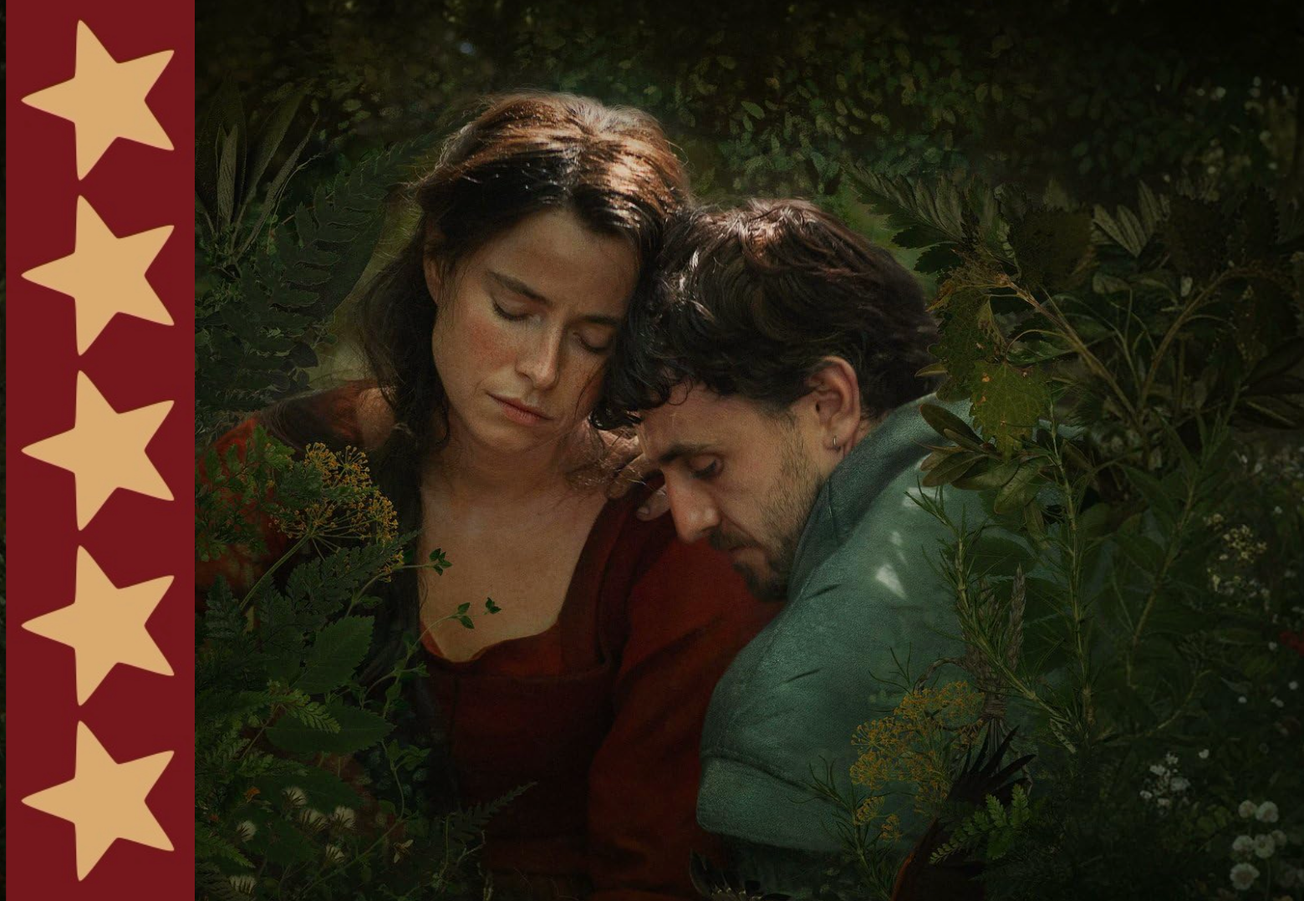
Hamnet, adapted from Maggie O’Farrell’s novel, is less a biographical account of Shakespeare’s life than an intimate exploration of grief, love, and the emotional origins of authorship. Rather than foregrounding Shakespeare as a literary icon, the film presents him as a man shaped by the forces around him: his marriage, his children, and the journey he endures. Through cyclical imagery, sound, and parallel storytelling, Hamnet suggests that tragedy is not invented, but carried.
It is also worth noting from the outset that the names Hamnet and Hamlet were historically interchangeable, a fact acknowledged in the film’s opening (with reference to archival records, including those at Stanford), immediately framing the story as both personal and mythic.
The film opens with melodic music layered with birdsong, creating an atmosphere that is at once serene and foreboding. A tracking shot through a sunlit forest introduces Agnes (Jessie Buckley), asleep on the forest floor, her clothing- deep reds, oranges, and brows- contrasting sharply against the green landscape and making her an intriguing, almost otherworldly figure. From the outset, Agnes is aligned with nature and intuition. This intimacy with the natural world marks her as a figure of quiet power, later dismissed by others as witchcraft - she is explicitly referred to as a ‘child of a forest witch’ - but framed by the film as emotional and spiritual insight. Thunder rolls in the distance, a storm approaching, reinforcing the film’s obsession with cycles, warning signs, and inevitability.
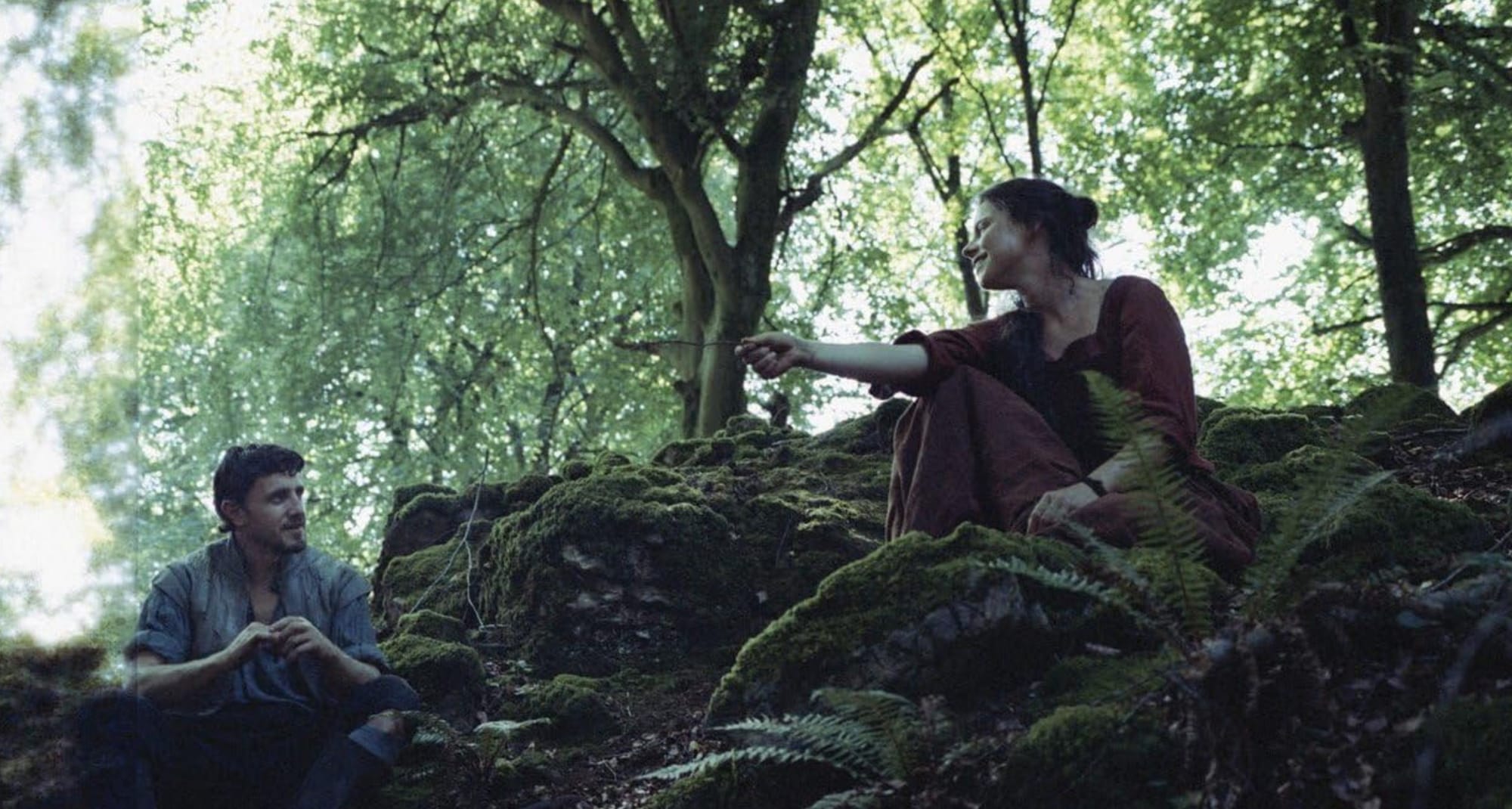
Shakespeare’s introduction is markedly different. He appears tutoring boys in Latin, reciting structured verse, already positioned as a ‘man of words.’ Paul Mescal’s portrayal resists grandiosity; his Shakespeare is hesitant, inward, and visibly uncomfortable in social situations. Mescal works almost entirely through subtle expression: furrowed brows, fleeting smiles, pauses heavy with meaning. So much is communicated in his silence particularly in scenes with Agnes, where his restraint gives their intimacy a far greater impact. While he struggles speaking plainly, he comes alive when telling stories at her request, confidently recounting Greek myths. Language for him, is safest when shaped into narrative rather than used for intimacy.
Their relationship builds quickly, driven by the rhythm and repetition of their routines. The forest becomes a recurring space of connection, echoed later by the cyclical return to the window from which he watches Agnes move through the world. Music swells as their intimacy deepens, mirroring the opening melody and reinforcing a sense of inevitability. Their physical relationship, occurring out of wedlock, is framed not as moral failing but emotional necessity. Agnes tends to his wounds, both literal and psychological, and her belief that she can ‘read’ a person through touch foreshadows her later inability to save her son.
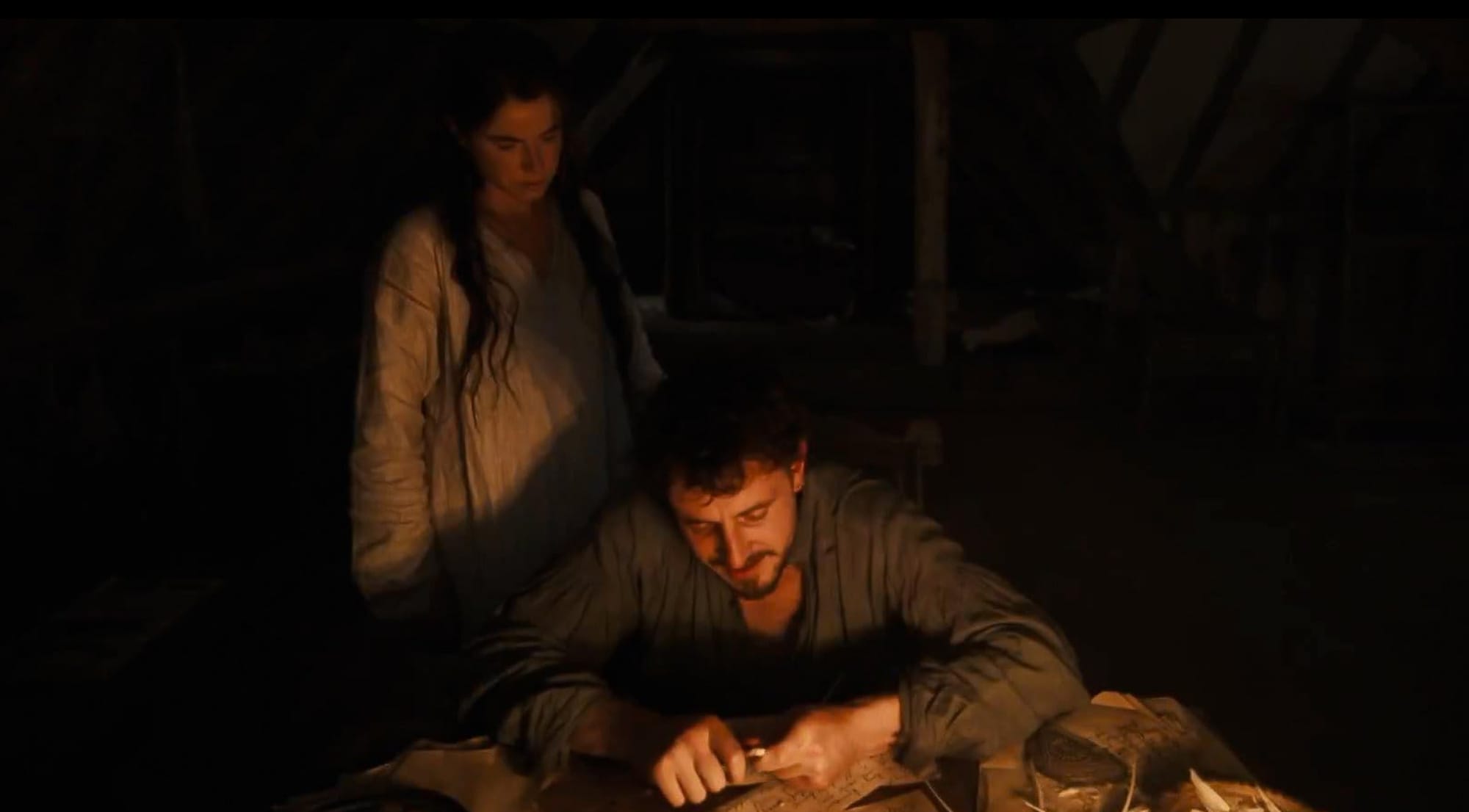
Crucial to understanding Shakespeare’s choices is the influence of his father, John (David Wilmot). His home environment contrasts sharply with Agnes’s world: dark, somber, emotionally barren. John is cold, embittered, and openly disappointed in his son, repeatedly calling him useless and reminding him of debts and failure. Their relationship is marked by violence and shame, culminating in a physical confrontation that leave Shakespeare drunk, angry, and frightened of what he might become. This inherited brutality weighs heavily on him as he admits to Agnes she is scared he will see what he is capable of. The setting reinforces this: dim interiors, heavy shadows, and claustrophobic framing make his family home feel oppressive, in stark opposition to the openness of the forest and Agnes’s light-filled spaces. The film makes it painfully clear that Shakespeare is not simply running towards success, but away from becoming his father.
This burden explains his departure for London, encouraged by Agnes herself. While framed outwardly as an opportunity (to earn money, secure housing, and support his family) it is equally an escape. London represents distance: from his father’s judgment, from his own perceived inadequacy, and later, from unbearable grief. Parallel shots underline this divide: Agnes in the garden, surrounded by their children and nature while Shakespeare stands alone taking in the rivers view and movements from the city. Even after Hamnet’s death, Shakespeare’s absence becomes another weight he places on himself, one Agnes cannot forgive. His self-exile is both punishment and survival.

The domestic scenes that follow are tender yet ominous. Agnes teaches the children about herbs and healing, while Shakespeare teaches Hamnet (Noah Jupe) to fight, symbolising their differing approaches to protection. The burial of Agnes’s hawk introduces the children to death, quietly foreshadowing the tragedy to come. When Shakespeare leaves again for London, he places the responsibility of ‘man of the house’ onto Hamnet, an emotionally devastating moment that underscores the impossibility of the role.
Hamnet’s death from the plague is portrayed with restraint and unbearable inevitability. Agnes refuses to let Judith ‘cross over’, trying every remedy she knows, while Hamnet quietly offers himself in her place. The hawk appears again at the moment of his death, seen by Shakespeare despite the miles between them: a visual manifestation of the bond that still connects them. It is one of the film’s most haunting images, and one that makes it almost impossible not to break. This is where the film earns its reputation: bring tissues, seriously.
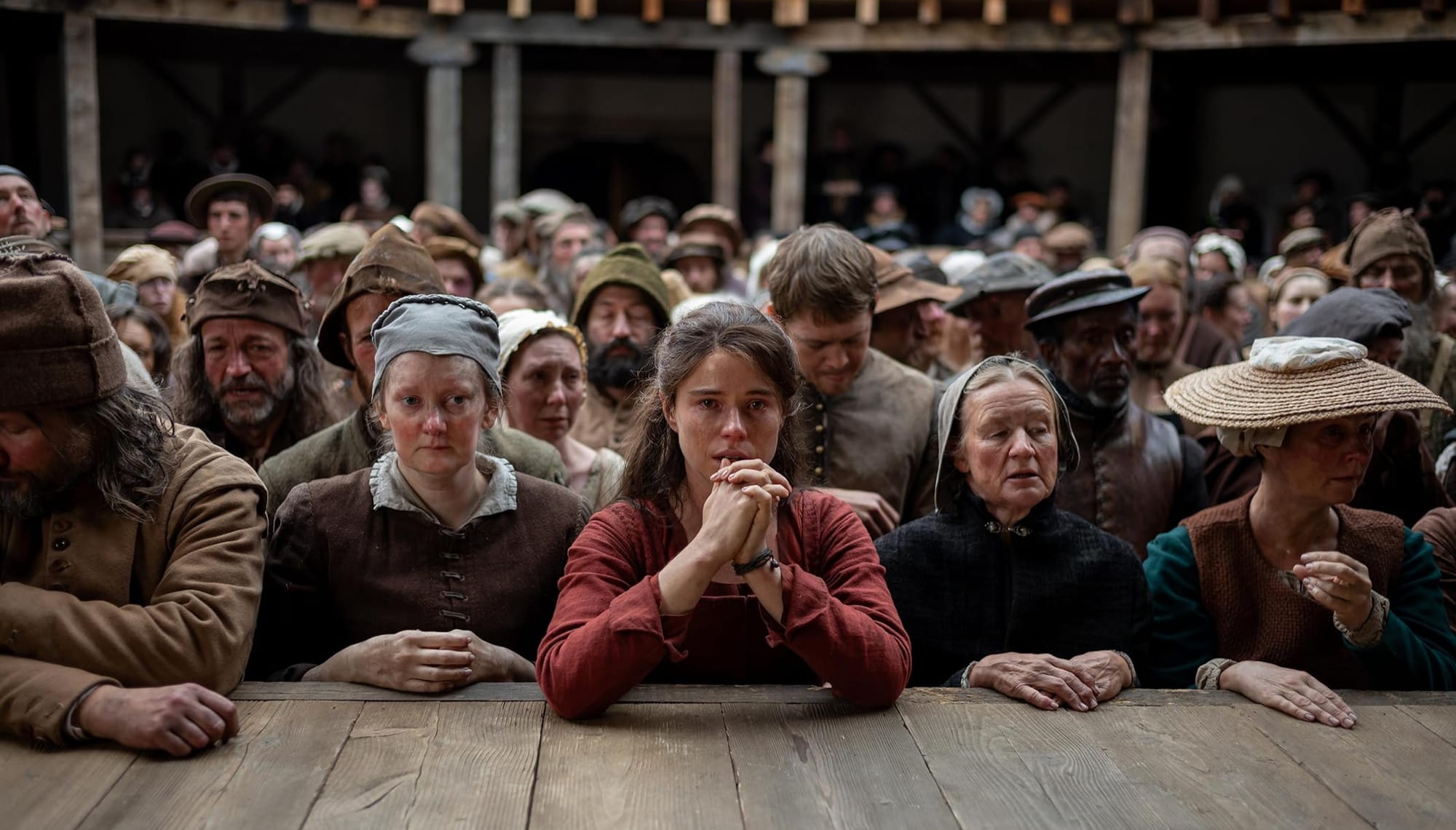
The final act shifts to London and the staging of Hamlet. Agnes initially rejects the play, disturbed by its transformation of her son’s death into public spectacle. The rising music, now more sinister than earlier in the film, overlaps with the bustle of the crowd as she is swept into the Globe Theatre. But gradually she realises Shakespeare has not erased Hamnet, only displaced him. Her son has been given another life, another voice.
The sword-fighting scene Hamnet once imagined for himself is now enacted on stage, and when the line “the rest is silence” is spoken directly to Agnes, it becomes an offering rather than an ending. The crowd weeps with her; her grief is finally shared. Shakespeare, removing his makeup backstage, cycles through sobbing and laughter, hysteria and release, as ‘to be or not to be’ echoes faintly; a man unravelled by what he has made.
 Charles Hubbard
Notably, Shakespeare’s name is withheld until near the end of the film, spoken only once he has achieved recognition. Agnes alone calls him ‘Will’, emphasising the divide between the man she loved and the figure the world reveres. When she taps her chest and he turns away into darkness, the gesture is devastating in its simplicity: Hamnet lives on, not just in art, but in the heart. Hamnet is a film that refuses spectacle in favour of emotional truth.
It is quiet, devastating, and unrelenting in its grief, and in doing so becomes one of the most affecting portrayals of loss in recent cinema. Tragedy here is not catharsis: it is memory, carried forward, spoken aloud, and never truly resolved.
Featured Image: Simran Jhalli / IMDb
Have you managed to catch Hamlet in cinemas?